Last verified and updated on November 23, 2026, at 12:02 UTC.
A growing body of orbital mechanics and deep-space survey data has placed astronomers closer than ever to answering one of modern astrophysics' most tantalizing mysteries: the presence of a hidden giant world lurking in the farthest reaches of our solar system. The hypothetical body, widely designated as Planet Nine, is predicted to be a frigid super-Earth or sub-Neptune roughly five to ten times the mass of Earth, traversing an elongated, highly tilted orbit hundreds of times farther from the Sun than Neptune.
Recent landmark research led by Caltech astrophysicists Konstantin Batygin and Mike Brown has shifted the debate from speculation to rigorous statistical probability. By tracking anomalies in the orbits of distant icy bodies beyond Neptune and accounting for previously unexplained low-inclination trans-Neptunian objects crossing Neptune's path, researchers have demonstrated that a distant, massive perturber remains the simplest dynamical explanation. Simultaneously, deep observational surveys have ruled out approximately 78 percent of the planet's suspected orbital track, zeroing in on the remaining narrow strip of the outer solar system where the elusive world may be hiding.
Destaques
- Substantial Gravitational Footprint: Numerical simulations show Planet Nine's gravitational pull best explains the clustering of extreme trans-Neptunian objects (ETNOs) and the existence of stable low-inclination, Neptune-crossing orbits.
- Parameter Space Squeezed: Combining data from Pan-STARRS1, the Dark Energy Survey (DES), and the Zwicky Transient Facility (ZTF) has eliminated roughly 78% of theoretical orbital positions, directing searches toward dense, star-rich backgrounds along the northern galactic plane.
- Refined Planetary Profile: Updated models predict a world roughly 4.5 to 7 Earth masses, orbiting with a semi-major axis near 400 to 500 astronomical units (AU) and an orbital period of approximately 10,000 to 15,000 years.
- The Decisive Test: Wide-field sky surveys, led by the advanced optical capabilities of the Vera C. Rubin Observatory in Chile, are poised to conduct the definitive search to either photograph the world directly or decisively constrain the hypothesis.
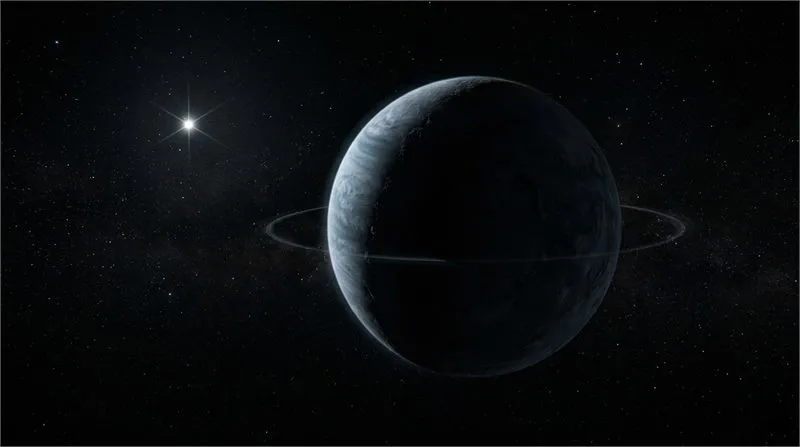
Figure 1: An illustrative photorealistic rendering of the hypothetical Planet Nine, envisioned as a dark, icy super-Earth dimly lit on one crescent by the distant Sun in the extreme outer solar system.
Why Do Astronomers Believe Planet Nine Exists?
The hypothesis for Planet Nine does not stem from a direct telescope sighting, but rather from classic Newtonian gravitational detective work—reminiscent of how irregularities in Uranus's orbit led Urbain Le Verrier and John Couch Adams to calculate the exact position of Neptune in 1846.
In the Kuiper Belt—a vast debris disk of icy bodies extending beyond Neptune—astronomers discovered a family of Extreme Trans-Neptunian Objects (ETNOs) with semi-major axes exceeding 150 to 250 astronomical units (where 1 AU is the average distance between the Earth and the Sun). Under random gravitational scattering by giant gas planets, these icy worlds should have orbits randomly oriented in all directions. Instead, the orbits of the most distant ETNOs share two startling geometric features:
- Physical Clustering: Their perihelia (the closest point in their orbits to the Sun) cluster in the same quadrant of space.
- Orbital Plane Alignment: Their orbital planes are tilted at nearly identical angles relative to the plane of the major planets.
According to Batygin and Brown's statistical models, the probability that this clustering occurred by mere coincidence is less than 0.2 percent. A massive, eccentric planet orbiting in an anti-aligned orientation provides the steady gravitational torque required to herd these distant icy bodies into their observed configurations.
What Are the Latest Discoveries and Refined Clues?
While early critics argued that observational bias might explain the clustering—proposing that telescopes simply looked at specific patches of the sky at certain times of the year—subsequent analyses have strengthened the planet hypothesis:
1. Explaining Neptune-Crossing Objects
In a major milestone published in The Astrophysical Journal Letters, Batygin, Alessandro Morbidelli, Mike Brown, and David Nesvorný investigated a class of long-period trans-Neptunian objects that cross Neptune’s orbit at relatively low orbital inclinations. Standard solar system models struggle to sustain such populations. The researchers ran comprehensive N-body simulations demonstrating that a distant Planet Nine naturally pumps eccentricities and scatters Kuiper Belt objects into these exact trajectories, providing what researchers described as the strongest dynamical evidence to date.
2. Eliminating 78% of the Blind Spots
Through comprehensive re-analyses of data from the Pan-STARRS1 survey in Hawaii, researchers systematically searched for slow-moving, faint objects matching Planet Nine's predicted infrared and optical signatures. When combined with past coverage from the Dark Energy Survey in Chile and the Zwicky Transient Facility at Palomar Observatory, astronomers ruled out nearly 78% of the parameter space. Planet Nine cannot be located in the closest, brightest portions of its orbit; rather, it is almost certainly lingering near its aphelion—its farthest point from the Sun—where it moves at its slowest and blends against the dense star fields of the Milky Way.
3. Solving the Sun's Peculiar Tilt
Astronomers have long puzzled over why the Sun’s axis of rotation is tilted by approximately 6 degrees relative to the orbital plane of Mercury, Venus, Earth, Mars, Jupiter, and Saturn. Because Planet Nine is modeled to follow an orbit tilted roughly 20 to 30 degrees off the solar system’s ecliptic plane, its massive gravitational lever arm over four billion years could have applied a gentle, persistent torque, tilting the spin axis of the inner planetary system relative to the Sun.
What Would Planet Nine Look Like?
Astrophysical calculations indicate that Planet Nine is likely an intermediary class of planet that is ubiquitous across the Milky Way yet mysteriously absent from our inner solar system: a super-Earth or mini-Neptune.
- Mass: Estimated between 4.5 and 7 Earth masses (considerably smaller than Uranus or Neptune, which are 14.5 and 17.1 Earth masses, respectively).
- Composition: A dense rocky and metallic core blanketed by an icy mantle of water, ammonia, and methane, surrounded by a thin hydrogen-helium envelope.
- Temperature: At distances between 400 and 600 AU, solar radiation is negligible. Planet Nine's surface temperature is estimated to hover around 30 to 45 Kelvin (-243°C to -228°C), heated primarily by its own internal core contraction rather than sunlight.
How and When Will Planet Nine Finally Be Confirmed?
Because sunlight drops off with the fourth power of distance for reflective observation, detecting Planet Nine requires instruments capable of sensing exceptionally faint moving objects against crowded background stars. The global astronomical community has pinned its primary hopes on the Vera C. Rubin Observatory and its 10-year Legacy Survey of Space and Time (LSST).
Equipped with an 8.4-meter primary mirror and a 3.2-gigapixel camera, Rubin is designed to scan the entire visible southern sky every three to four nights. If Planet Nine is traversing its predicted path across the southern celestial hemisphere within its theoretical brightness limit (apparent magnitude between 20 and 22), Rubin's automated transient detection pipelines will capture its slow parallax movement across the background starfield, ending decades of speculation with definitive photographic confirmation.
Frequently Asked Questions
Is Planet Nine the same object as Pluto or Nibiru?
No. Pluto is a dwarf planet located roughly 39 AU from the Sun with a mass only 0.2% of Earth's. Planet Nine is an entirely different, hypothetical super-Earth located more than ten times farther out. Nibiru is a thoroughly debunked pseudo-scientific conspiracy myth with no basis in astronomy or physics; Planet Nine is a legitimate scientific hypothesis published in peer-reviewed astrophysics journals.
Why hasn't the James Webb Space Telescope or Hubble found it yet?
Hubble and the James Webb Space Telescope (JWST) have extraordinarily powerful, narrow fields of view, akin to looking at the sky through a drinking straw. They are designed to study small, specific targets in extreme detail, not to sweep large swaths of the sky for unknown objects. Finding Planet Nine requires wide-field optical survey telescopes like Pan-STARRS, the Subaru Telescope, and the Vera C. Rubin Observatory.
What happens if the Rubin Observatory finds nothing?
If comprehensive wide-field surveys cover 100 percent of the predicted parameter space down to magnitude 22 or fainter without detecting Planet Nine, the planetary hypothesis will be heavily constrained or discarded. In that scenario, astrophysicists will need to revisit alternative explanations for ETNO clustering, such as the collective gravitational pull of a massive, undiscovered disk of small icy planetesimals or modifications to trans-Neptunian orbital mechanics.