Home
» Today
»
Planet X2 Beyond Neptune: What New Research Really Shows | November 23, 2026
Planet X2 Beyond Neptune: What New Research Really Shows | November 23, 2026
Checked November 23, 2026, at 3:52 p.m. Pacific Standard Time (UTC−08:00) / 11:52 p.m. UTC.
A new peer-reviewed study has given the hypothetical “Planet X2” a more specific shape: computer simulations suggest an unseen, roughly 1.5-to-2-Earth-mass planet on a distant, elongated orbit could help explain several puzzling paths followed by icy objects beyond Neptune. The paper, published online November 23 in Monthly Notices of the Royal Astronomical Society, does not report a planet detection. Its proposal is a testable model, not evidence that astronomers have found a hidden world.
The distinction matters as the Vera C. Rubin Observatory begins its decade-long Legacy Survey of Space and Time (LSST). Rubin has already found trans-Neptunian objects, including dwarf-planet candidate 2026 ED138, but that candidate is not Planet X2. Future observations may help check the model by expanding and refining the census of distant objects—and potentially searching for the planet itself.
Highlights
Planet X2 is a computer-model hypothesis, not a confirmed planet.
The study describes a possible 1.5–2 Earth-mass world with an orbit averaging roughly 350–500 astronomical units.
Rubin’s 2026 ED138 is a separate trans-Neptunian dwarf-planet candidate, not evidence that X2 has been detected.
Rubin’s repeated sky survey can test the idea over time, but no discovery date or guaranteed detection has been announced.
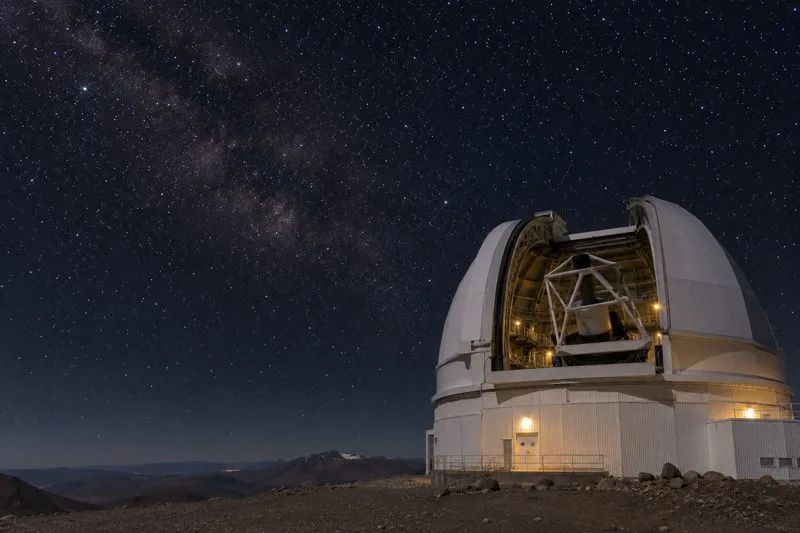
An illustrative view of a research observatory under a dark sky; this is not a photograph of the Vera C. Rubin Observatory.
What is Planet X2?
“Planet X2” (PX2) is the name the research team gives to a hypothetical distant planet in a model of the outer Solar System. In simulations spanning 4.5 billion years of Solar System evolution, its gravity helps account for some unusual orbital patterns among trans-Neptunian objects (TNOs)—icy bodies orbiting beyond Neptune. These include objects on very elongated or highly tilted paths that are difficult to explain using only the known planets.
The model’s proposed planet would have about 1.5 to 2 times Earth’s mass. Its orbit would be far outside the planets: the paper gives a semi-major axis, a measure of an orbit’s scale, of about 350 to 500 astronomical units (AU). One AU is the average Earth–Sun distance. In the modeled orbit, PX2 would remain at least 200 AU from the Sun even at its closest approach.
Those numbers describe a possible configuration that can reproduce observed patterns in the simulations. They are not measurements of a known object. The Royal Astronomical Society’s summary of the study also notes that the model does not match every feature of the observations; the researchers say those differences need further investigation.
Is Planet X2 the same as Planet Nine?
No. Planet X2 and Planet Nine are separate hypotheses. Both concern a possible unseen planet beyond Neptune, but the new study’s Planet X2 is an Earth-class object with a modeled mass of 1.5 to 2 Earths. The Planet Nine idea generally invokes a substantially more massive world to explain some distant orbits. A model that fits part of the TNO evidence does not establish either planet’s existence.
The name also should not be confused with the historical “Planet X” searches that contributed to Pluto’s discovery. Pluto was later found to be too small to explain the planetary motions that motivated those searches. “Planet X2” is the label for this particular, newly modeled scenario.
What has Rubin Observatory actually found?
Rubin’s work provides important context, but it is separate from the Planet X2 modeling result. In an October 27 announcement, the observatory reported 2026 ED138, a large TNO detected in data gathered during early operations. It is a dwarf-planet candidate, pending further characterization; the observatory estimates a broad size range and says infrared observations are needed to constrain its size and confirm its nature.
In April, Rubin’s team also submitted observations of more than 11,000 new asteroids to the Minor Planet Center, including roughly 380 TNOs. Those objects are members of the small-body population beyond Neptune, not a newly found planet. ED138’s reported distance is about 46 AU—much closer than the proposed Planet X2 orbit, whose modeled closest approach is at least 200 AU.
The distinction is useful: TNO discoveries can reveal the structure and history of the outer Solar System, while Planet X2 is a proposed explanation for some of that structure. Finding more TNOs may strengthen, weaken, or reshape the case for the model; it does not by itself confirm a planet.
How could Rubin test the hidden-world idea?
The LSST is designed to repeatedly image the southern sky over ten years. Repeated observations let researchers identify moving objects, improve their orbits, and find faint or distant bodies that earlier surveys may have missed. A larger, better-characterized sample of TNOs will let astronomers compare observed orbital patterns with predictions from models such as Planet X2.
Testing can happen in two ways. First, astronomers can ask whether the growing TNO catalog shows the orbital features the model predicts, while accounting for survey coverage and detection biases. Second, teams can search for the planet directly. A distant planet would move slowly and reflect little sunlight, so finding it could require careful image analysis and follow-up observations. Rubin’s wide, repeated survey makes that search more capable; it does not guarantee a detection.
What should readers take away?
The strongest current conclusion is modest but interesting: researchers have published a detailed new model that makes one hidden-planet scenario more specific and gives future observations something concrete to test. There is no confirmed Planet X2, no official discovery announcement, and no reliable countdown to one. Rubin’s observations of TNOs are real; the link to PX2 is that its future survey may test the hypothesis.
For readers following the story, the useful milestones are peer-reviewed follow-up studies, new TNO orbit measurements, and any direct candidate reported by an observatory or the Minor Planet Center. A convincing planet claim would need repeated observations that establish a consistent orbit, followed by independent confirmation—not just an unusual pattern or an artist’s rendering.