01. Current Data
The market data shaping the current platinum outlook
Any serious commodity forecast should begin with the current physical and macro regime, not with recycled narratives. That is especially true for platinum, where short-term price behavior and long-run structural stories can point in different directions. The goal here is to establish the numbers that matter most before we move to valuation, scenarios, or advice.
For this rewrite, I prioritized primary or near-primary sources: official exchange material, institutional market studies, the IMF, the World Bank, IEA analysis, and U.S. macro releases. That matters because the difference between a useful commodity article and a thin SEO page is whether the analysis stays anchored to verifiable data. In this case, the anchor points are $2,923/oz high, 240 koz deficit, and the still-important inflation backdrop of April 2026 U.S. CPI rose 3.8% year over year, April 2026 core CPI rose 2.8%, and March 2026 core PCE rose 3.2%.
| Period | Data point | Why it matters |
|---|---|---|
| 2025 | Total supply 7,215 koz | Supply fell 1% year over year |
| 2025 | Total demand 8,297 koz | Demand rose 1% year over year |
| 2025 | Deficit 1,082 koz | Largest shortfall in the WPIC time series since 2013 |
| 2026f | Total demand 7,619 koz | Demand seen down 8%, but still strong enough for a deficit |
| 2026f | Deficit 240 koz | Market remains short, not balanced |
Those figures are enough to make one point clear. The current market is not a blank slate. It is already telling investors how much tension exists between today's balance and tomorrow's risk premium. A disciplined article should respect that tension instead of pretending the answer is obvious.
02. Institutional Lens
What the latest institutional data actually say
The institutional lens for platinum is stronger than it looks if you stay close to primary materials rather than broker headlines. The March 4, 2026 WPIC Platinum Quarterly said the market recorded a 1,082 koz deficit in 2025, the largest shortfall in its time series since 2013. Total supply fell 1% to 7,215 koz, while total demand rose 1% to 8,297 koz. For 2026, WPIC still expects a 240 koz deficit, even after forecasting demand down 8% to 7,619 koz.
That matters because it means today's platinum story is not just momentum. It is a metal that has already consumed a meaningful amount of above-ground inventory. WPIC said stocks are projected to remain at just over four months of global demand through 2026. A market can trade with low inventory for a while, but it becomes more vulnerable to disorderly price jumps if supply disappoints again.
WPIC also gave a useful price anchor. In its February 12, 2026 platinum perspective it said platinum hit an all-time high of $2,923/oz on 26 January 2026, then reset and climbed back above $2,000/oz in early February. That pattern is important. It tells you that platinum can overshoot violently, but it also suggests the market now recognizes a fundamentally tighter floor than in previous years.
The macro backdrop still matters. The World Bank's April 2026 commodity outlook said precious metals are expected to post all-time annual highs in 2026, while the IMF still sees global GDP growth at 3.1% in 2026 and 3.2% in 2027. That is enough growth to keep industrial demand relevant, but the key institutional message is narrower: platinum no longer needs every demand segment to be perfect in order to remain fundamentally tight.
| Factor | Why it matters | Current Assessment | Bias | Current evidence |
|---|---|---|---|---|
| Supply balance | A third straight deficit is a serious structural signal | Bullish | + | WPIC reported a 1,082 koz deficit in 2025 and still sees a 240 koz deficit in 2026 |
| Above-ground stocks | Low stocks make the market more fragile to shocks | Bullish | + | WPIC says stocks remain at just over four months of demand through 2026 |
| Industrial demand mix | Demand is diversified but cyclical | Mixed | 0 | Industrial demand is forecast to rebound 11% in 2026 to 2,124 koz |
| Price behavior | The market has already repriced sharply, so drawdowns will be violent too | Mixed | 0 | WPIC cited an all-time high of $2,923/oz on 26 January 2026 |
| Hydrogen and AI optionality | Long-term upside exists, but it is not yet dominant in the current balance | Constructive | + | Hydrogen was under 1% of demand in 2025f and WPIC sees it reaching 4% by 2030f |
The scoring table matters because a reader should be able to see the current tilt factor by factor. Right now, the balance of evidence is not uniformly bullish or bearish. It is a weighted picture. Some signals support higher prices, some cap the upside, and some mainly tell you that the right strategy depends on time horizon.
03. Countercase
The risks that could weaken the current thesis
The key bear case for platinum is not that the deficit story is fake. It is that the market already moved a long way in a short time, and some of that move can unwind if the urgency premium fades. WPIC itself expects total platinum demand to fall 8% in 2026 after the exceptional investment and exchange-stock flows seen in 2025. If investors treat 2025 as a one-off rather than a new regime, price can still correct sharply even with a modest 2026 deficit.
The second risk is substitution and elasticity at the margin. Higher platinum prices can support recycling, and WPIC expects recycling supply to rise 10% in 2026. That does not solve the market by itself, but it can reduce the sense of immediate scarcity. If jewellery or industrial buyers step back while recycled supply improves, the price can retreat before the next leg higher.
The third risk is macro liquidity. U.S. inflation is not fully subdued, with April 2026 CPI at 3.8% and March 2026 core PCE at 3.2%. If real rates stay higher for longer and broad commodity positioning cools, platinum can suffer as a high-volatility precious metal even if its own fundamentals remain better than those of gold or silver at the margin.
That is why the countercase has to be framed with current data and not with textbook abstractions. When a risk is real, the article should say what number would confirm it, how often that number updates, and what would make the thesis worth revisiting. That is the difference between a warning and a useful investment framework.
04. Forecast Framework
By 2027, the market should already reveal whether the current thesis is strengthening or fading
The 2027 horizon is useful because it is short enough for today's data to matter and long enough for new supply or demand trends to show themselves. I would not treat any 2027 number as a promise. I would treat it as a range conditioned on inventories, macro policy, and the next two annual supply-demand revisions.
For investors who are already profitable, that usually argues for discipline rather than emotional conviction. Trimming into strength can make sense when the price is pushing the top of the bull band without fresh confirmation from balances or macro data. For investors who are underwater, the better question is not whether the asset is "good," but whether the original thesis still matches the new data. If the data are improving, averaging thoughtfully may be defensible. If the data are weakening, blind averaging is just denial.
For investors with no position, the practical distinction is between trend confirmation and valuation discipline. If the market is still confirming the thesis, waiting for a pullback can be emotionally satisfying but operationally expensive. If the market is already euphoric while the data are only mixed, patience is more rational. In other words, the right action depends on both entry point and evidence, not on a generic buy-or-sell slogan.
Another discipline that improves long-horizon results is to separate structural conviction from tactical sizing. A metal can deserve a positive three- to ten-year view while still being a poor chase after a sharp momentum burst. That distinction matters because commodities frequently overshoot fair value in both directions. Position sizing, review dates, and trigger levels are therefore not optional details. They are the practical bridge between a good thesis and a defensible portfolio decision.
In that sense, the scenario ranges in this article are not just editorial decoration. They are meant to help different readers act differently. A trader may care most about trigger levels over the next quarter. A long-only allocator may care more about whether the base case is improving or deteriorating every six months. A business operator exposed to the metal may care most about whether today's pricing still justifies hedging activity. The same article should be usable for all three.
A final practical rule is to avoid treating volatility as proof that the thesis is wrong. In commodity markets, volatility is often the normal transmission mechanism through which the thesis expresses itself. The more important question is whether volatility is occurring alongside improving evidence or deteriorating evidence. If the balance sheet of the story is strengthening, volatility can be an opportunity. If the evidence is weakening, the same volatility can be an exit signal. That distinction is what keeps scenario analysis grounded in process rather than emotion.
05. Scenarios
Actionable scenarios with probabilities, triggers, and review points
Scenario analysis only becomes useful when it includes explicit probabilities, measurable triggers, and a review schedule. Otherwise it is just polished ambiguity. The map below is designed to be monitored over time, not merely read once.
| Scenario | Probability | Range / implication | Trigger | When to review |
|---|---|---|---|---|
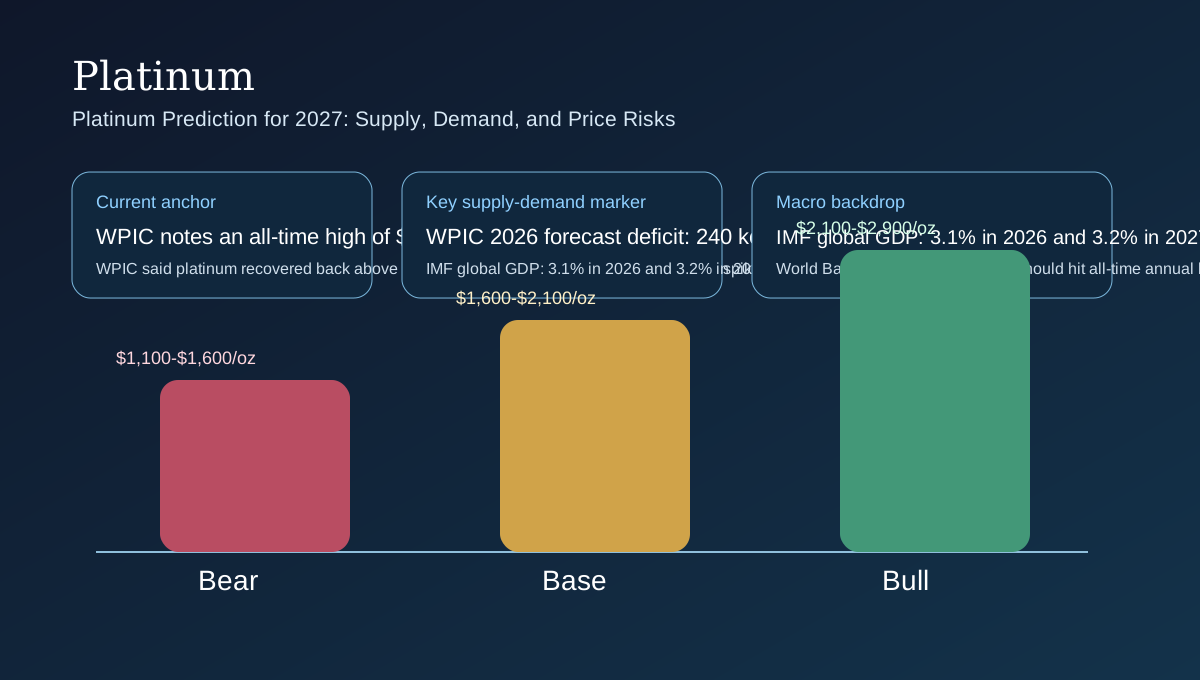
| Bull case | 30% | $2,270/oz-$2,401/oz | Low stocks and renewed investment demand tighten the market again | Review after each WPIC quarterly update |
| Base case | 50% | $2,117/oz-$2,201/oz | The market remains in deficit but no longer panic-tight | Review after Q3 2026 and Q1 2027 |
| Bear case | 20% | $1,895/oz-$2,017/oz | ETF and exchange flows fade and industrial demand weakens | Review if lease rates and backwardation cool materially |
The purpose of this table is not to create false precision. It is to force a disciplined process. If a trigger is hit, the probability mix should change. If it is not hit, conviction should stay limited. That approach is especially important in commodities because spot moves can be dramatic while the underlying physical trend changes much more slowly.
06. Sources
Primary and institutional sources used in this article
- WPIC Platinum Quarterly Q4 2025
- WPIC supply and demand page
- WPIC January 2026 five-year supply-demand outlook
- WPIC on hydrogen and electrolysis demand
- WPIC on electrical demand and AI-linked applications
- LME LBMA Platinum page
- USGS platinum-group metals statistics
- World Bank Commodity Markets Outlook, April 2026
- IMF World Economic Outlook, April 2026
- BLS CPI April 2026
- BEA Personal Income and Outlays, March 2026