01. Current Data
The current data that matter most
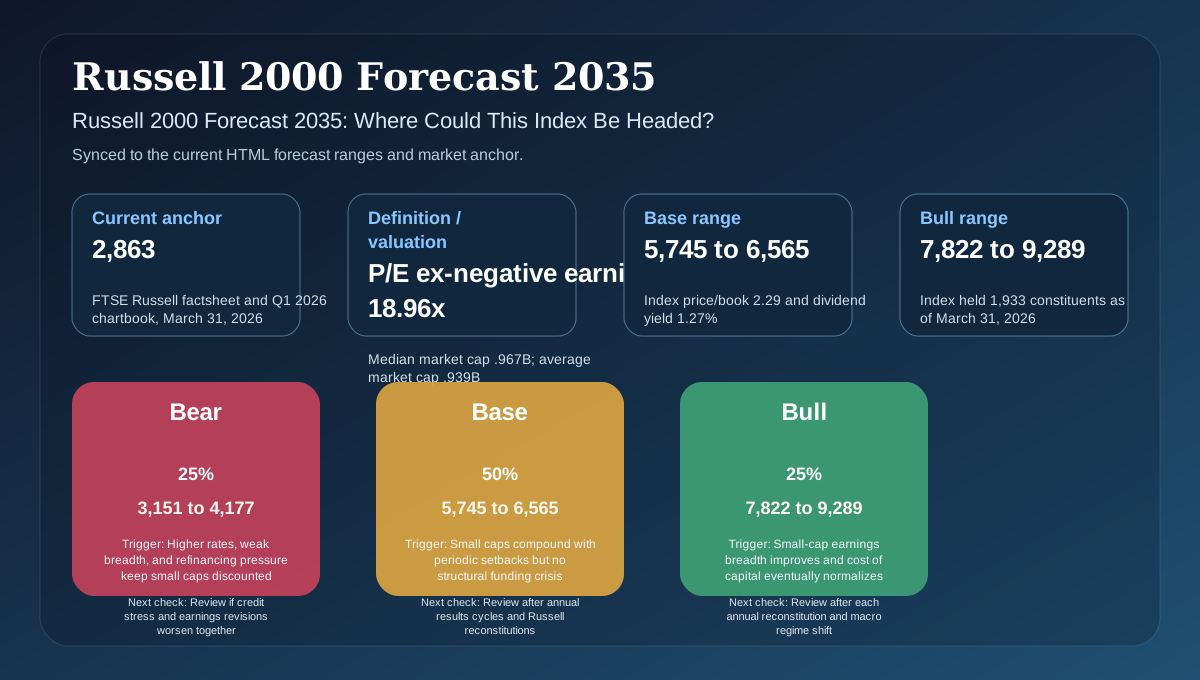
| Metric | Latest figure | Why it matters |
|---|---|---|
| Current anchor | 2,863 | Defines the starting point for the scenario discussion |
| Valuation or definition | P/E ex-negative earnings 18.96x | Shows how the market should interpret the asset |
| Structural characteristic | Median market cap .967B; average market cap .939B | Provides context for what this benchmark actually measures |
| Latest source anchor | Index price/book 2.29 and dividend yield 1.27% | FTSE Russell factsheet and Q1 2026 chartbook, March 31, 2026 |
| Additional context | January 2026 Russell 2000 return +5.31%; small caps briefly led the market | Helps turn the thesis into something monitorable |
The Russell 2000 is best understood as the public market's real-time test of small-cap balance-sheet tolerance, earnings breadth, and domestic growth sensitivity. FTSE Russell's March 31, 2026 factsheet gives the cleanest current snapshot: price/book was 2.29, dividend yield 1.27%, P/E excluding negative earners was 18.96x, five-year EPS growth stood at 10.36, and the benchmark held 1,933 constituents. Median market cap was just under .0 billion. Those are useful numbers because they show the asset class is cheaper than large-cap growth, but also fundamentally more fragile.
The benchmark's recent behavior reinforces that mixed message. Cboe's January 2026 market recap showed the Russell 2000 gained 5.31% that month, outperforming the S&P 500 as investor attention rotated away from the most crowded mega-cap trades. But LSEG's Q1 2026 spotlight also showed that small-cap valuation multiples derated over the quarter and that style dispersion remained significant. That combination matters: small caps can lead when rates and breadth cooperate, but the leadership is rarely durable if funding conditions stay tight.
Macro data remain central here. Goldman Sachs' roughly 2.5% U.S. GDP expectation and IMF's 2.4% 2026 U.S. growth baseline are still consistent with economic expansion. Yet April 2026 CPI at 3.8% and March 2026 core PCE at 3.2% mean the market still cannot assume a frictionless easing cycle. That is especially important for the Russell 2000 because smaller companies are usually more exposed to refinancing costs, margin swings, and narrower access to capital than large-cap peers.
02. Key Factors
Five factors shaping the next move
The first factor is valuation quality, not just valuation level. A P/E excluding negative earners of 18.96x is not extreme by historical small-cap standards, but the exclusion itself is meaningful because it reminds investors that loss-making companies are still a non-trivial part of the opportunity set. The second factor is breadth. A broad small-cap advance is healthier than a rally led by a small cluster of profitable cyclicals or biotech rebounds. If breadth keeps improving, the Russell 2000 catch-up trade becomes more credible.
The third factor is macro sensitivity. Small caps typically benefit more than large caps from lower real rates and improved domestic lending conditions, but they also suffer more when inflation or financing costs remain sticky. The fourth factor is index construction and reconstitution. LSEG has already highlighted that Russell U.S. indexes are moving to semi-annual reconstitutions in 2026, which matters because membership changes and IPO flows can reshape the opportunity set more quickly. The fifth factor is profitability dispersion. Some parts of the benchmark may be improving fundamentally while weaker balance-sheet cohorts still struggle.
| Factor | Why it matters | Current Assessment | Bias | Current evidence |
|---|---|---|---|---|
| Valuation | Small caps need enough earnings support to justify rerating | Reasonable vs large caps, but fragile | + | Russell 2000 P/E ex-negative earnings was 18.96x and price/book 2.29 as of 3/31/2026 |
| Breadth | A broad small-cap rally is healthier than a narrow bounce | Still incomplete | 0 | Small caps led in January 2026, but Q1 derating and style dispersion remained visible |
| Macro sensitivity | Small caps are more rate-sensitive than large caps | Mixed | 0 | Goldman Sachs 2026 U.S. GDP around 2.5%; IMF 2026 U.S. GDP 2.4%; April 2026 CPI 3.8% year over year; core CPI 2.8%; March 2026 headline PCE 3.5%; core PCE 3.2% |
| Profitability quality | Negative earners and weaker balance sheets matter more here | More fragile than large caps | - | The benchmark uses P/E ex-negative earnings, which is already a clue that loss-making names still matter |
| Structural opportunity | Small-cap catch-up remains possible if rates and breadth cooperate | Constructive but selective | + | The Russell 2000 still offers the cleanest listed expression of a small-cap catch-up trade, but that thesis remains tightly linked to rate relief, earnings breadth, and balance-sheet tolerance for a higher-cost-of-capital regime. |
03. Countercase
What could weaken the current thesis
The bear case for the Russell 2000 starts with funding pressure. If inflation remains sticky enough to keep rates elevated, smaller companies may find it harder to refinance, maintain margins, or attract incremental capital at reasonable prices. That does not require recession. It only requires that the cost of capital remains less forgiving than the market hoped.
The second risk is earnings breadth. Small caps often look statistically cheap after a correction, but that does not automatically make them attractive if too many businesses are still losing money or facing weak demand. The third risk is that leadership narrows again. If large-cap quality and AI concentration retake control of market flows, the Russell 2000 can slip back into relative underperformance even without a dramatic macro break.
| Risk | Latest data point | Why it matters now | What would confirm it |
|---|---|---|---|
| Macro pressure | March 2026 headline PCE 3.5%; core PCE 3.2% | Rates and growth still matter for both benchmarks | Sticky inflation or worsening growth scare |
| Structure / breadth | Index held 1,933 constituents as of March 31, 2026 | The internal quality of the signal matters as much as the headline | Narrower participation or adverse structure change |
| Valuation / regime risk | P/E ex-negative earnings 18.96x | Cheap-looking or calm-looking conditions can still reverse | Loss of valuation support or renewed stress spike |
| Narrative oversimplification | January 2026 Russell 2000 return +5.31%; small caps briefly led the market | The benchmark can be misread if investors rely on one storyline | Data stop confirming the preferred narrative |
04. Institutional Lens
How official source material changes the outlook
The strongest institutional material for the Russell 2000 right now comes from FTSE Russell and LSEG rather than from generic strategy commentary. Their factsheet gives the cleanest current valuation and composition data, while the quarterly chartbook and spotlight help place recent performance, style dispersion, and reconstitution changes in context. That is more useful than pretending there is one bank target that settles the small-cap outlook.
The practical conclusion is that the Russell 2000 still has a live catch-up case, but the burden of proof is higher than it would be for a large-cap benchmark. Better breadth, a friendlier inflation trajectory, and steadier profits can justify the bull case. Sticky inflation, weaker breadth, and a high-cost-of-capital environment can keep the discount in place much longer than valuation-only arguments suggest.
| Source type | Concrete datapoint | Why it matters here |
|---|---|---|
| Official benchmark or methodology source | P/E ex-negative earnings 18.96x | Defines what the benchmark measures and how it should be interpreted |
| Latest benchmark snapshot | Index price/book 2.29 and dividend yield 1.27% | Provides the most recent quantitative anchor |
| Macro data | April 2026 CPI 3.8% year over year; core CPI 2.8%; March 2026 headline PCE 3.5%; core PCE 3.2% | Sets the rate and growth backdrop that moves both benchmarks |
| Recent market-structure commentary | January 2026 Russell 2000 return +5.31%; small caps briefly led the market | Shows how the regime has behaved in the current year |
05. Scenarios
Scenario analysis with probabilities and review points
The scenario ranges below are designed to be monitorable. Each path has a probability, a practical trigger, and a clear review rhythm so the thesis can be updated as the data change.
| Scenario | Probability | Range / implication | Trigger | When to review |
|---|---|---|---|---|
| Bull | 25% | 7,822 to 9,289 | Small-cap earnings breadth improves and cost of capital eventually normalizes | Review after each annual reconstitution and macro regime shift |
| Base | 50% | 5,745 to 6,565 | Small caps compound with periodic setbacks but no structural funding crisis | Review after annual results cycles and Russell reconstitutions |
| Bear | 25% | 3,151 to 4,177 | Higher rates, weak breadth, and refinancing pressure keep small caps discounted | Review if credit stress and earnings revisions worsen together |
References