01. Historical Context
Current market snapshot before the forecast
Samsung's base case is stronger than it looked a year ago because memory pricing, HBM execution, and AI-related system demand have all turned up together, but the stock is now more exposed to cyclical and labor risks. Samsung Electronics announces fourth quarter and FY2025 results and Samsung 1Q 2026 earnings presentation together show how dramatic the cycle turn has been: 1Q2026 revenue reached KRW133.9 trillion and operating profit KRW57.2 trillion after FY2025 revenue of KRW333.6 trillion and operating profit of KRW43.6 trillion.
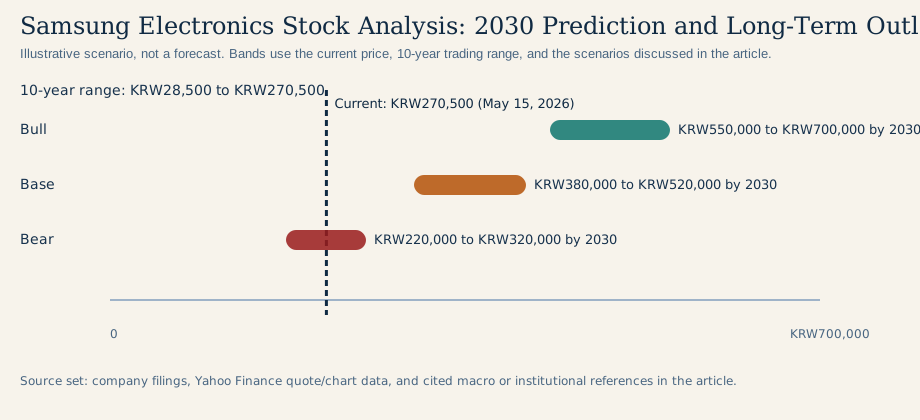
Samsung's recent close of KRW270,500 is effectively at the top of its own 10-year range. That means the long-term story cannot rest on simple mean reversion anymore; it has to rest on whether AI memory and adjacent businesses can justify a new plateau. Yahoo Finance quote page for Samsung Electronics
| Metric | Current reading | Why it matters |
|---|---|---|
| Recent close | KRW270,500 on May 15, 2026 | Yahoo Finance 1-month daily chart |
| 10-year range | KRW28,500 to KRW270,500 | Yahoo Finance 10-year monthly chart |
| Consensus marker | 1-year target estimate about KRW323,520 | Yahoo Finance quote page |
| Latest quarterly results | 1Q2026 revenue KRW133.9 trillion and operating profit KRW57.2 trillion | Samsung 1Q2026 results |
| Memory/AI signal | HBM4 commercial shipments began and HBM4E samples were scheduled for Q2 2026 | Samsung newsroom updates |
Samsung's valuation requires context because trailing metrics are distorted by the memory-cycle trough, while forward metrics imply the market still doubts the durability of the new HBM-driven earnings base.
02. Key Forces
Main drivers shaping the next move
The first driver is AI memory leadership. Samsung Electronics announces fourth quarter and FY2025 results and Samsung says it shipped commercial HBM4 products show that HBM4, DDR5, enterprise SSDs, and server demand are now central to Samsung's earnings, not just nice-to-have upside.
The second driver is estimate momentum. Yahoo Finance analyst estimates page for Samsung Electronics showed broad upward revisions in the last available analyst snapshot, which is exactly what a cyclical leader needs when it is pushing against the top of a decade-long trading range.
The third driver is industrial support and execution risk. Korea.net release on the Semiconductor Industry Strategy for the AI Era shows Korea is still backing semiconductors as a strategic industry, but the same story is happening alongside a live labor dispute that can interfere with output and sentiment.
| Factor | Latest evidence | Current assessment | Bias |
|---|---|---|---|
| AI memory cycle | Memory posted record quarterly revenue and profit in 1Q2026 as Samsung ramped HBM4 and AI-focused products. | This is the main driver of the current rerating. | Bullish |
| Foundry and logic execution | Samsung said foundry earnings fell in 1Q2026 even as it maintained HPC design wins and a foundation in silicon photonics. | The foundry story is improving, but not yet clean. | Neutral |
| Mobile and devices | MX and Networks revenue reached KRW38.1 trillion with KRW2.8 trillion operating profit in 1Q2026. | Consumer electronics is helpful, but semis still dominate the investment case. | Neutral |
| Estimate momentum | Yahoo Finance analyst pages showed 22 upward revisions for next-year EPS over 30 days in the last available snapshot. | Revision breadth is clearly constructive. | Bullish |
| Labor and policy risk | Reuters reported union strike plans for May 21, 2026 after pay talks broke down. | Operational risk is elevated near term even with strong demand. | Bearish |
03. Countercase
What could invalidate the thesis
The first countercase is cycle risk. Samsung is now priced much closer to best-case memory conditions than it was a year ago, so any evidence of oversupply or weaker pricing would hit expectations hard.
The second risk is operational. Reuters-syndicated report on Samsung union strike plans is the live reminder that a prolonged strike would matter because Samsung is the world's biggest memory producer and AI supply chains are already tight.
The third risk is portfolio concentration in semiconductors. If foundry and mobile do not broaden the earnings base, the stock remains heavily exposed to one powerful but volatile profit engine.
| Risk | Latest data or context | Why it matters now | When to review |
|---|---|---|---|
| Strike or labor disruption | Reuters said Samsung's union kept plans for a strike starting May 21, 2026 and shares slid on the news. | Watch whether talks resume and whether Pyeongtaek output is affected. | Daily until the wage dispute is resolved |
| Memory cycle turns too hot | Broker commentary already calls Samsung and SK hynix undervalued on about 6x forward P/E, which means the market expects profit normalization to stick. | Watch ASP trends, HBM shipment growth, and signs of over-ordering. | Each quarterly result and supplier commentary |
| Foundry lag persists | Samsung highlighted better design wins, but foundry earnings still weakened in 1Q2026. | If non-memory execution keeps lagging, the stock may remain a memory proxy instead of a broader AI winner. | Reassess after second-half 2026 product launches |
| Macro or export shock | The IMF said Korea's economy should rebound in 2026 but still faces persistent external uncertainty. | Watch exports, U.S.-China chip policy, and AI infrastructure spending by hyperscalers. | Monthly Korea trade data and policy headlines |
04. Institutional Lens
What the latest institutional and primary-source evidence says
Institutional work is only useful when it changes the evidence set. For Samsung, the most relevant inputs are the Q1 earnings release, the analyst revision trend, the macro outlook for Korea, and the live operational risks around labor and chip supply. Samsung Electronics announces first quarter 2026 results and Yahoo Finance quote page for Samsung Electronics matter more than generic semiconductor cheerleading.
That matters because each scenario range below is anchored to a recent trading price, the last 10 years of monthly price history, present valuation, and the direction of earnings or revenue revision signals. The methodology is intentionally simple: use the current price as the anchor, then widen or narrow the band depending on whether operating proof and macro conditions are improving or deteriorating.
In other words, these are probability-weighted ranges, not promises. The article becomes more bullish only if the measurable triggers continue to improve after the next review date.
| Source | Updated | What it says | Why investors should care |
|---|---|---|---|
| Samsung 1Q2026 results | April 30, 2026 | Revenue hit KRW133.9 trillion and operating profit KRW57.2 trillion; DS operating profit was KRW53.7 trillion. | This is the strongest earnings evidence in the group and explains why the stock is challenging its historical range. |
| Samsung FY2025 results | January 29, 2026 | Full-year revenue was KRW333.6 trillion, operating profit KRW43.6 trillion, and R&D spending a record KRW37.7 trillion. | The annual base confirms the company kept investing before the cycle fully turned. |
| Yahoo Finance consensus | May 2026 quote snapshot | 1-year target estimate was roughly KRW323,520. | The market still sees upside despite the stock already revisiting the top of its 10-year range. |
| Yahoo Finance analyst trends | Last available analysis snapshot | Consensus next-year revenue was KRW454.3 trillion and next-year EPS about KRW17,735.61, with broad upward revisions. | That is a strong revisions signal, though the cycle can still surprise on the downside. |
| Korean brokers and policy backdrop | May 2026 | Broker reports highlighted roughly 6x forward P/E and target-price hikes, while Korea's semiconductor strategy for the AI era continued to roll out. | Samsung benefits both from a favorable cycle and from explicit national industrial support. |
05. Scenarios
Scenario analysis and investor positioning
The probability table below reflects the current setup, not a permanent view. Rising odds represent the chance that the stock finishes the next review window above today's level by enough to validate the thesis; sideways odds cover consolidation or only modest change; falling odds cover a material de-rating or drawdown.
Current framework: probability of rising 47%, probability of moving sideways 23%, and probability of falling 30%. Investors should review the thesis when either consensus revisions, free cash flow, or the specific company catalyst path changes meaningfully.
| Scenario | Probability | Illustrative target range | Trigger conditions | When to revisit |
|---|---|---|---|---|
| Bull | 35% | KRW550,000 to KRW700,000 by 2030 | HBM, packaging, and premium-device AI keep driving a structurally higher earnings base. | Reassess after each annual memory-cycle review |
| Base | 43% | KRW380,000 to KRW520,000 by 2030 | Samsung keeps a leadership role in memory but foundry remains only partly improved. | Reassess yearly against earnings and capex |
| Bear | 22% | KRW220,000 to KRW320,000 by 2030 | A downturn in memory pricing or labor disruption breaks the current earnings momentum. | Reassess immediately if cycle indicators roll over |
| Investor group | Suggested posture | Practical action | What to monitor next |
|---|---|---|---|
| Investor already in profit | Hold a core position but rebalance if the scenario table moves away from your original thesis. | Protect gains when probability skews worsen. | Revision breadth, valuation, and next catalyst |
| Investor currently at a loss | Separate a delayed thesis from a broken thesis. | Add only when measurable triggers improve. | Guidance, margin trend, and cash flow |
| Investor with no position | Waiting for a cleaner setup is valid. | Use scenario triggers rather than headlines as entry rules. | Price relative to current range and catalyst calendar |
| Trader | Focus on review dates and trigger conditions, not the long-range target. | Use stop-losses because scenario bands are wide. | Earnings reactions and macro data |
| Long-term investor | Use gradual position building or rebalancing rather than all-in decisions. | A wide base case is normal in long-horizon work. | Structural competitiveness and capital allocation |
| Investor seeking a hedge | Hedging is sensible when portfolio concentration is high. | Match hedge size to risk exposure rather than fear. | Volatility, correlation, and event timing |
The forecast ranges in this article are built from four anchors: the recent market price, the 10-year trading range, the current valuation regime, and the direction of revisions or cash-flow evidence. That framework is intentionally conservative because it tries to separate what is plausible from what is merely possible.
Disclaimer: This is a scenario-based research article, not personalized investment advice. Markets can move sharply on earnings, regulation, macro data, and liquidity. Use position sizing, stop-loss discipline where appropriate, and independent due diligence.
References
Sources
- Samsung Electronics announces fourth quarter and FY2025 results
- Samsung Electronics announces first quarter 2026 results
- Samsung 1Q 2026 earnings presentation
- Samsung says it shipped commercial HBM4 products
- Samsung HBM4E and NVIDIA GTC 2026 announcement
- Samsung Electronics releases 2025 sustainability report
- Yahoo Finance quote page for Samsung Electronics
- Yahoo Finance analyst estimates page for Samsung Electronics
- IMF staff completes 2025 Article IV mission to Republic of Korea
- Korea.net release on the Semiconductor Industry Strategy for the AI Era
- Reuters-syndicated report on Samsung union strike plans
- Korea JoongAng Daily on broker target-price hikes and forward P/E