01. Historical Context
What matters for a 2030 view
SAP's long-term case rests on recurring revenue, suite depth, and data gravity. The stock has compounded at roughly 9.61% annually on an adjusted-price basis over the last ten years, with a wide adjusted range of about EUR 57.54 to EUR 261.65. That history shows two things at once: SAP can create strong equity returns over time, and the path is rarely smooth.
The current setup is therefore unusually important. A stock at EUR 144.06, well below the 52-week high, already discounts some skepticism about the cloud-and-AI bridge. If management delivers through the next few years, 2030 upside remains meaningful without requiring a bubble multiple.
| Horizon | What matters most | Current assessment | Bias |
|---|---|---|---|
| 2026 | Backlog durability and conversion into revenue | Strong start, still needs follow-through | Bullish |
| 2027-2028 | Whether cloud and AI remain monetized at scale | Commercial traction exists, but the base is getting larger | Neutral to bullish |
| 2029-2030 | Whether SAP behaves like a structurally stronger cash-flow company | Possible if the current transition keeps deepening | Neutral |
02. Key Forces
Structural drivers into 2030
The first structural driver is the sheer scale of the recurring cloud base. SAP's FY2026 consensus still points to EUR 25.527 billion of cloud revenue and more than EUR 10 billion of free cash flow. If that bridge holds, the company enters the back half of the decade with a much larger monetized subscription base than it had even two years ago.
The second driver is that SAP's AI strategy is being connected to data infrastructure rather than treated as a superficial add-on. The Prior Labs and Dremio deals, the Business Data Cloud push, and the Autonomous Enterprise roadmap all point to an attempt to make AI more deeply embedded in enterprise workflows.
| Factor | Current data point | Current assessment | Bias |
|---|---|---|---|
| Recurring revenue depth | FY2026 cloud revenue consensus EUR 25.527 billion | Large enough to support durable compounding | Bullish |
| Cash generation | FY2026 FCF consensus EUR 10.067 billion | Strong support for long-run capital allocation | Bullish |
| AI commercialization | Business AI in two thirds of Q4 cloud order entry | Commercial relevance exists already | Bullish |
| Valuation starting point | Stock still close to the lower end of the 52-week range | Leaves room for upside if execution improves | Neutral to bullish |
| Execution sensitivity | Management expects some backlog deceleration in 2026 | A reminder that 2030 upside still needs steady delivery | Neutral |
03. Countercase
What could keep 2030 returns subdued
The long-run bear case is not that SAP loses its installed base. It is that the market decides the cloud and AI transition is becoming more mature and therefore deserves a lower multiple. That can happen even while revenue and profit are still rising.
A second risk is competitive and architectural pressure. If SAP's platform additions are useful but not uniquely monetizable, the market may keep treating the stock as a good business with only moderate upside.
| Risk | Latest data point | Why it matters | Bias |
|---|---|---|---|
| Backlog slows faster than expected | Management already guided to some deceleration in 2026 | The long-term model becomes less powerful if backlog quality erodes early | Bearish |
| Valuation ceiling stays low | Current stock still far below its 52-week high | Shows the market is not yet paying for a full strategic win | Neutral to bearish |
| Consensus bridge weakens | FY2026 EPS median EUR 7.14 | A weaker bridge would reduce the 2030 base case | Bearish |
| AI monetization stays incremental | AI traction exists, but disclosed numbers remain largely cloud and backlog metrics | Could limit the magnitude of rerating into 2030 | Neutral |
04. Institutional Lens
The best institutional anchors for a 2030 model
SAP gives investors unusually useful public anchors: a current-year consensus table, an integrated report with basic EPS history, and repeated commentary on backlog quality and revenue acceleration. Those are enough to build a disciplined 2030 model without pretending to know the exact earnings line four years out.
The base case in this article therefore assumes continued growth, but not a return to the peak enthusiasm seen when the stock was near its 52-week high. The upside case requires better execution than what the current price is discounting.
| Source and date | What it said | Specific number | Why it matters |
|---|---|---|---|
| SAP integrated report 2025, published February 2026 | Actual 2025 basic EPS | EUR 6.14 | The clean trailing base for long-run modelling |
| SAP consensus page, April 22, 2026 | FY2026 EPS and FCF medians | EPS EUR 7.14; FCF EUR 10.067 billion | The current bridge into the late 2020s |
| SAP FY2025 results, January 29, 2026 | Total revenue should accelerate through 2027 | Explicit management framing | Supports a stronger medium-term slope |
| SAP Q1 2026 results, April 23, 2026 | Current cloud backlog remained strong | EUR 21.9 billion; +25% cc | Supports the bridge rather than breaking it |
05. Scenarios
Probability-weighted 2030 ranges
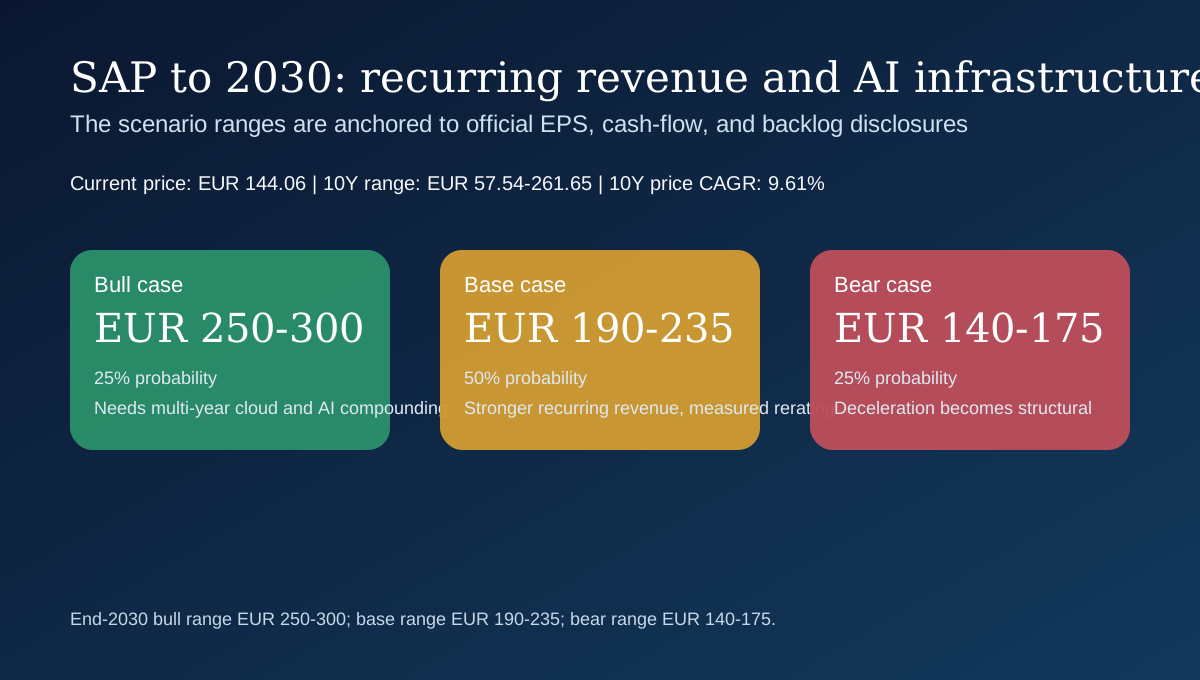
The 2030 range should be reviewed after every year-end cycle because the most important long-run variable is whether SAP keeps converting recurring revenue growth into higher-quality cash flow. A good software stock can still disappoint if cash flow quality lags the revenue story.
The base case here assumes SAP keeps compounding from a larger recurring base, but with a valuation that remains more measured than at the cycle peak.
| Scenario | Probability | Trigger | Review date | Target range |
|---|---|---|---|---|
| Bull case | 25% | SAP sustains strong cloud growth, AI monetization broadens, and FCF scales beyond current consensus assumptions | Annual results through 2028 and 2029 | EUR 250-300 |
| Base case | 50% | SAP delivers a durable recurring-revenue compounding path and retains a reasonable software multiple | Annual results through 2028 and 2029 | EUR 190-235 |
| Bear case | 25% | Backlog deceleration becomes structural and the stock never regains a stronger multiple | Annual results through 2028 and 2029 | EUR 140-175 |
References
Sources
- Yahoo Finance chart API for SAP.DE 10-year price history and latest market data
- SAP Q1 2026 results, published April 23, 2026
- SAP Q4 and FY 2025 results, published January 29, 2026
- SAP Integrated Report 2025 five-year summary, including 2025 basic EPS
- SAP company-published consensus estimates, last update April 22, 2026
- SAP recent results page with 2026 outlook corridor and backlog commentary
- StockAnalysis valuation page for SAP, used for trailing and forward multiple cross-checks