01. Historical Context
A 2035 view should be built from the business model, not the latest quarter
SAP's long-run appeal is its ability to convert mission-critical software relationships into recurring revenue and cash flow. Over the last decade, that has produced a roughly 9.61% annualized adjusted price return, but the ride has included deep swings. That matters because a 2035 model should capture both the durability of the business and the reality that software valuations move in cycles.
The current setup is interesting precisely because the stock is no longer priced for perfection. At EUR 144.06, SAP is far below its recent highs even though published consensus still expects FY2026 EPS of EUR 7.14 and free cash flow above EUR 10 billion. If those figures become the base rather than the peak, the 2035 outlook stays attractive.
| Horizon | What matters most | Current assessment | Bias |
|---|---|---|---|
| 2026-2027 | Conversion of backlog into earnings and cash flow | Strong public bridge, still execution-sensitive | Bullish |
| 2028-2031 | Whether AI and data-platform investments deepen the moat | The strategy is visible, monetization must stay real | Neutral to bullish |
| 2032-2035 | Whether SAP keeps compounding as a larger recurring-revenue platform | Plausible if the present transition holds | Neutral |
02. Key Forces
The long-run forces that can shape 2035 returns
Scale is the first force. A cloud business already running toward a EUR 25.5 billion 2026 consensus base has the ability to keep growing even if percentage growth naturally moderates. Large recurring bases matter in long-term software compounding because they support cash flow, retention, and cross-sell.
The second force is enterprise AI tied to structured data. SAP's push into Prior Labs, Dremio, Business Data Cloud, and the Autonomous Enterprise concept suggests the company is trying to own the data context and orchestration layer, not just bolt AI onto existing screens. If that becomes commercially sticky, 2035 upside expands.
| Factor | Current data point | Current assessment | Bias |
|---|---|---|---|
| Recurring revenue scale | FY2026 cloud revenue median EUR 25.527 billion | Large enough to support long-run compounding | Bullish |
| Cash flow quality | FY2026 FCF median EUR 10.067 billion | Provides strategic flexibility and downside resilience | Bullish |
| AI platform depth | Prior Labs investment > EUR 1 billion over four years; Dremio acquisition announced May 4, 2026 | Serious strategic commitment rather than marketing language | Bullish |
| Valuation risk | Stock remains far below the recent peak | The market still wants proof before paying up again | Neutral |
| Historic compounding | 10Y adjusted price CAGR 9.61% | A fair base for moderate long-run optimism | Neutral to bullish |
03. Countercase
What could keep SAP from compounding well into 2035
The long-run bear case is that SAP becomes a slower, larger, lower-multiple software utility. That is not catastrophic, but it materially reduces upside from here. It can happen if cloud growth keeps decelerating, if AI monetization remains more strategic than financial, or if investors decide the business deserves a permanently lower multiple.
A second risk is integration complexity. The more SAP tries to be the operating system for enterprise data and AI, the more it must prove that the platform remains open, commercially attractive, and not overly cumbersome for customers.
| Risk | Latest data point | Why it matters | Bias |
|---|---|---|---|
| Cloud growth matures fast | Management already expects some backlog deceleration in 2026 | A mature growth curve can cap 2035 upside if valuation also compresses | Bearish |
| AI remains incremental | Current public numbers are still mostly cloud, revenue, and FCF metrics | If AI does not change those curves, the premium stays limited | Neutral |
| Valuation never fully returns | Stock remains well below its recent peak | The market may keep a lower ceiling on the multiple | Neutral to bearish |
| Execution load rises | Multiple strategic acquisitions and platform layers are now being added | Can increase delivery and integration risk over time | Neutral |
04. Institutional Lens
Useful long-range institutional anchors
SAP's public documentation makes it possible to build a 2035 model without pretending to know everything. Investors already have a 2025 basic EPS base of EUR 6.14, a 2026 EPS median of EUR 7.14, and a free-cash-flow median above EUR 10 billion. That is enough to judge whether the late-2020s slope is getting stronger or weaker.
The 2035 base case in this article assumes SAP remains a high-quality software compounder, but not one that permanently trades on peak enthusiasm. The bull case is reserved for a decade in which AI and data-platform execution visibly strengthen the financial model.
| Source and date | What it said | Specific number | Why it matters |
|---|---|---|---|
| SAP integrated report 2025, published February 2026 | Actual basic EPS | EUR 6.14 | The trailing base for decade-long modelling |
| SAP consensus page, April 22, 2026 | FY2026 basic EPS and FCF medians | EPS EUR 7.14; FCF EUR 10.067 billion | Current slope of the earnings model |
| SAP Prior Labs announcement, May 4, 2026 | Long-term AI investment commitment | More than EUR 1 billion over four years | Shows strategic seriousness |
| Yahoo Finance chart API, May 15, 2026 market data | Actual long-term trading record | 10Y adjusted price CAGR about 9.61% | Keeps the model tied to real equity history |
05. Scenarios
Probability-weighted 2035 ranges
A 2035 model should be refreshed yearly with two questions: is SAP still deepening the financial value of its recurring cloud base, and is the AI layer becoming a larger commercial differentiator rather than a narrative overlay? That is more useful than pretending to know the exact 2035 EPS line.
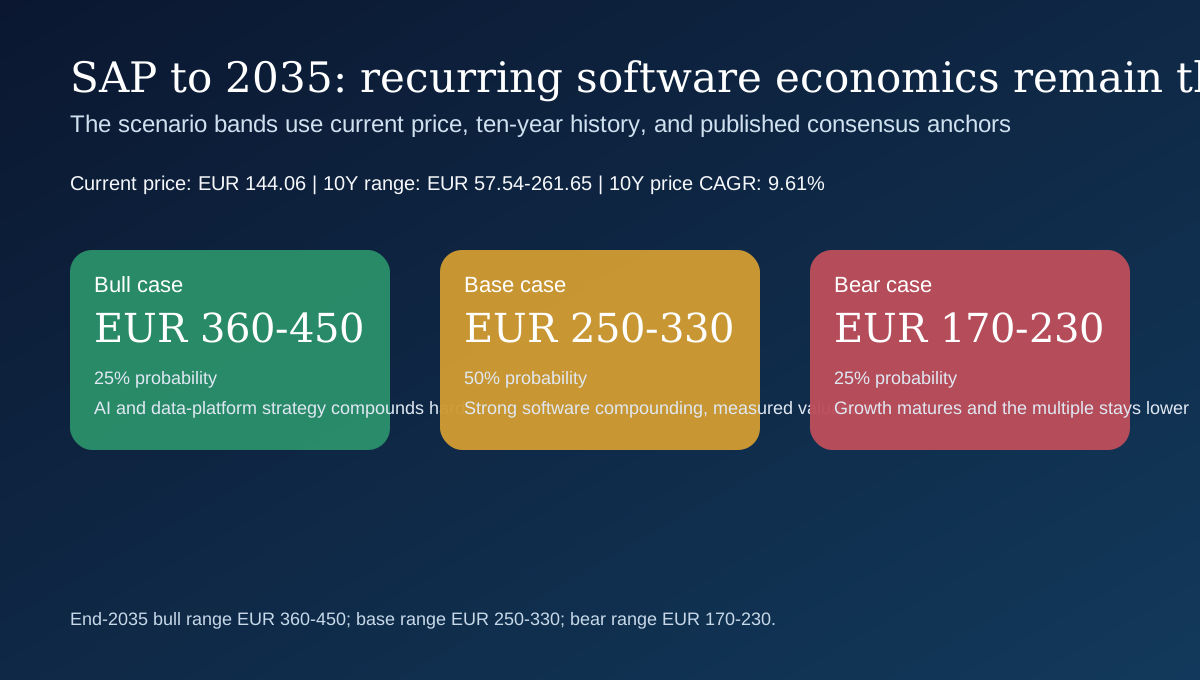
The base case assumes SAP compounds well from here, but with valuation discipline. The bull case assumes the company wins more of the enterprise AI stack than the market currently prices.
| Scenario | Probability | Trigger | Review date | Target range |
|---|---|---|---|---|
| Bull case | 25% | Cloud, data, and AI platform monetization remain strong through the early 2030s | Annual results through 2030-2034 | EUR 360-450 |
| Base case | 50% | SAP compounds from a large recurring base with a solid but measured valuation | Annual results through 2030-2034 | EUR 250-330 |
| Bear case | 25% | Growth matures, valuation stays constrained, and AI remains only modestly accretive | Annual results through 2030-2034 | EUR 170-230 |
References
Sources
- Yahoo Finance chart API for SAP.DE 10-year price history and latest market data
- SAP Q1 2026 results, published April 23, 2026
- SAP Q4 and FY 2025 results, published January 29, 2026
- SAP Integrated Report 2025 five-year summary, including 2025 basic EPS
- SAP company-published consensus estimates, last update April 22, 2026
- SAP recent results page with 2026 outlook corridor and backlog commentary
- StockAnalysis valuation page for SAP, used for trailing and forward multiple cross-checks