01. Historical Context
Shell in context: price discipline matters more than a heroic rerating call
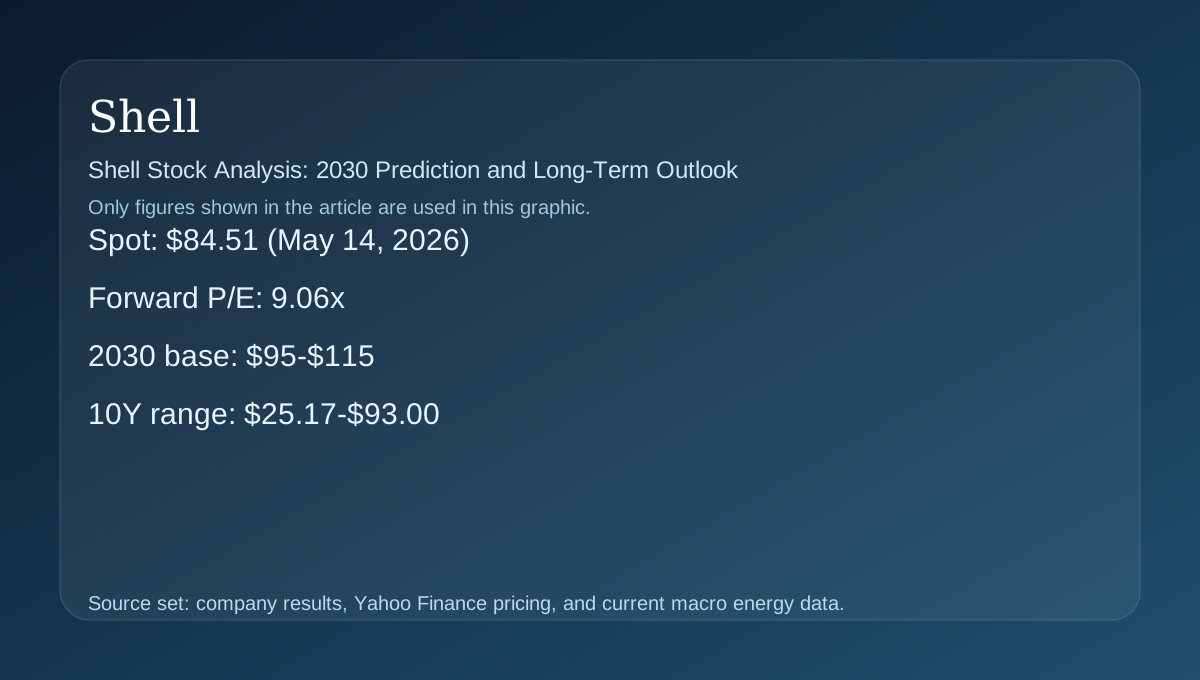
Shell closed at $84.51 on May 14, 2026, which leaves it 9.1% below the 10-year high of $93.00. Price-only, the stock moved from $55.22 on June 1, 2016 to today's level, a 4.4% annualized gain, while still experiencing a 10-year drawdown zone down to $25.17. That history argues against treating the shares as stable compounders in the way investors might treat a software platform or a consumer monopoly. These remain capital-intensive energy businesses whose equity value can move a lot faster than their operating assets.
The current setup is stronger than the generic templates these pages previously used because it now starts with real operating data. Q1 2026 adjusted earnings of $6.9 billion came with adjusted EBITDA of $17.7 billion, cash flow from operations excluding working-capital movements of $17.2 billion, and a new $3.0 billion buyback. Just as important, management reported gearing at 23.2% and net debt at $52.6 billion and upstream and integrated gas production of 2,752 kboe/d. Shell still looks like a cash-return compounder first and a multiple-expansion story second.
The valuation anchor is straightforward. Yahoo Finance currently shows 9.06x forward earnings, 13.16x trailing earnings, and forward EPS of $9.33 against trailing EPS of $6.42. That implies a large rebound is already embedded in current expectations. The stock is no longer cheap enough for investors to ignore execution, but it still sits below the Street high target and below its 10-year peak.
| Horizon | What matters most | What would strengthen the thesis | What would weaken the thesis |
|---|---|---|---|
| 1-3 months | Oil, gas, and inflation headlines | EIA keeps Brent near or above $106 | Energy shock fades quickly and rates stay restrictive |
| 6-18 months | Quarterly cash delivery | With the Street mean target at $99.59 and forward EPS at $9.33, the easiest route to upside is steady execution rather than a dramatic rerating. | Shell remains materially exposed to LNG and refining spreads, so a softer gas market can offset otherwise healthy headline oil prices. |
| To 2030 | Cash returns and normalized oil pricing | Brent normalizes into the $80-$95 range, buybacks remain active, and forward P/E stays around 8x-10x. | Brent falls below $75 for a full quarter, buybacks are reduced, or sticky inflation keeps core PCE above 3% into late 2026. |
02. Key Forces
Five forces that actually decide the medium-term equity case
The first force is still the commodity tape. EIA's May 12, 2026 Short-Term Energy Outlook placed Brent near $106 for May and June after an April average of $117. That is an obvious cash-flow tailwind for Shell, but it is not a permanently capitalizable number. If this stays an event premium rather than a structural deficit, the stock can enjoy stronger quarterly results without necessarily earning a durable rerating.
The second force is the valuation bridge between trailing earnings and forward earnings. At 9.06x forward P/E and 13.16x trailing P/E, the market is clearly paying for some normalization. Forward EPS of $9.33 versus trailing EPS of $6.42 implies a rebound of roughly 45.4%. That is reasonable for a cyclical major, but it also means the next disappointment matters more than it would in a deep-value setup.
The third force is capital returns. A 3.7% dividend yield matters because it cushions total return if the price stalls. It matters even more when combined with buybacks and balance-sheet discipline. For this group, equity performance improves meaningfully when management can keep dividends, buybacks, and capex in balance without levering up into a weaker oil tape.
The fourth force is business mix. Shell still benefits from a relatively balanced portfolio across LNG, upstream, chemicals, marketing, and trading. That mix reduces single-segment risk, but it also means the stock does best when more than one cash engine is working at the same time.
The fifth force is macro policy. April CPI at 3.8% year over year and March core PCE at 3.2% year over year tell investors that inflation has not vanished. That keeps the discount-rate conversation alive. Even if Shell posts good quarters, higher-for-longer real rates can still cap multiple expansion.
| Factor | Latest data | Current Assessment | Bias | Why it matters |
|---|---|---|---|---|
| Valuation | $84.51 spot, 9.06x forward P/E, Street mean target $99.59 | Still reasonable, but no longer ignored | Neutral to Bullish | Low multiples still help, but the rerating headroom is narrower than it was near the 2020-2022 trough. |
| Commodity tape | EIA sees Brent at $106 in May-June; IEA sees 2026 demand at 104.0 mb/d | Supportive but event-driven | Bullish | Higher realized liquids and gas prices remain the fastest route to upside for all three names. |
| Inflation and rates | April CPI 3.8% YoY, March core PCE 3.2% YoY | Still restrictive for multiples | Bearish | Sticky inflation keeps equity discount rates elevated and limits how much rerating energy equities deserve. |
| Current earnings quality | Forward EPS $9.33, trailing EPS $6.42, implied forward uplift 45.4% | Improving, but cyclically sensitive | Neutral | Consensus still expects a notable EPS rebound, so execution has to confirm the estimate path. |
| Capital returns | Q1 2026 included a $3.0 billion buyback, 3.7% dividend yield, and 23.2% gearing | Well-funded | Bullish | Shell can still support the stock through buybacks as long as cash flow does not fall sharply. |
03. Countercase
What would break the base case
The first risk is macro, not company-specific. April CPI rose 3.8% from a year earlier, core CPI was 2.8%, and March core PCE was still 3.2%. Those readings are far below the inflation panic phase, but they are still high enough to keep central banks from handing investors an easy discount-rate tailwind.
The second risk is that current oil support is too temporary. The IEA's May 15, 2026 Oil Market Report cut 2026 demand by -420 kb/d and still saw supply rising to 102.2 mb/d. If the geopolitical premium fades before earnings estimates adjust, Shell could lose the cash-flow uplift that is helping sentiment today.
The third risk is company execution. Shell remains materially exposed to LNG and refining spreads, so a softer gas market can offset otherwise healthy headline oil prices. That does not require a disaster. It only requires enough evidence that earnings normalization is slower than the market expects.
| Risk | Latest data point | Current Assessment | Bias |
|---|---|---|---|
| Rates stay restrictive | CPI 3.8% YoY and core PCE 3.2% YoY | Real-rate risk is still live | Bearish |
| Oil shock reverses | EIA's disruption case has Brent at $106 near term; a reversal toward sub-$80 would cut cash flow support | Two-way risk, not a one-way tailwind | Neutral |
| Consensus is too high | Forward EPS of $9.33 versus trailing EPS of $6.42 | Rebound is already embedded | Neutral to Bearish |
| Company-specific execution | Shell remains materially exposed to LNG and refining spreads, so a softer gas market can offset otherwise healthy headline oil prices. | Needs monitoring each quarter | Neutral |
04. Institutional Lens
What current institutional data says now
The cleanest macro anchor is still the IMF. In the April 14, 2026 World Economic Outlook, the IMF projected global growth of 3.1% in 2026 and 3.2% in 2027. That is slow enough to argue against exuberance, but not weak enough to imply a default recession call for oil demand.
Energy-specific institutions currently disagree on persistence, not on the fact of tightness. The EIA's May 12, 2026 STEO held Brent near $106 in the near term after an April average of $117. One week later, the IEA cut its 2026 demand view by -420 kb/d to 104.0 mb/d and still saw supply rising to 102.2 mb/d. The implication is clear: elevated spot pricing helps today's quarterly numbers, but investors should not blindly annualize the current shock regime into 2030 or 2035.
The company-specific read-through comes from current filings and current consensus. Q1 2026 adjusted earnings of $6.9 billion on May 7, 2026 gave investors a real operating checkpoint, while Yahoo Finance still shows a mean target of $99.59. That combination supports a constructive but not careless stance. With the Street mean target at $99.59 and forward EPS at $9.33, the easiest route to upside is steady execution rather than a dramatic rerating.
| Source | Updated | What it said | Read-through for Shell |
|---|---|---|---|
| IMF | April 14, 2026 | Global growth at 3.1% for 2026 and 3.2% for 2027 | No hard-landing base case, but no excuse for aggressive multiple expansion either. |
| EIA | May 12, 2026 | Brent averaged $117 in April and is seen near $106 in May-June under the disruption case | The oil tape is helpful now, but not a stable long-term valuation anchor. |
| IEA | May 15, 2026 | 2026 oil demand forecast cut by -420 kb/d to 104.0 mb/d; supply seen rising to 102.2 mb/d | Current price support is geopolitical and can reverse quickly if disruptions ease. |
| Shell | May 7, 2026 | Q1 2026 adjusted earnings of $6.9 billion, adjusted EBITDA of $17.7 billion, cash flow from operations excluding working-capital movements of $17.2 billion, and a new $3.0 billion buyback, and gearing at 23.2% and net debt at $52.6 billion | Company execution is still the decisive differentiator once the oil shock normalizes. |
| Yahoo Finance consensus | May 14, 2026 | Mean target $99.59, low target $78.00, high target $122.00 | The Street still sees upside, but the range stays wide enough to justify scenario sizing. |
05. Scenarios
Actionable 2030 scenarios
The base case remains the most practical one: Shell is more likely to deliver moderate price appreciation plus large cash returns than a dramatic rerating. That is why the 2030 base-case range is $95-$115, not a triple-digit moonshot divorced from current valuation discipline.
For investors already long, the main job is to separate cash-return durability from oil-price euphoria. For new money, it makes more sense to size entries around confirmed quarterly cash delivery than around a single geopolitical oil spike.
| Scenario | Probability | Measured trigger | Target range | When to review |
|---|---|---|---|---|
| Bull | 25% | Brent holds above $95 for at least two monthly EIA updates, Shell keeps quarterly buybacks at or above $3.0 billion, and gearing stays below 25%. | $120-$145 | Recheck after Q3 2026 results and the October 2026 IMF WEO. |
| Base | 50% | Brent normalizes into the $80-$95 range, buybacks remain active, and forward P/E stays around 8x-10x. | $95-$115 | Recheck after each quarterly buyback authorization and monthly EIA updates. |
| Bear | 25% | Brent falls below $75 for a full quarter, buybacks are reduced, or sticky inflation keeps core PCE above 3% into late 2026. | $70-$85 | Invalidate the base case if buybacks shrink materially or leverage rises. |
References
Sources
- Yahoo Finance quote page for Shell
- Yahoo Finance 10-year chart API for Shell
- Shell Q1 2026 quarterly results PDF
- Shell Annual Report and Accounts 2025
- IMF World Economic Outlook
- U.S. EIA Short-Term Energy Outlook
- IEA Oil Market Report - May 2026
- BLS Consumer Price Index, April 2026
- BEA Personal Income and Outlays, March 2026