01. Historical Context
Siemens in context: why the 2027 call is mostly about the next guidance cycle
The base case is straightforward: Siemens still has enough operating evidence to justify a constructive stance, but the return path depends on whether execution continues to outrun a tougher macro backdrop. Recent price action matters only because it now sits on top of specific, checkable numbers rather than on a vague story.
As of May 13, 2026, recent Yahoo Finance quote pages showed Siemens around EUR 266.35, with a 52-week range of EUR 198.00 to EUR 275.75. The longer context is important too. MarketScreener's ten-year range snapshot put the stock between EUR 58.77 to EUR 275.75, which is why the next move should be judged against long-cycle valuation discipline, not just the last quarter.
| Horizon | What matters most | What would strengthen the thesis | What would weaken the thesis |
|---|---|---|---|
| 1-3 months | Q2 FY2026 execution, backlog quality, and valuation discipline | Orders stay above revenue, the book-to-bill ratio holds above 1.1, and the stock consolidates near highs instead of failing at them | A margin miss in Mobility or Smart Infrastructure, or a fast de-rating after Germany and euro area inflation stay sticky |
| 6-18 months | Whether software, electrification, and AI-linked demand sustain high-quality earnings | Digital Industries keeps margin above 17%, Smart Infrastructure keeps record order intake translating into revenue, and EPS tracks the EUR 10.70-EUR 11.10 FY2026 guide | The software cycle fades, tariffs keep biting Mobility, or the market refuses to pay mid-20s earnings multiples |
| To 2030/2035 | Compounding of software, infrastructure, and industrial AI | Revenue growth stays near the 6%-8% FY2026 group corridor and AI monetization improves the mix | Execution stays good but multiples compress toward the high teens |
02. Key Forces
The catalysts that matter between now and 2027
The first question is valuation. Siemens does not trade in a vacuum. The market is already expressing a view about the durability of earnings through today's multiple, and that multiple must be reconciled with current guidance, not with optimistic language. Recent Yahoo Finance statistics placed the stock near 26.5x trailing earnings and 24.5x forward earnings.
The second question is whether macro conditions are helping or hurting the next leg. ECB staff projections from March 2026 still point to euro area GDP growth of 0.9% in 2026, while Eurostat's flash estimate showed euro area inflation at 3.0% in April 2026. That is not recessionary, but it is not a clean disinflation backdrop either.
The third question is quality of execution. A stock can absorb macro noise when orders, margins, and cash conversion keep beating expectations. It struggles when investors have to defend the thesis with adjectives instead of data.
| Factor | Current Assessment | Bias | What the latest data says |
|---|---|---|---|
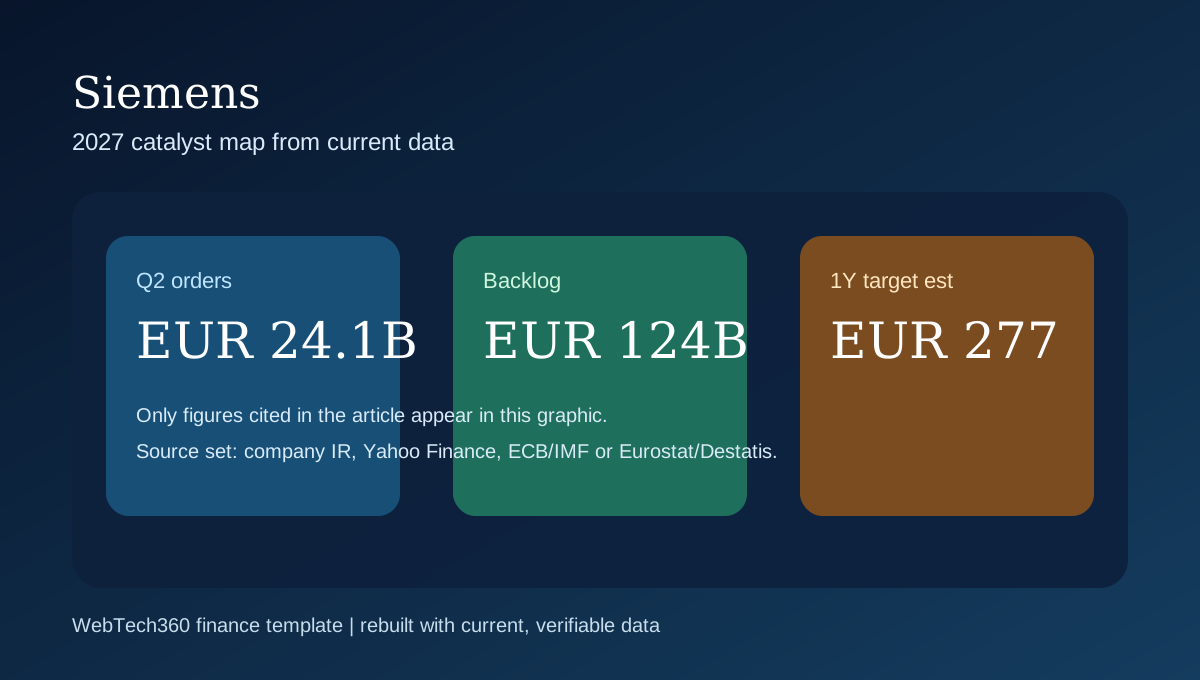
| Demand visibility | Improving | Bullish | Q2 FY2026 orders rose to EUR 24.1 billion and backlog reached a record EUR 124 billion. |
| Valuation | Full but supported by execution | Neutral | Recent Yahoo Finance snapshots put Siemens around 26.5x trailing and 24.5x forward earnings. |
| Cash generation | Strong | Bullish | Group free cash flow rose to EUR 1.7 billion in Q2 FY2026 and reached a record EUR 10.8 billion in fiscal 2025. |
| AI and software mix | Positive | Bullish | H1 FY2026 digital business growth was 19%, software ARR reached EUR 5.5 billion, and Siemens is deploying EUR 1 billion into industrial AI. |
| Macro and rates | Still a live constraint | Neutral | Euro area inflation printed 3.0% in April 2026, while ECB staff still expect 0.9% GDP growth for 2026. |
03. Countercase
The near-term risks that would invalidate the 2027 thesis
The main bearish case is not that the business suddenly stops working. It is that the market asks for a lower multiple at the same time that one or two operating lines soften. When inflation stops falling cleanly and investors have already paid up for a good story, the downside can come from valuation first and fundamentals second.
The other risk is timing. Guidance is only useful if investors trust that it still fits the environment. That trust usually weakens quickly once tariffs, input costs, or regional demand stop behaving the way management assumed at the beginning of the year.
| Risk | Latest data point | Why it matters now |
|---|---|---|
| Multiple compression | Germany CPI was 2.9% in April 2026 and euro area inflation 3.0%. | If inflation stays sticky, Siemens can keep growing while the stock still de-rates from mid-20s P/E. |
| Tariff exposure | Mobility margin fell to 6.9% from 9.1% in Q2 FY2026 due mainly to U.S. tariff impacts. | A broader tariff pass-through would hit the most operationally leveraged part of the story. |
| Execution slippage | FY2026 guidance still assumes 6%-8% comparable revenue growth and EPS pre PPA of EUR 10.70-EUR 11.10. | A miss versus that corridor would be punished because the shares are already near the 52-week high. |
| Acquisition integration | ROCE fell to 13.0% in Q2 FY2026 as capital employed rose after Altair and Dotmatics. | If integration costs last longer than expected, quality of growth matters more than top-line growth. |
04. Institutional Lens
Which current data points matter most for a 2027 prediction
The institutional picture is clearest when sources are separated. IMF and ECB publications define the macro corridor. Company releases define what management is actually delivering. Market data services such as Yahoo Finance define what investors are already pricing.
For Siemens, the numbers currently point to a market that is neither blind nor complacent. The stock is not priced as a distressed asset. It is also not priced for perfection in the same way a hyper-growth software name might be. That is why scenario analysis remains more useful than a single heroic target.
| Source | Updated | What it says | Type |
|---|---|---|---|
| Siemens | May 13, 2026 | Q2 FY2026 orders EUR 24.1 billion, book-to-bill 1.22, backlog EUR 124 billion, EPS pre PPA EUR 2.81; FY2026 EPS guide kept at EUR 10.70-EUR 11.10. | Company release |
| Yahoo Finance | May 2026 snapshots | Recent market snapshots showed Siemens around EUR 266.35, trailing P/E near 26.5x, forward P/E near 24.5x, and a 1-year target estimate of EUR 277.12. | Market data and analyst consensus |
| Siemens Annual Report | Fiscal 2025 | Revenue EUR 78.9 billion, net income EUR 10.4 billion, EPS pre PPA EUR 12.95, and free cash flow EUR 10.8 billion. | Annual report |
| ECB | March 2026 projections | Euro area GDP growth 0.9% in 2026 and headline inflation 2.6% in 2026. | Macro baseline |
| IMF | April 2026 WEO | Global growth projected at 3.1% in 2026. | Global macro baseline |
05. Scenarios
2027 scenarios with probabilities, triggers, and review dates
The useful 2027 question is not whether the stock is good in theory. It is whether the next handful of earnings releases can keep the market inside a constructive valuation range.
That makes current price and current valuation critical. A stock at EUR 266.35 with today's multiple can still go higher, but only if the next year of evidence stays consistent with the thesis.
| Scenario | Probability | Target range / outcome | Trigger | When to review |
|---|---|---|---|---|
| Bull | 25% | EUR 300-EUR 330 | Orders, margins, and cash conversion all hold above current company targets or trends. | Review after the next two full-year earnings cycles. |
| Base | 50% | EUR 270-EUR 300 | Operating delivery is acceptable but not spectacular, and valuation stays close to the current band. | Revisit after each quarterly result and after any guidance reset. |
| Bear | 25% | EUR 220-EUR 255 | Guidance is cut, inflation stays sticky, or regional demand weakens enough to trigger de-rating. | Immediate review if management changes the year-end outlook. |
References
Sources
- Yahoo Finance quote for Siemens (current price, 52-week range, target estimate)
- Yahoo Finance statistics snapshot for Siemens (valuation measures as of May 2026)
- Siemens Q2 FY2026 earnings release PDF
- Siemens Annual Report 2025
- Siemens industrial AI launch: Eigen Engineering Agent
- IMF World Economic Outlook, April 2026
- ECB staff macroeconomic projections for the euro area, March 2026
- Eurostat flash inflation for April 2026
- Destatis Germany CPI for April 2026
- MarketScreener Siemens quote page (10-year trading range snapshot)