01. Historical Context
A 2035 silver forecast should be built from ranges, not from point optimism
Silver has already moved from a June 2016 monthly close near $18.58 to a latest 10-year monthly close near $77.55, but that history should be a warning against naive compounding. The 10-year monthly-close range from Yahoo Finance spans about $14.09 to $77.55, while the recent daily range has already reached as high as $115.08. A credible 2035 outlook has to assume multiple full cycles in between.
| Horizon | What matters most | Current assessment | What would strengthen the thesis | What would weaken the thesis |
|---|---|---|---|---|
| 1-2 years | Inflation and physical tightness | Mixed because volatility is still extreme | Disinflation resumes while deficits remain visible | Another macro tightening phase |
| 2028-2031 | Industrial demand breadth | Potentially constructive if demand broadens beyond PV | AI, electronics, grid, and autos become larger demand anchors | Substitution keeps undermining the growth story |
| To 2035 | Long-cycle scarcity and investor demand | Constructive but cyclical | Repeated deficit years and structurally lower real rates | Supply catches up and monetary demand fades |
The 2035 horizon is long enough that the current macro regime will change more than once. That is why the forecast is better framed as a distribution. The metal may well spend time far above or below the base-case band before 2035, but the quality of the thesis should still be judged by deficits, industrial composition, and the cost of holding non-yielding assets.
02. Key Forces
Five structural drivers behind the 2035 bull, base, and bear cases
First, persistent deficits are the main reason silver deserves a higher long-run range than it had in the late 2010s. The Silver Institute's April 15, 2026 update forecasts a 46.3 Moz deficit in 2026 after a fifth consecutive deficit year in 2025. A long string of deficit years can support higher prices over time even if the path remains disorderly.
Second, industrial demand must keep reinventing itself. The 2025 industrial-demand print of 657.4 Moz was weaker than many silver bulls wanted, and the 2026 forecast still points lower because of PV thrifting and substitution. For the 2035 bull case to work, newer uses such as electronics, AI-related infrastructure, data-center power systems, power-grid upgrades, and automotive electrification have to become large enough to matter on their own.
Third, long-run macro policy still matters. April 2026 CPI was 3.8%, March 2026 PCE was 3.5%, and BEA's Q1 2026 GDP release showed PCE inflation running at a 4.5% annualized pace in the quarter. Those data are why the market still cannot assume a permanently low-rate environment. The 2035 upside case improves materially if inflation normalizes over the next several years rather than staying structurally sticky.
Fourth, silver remains partly a monetary trade. The gold-silver ratio near 59 on May 15, 2026 is healthier for silver than the extreme stress ratios seen in prior crises, but it also means a large part of the easy relative catch-up has already happened. Future outperformance needs fresh catalysts, not just a memory of past undervaluation.
Fifth, volatility should be treated as structural, not temporary. The World Bank's April 2026 report highlighted silver's 55% quarter-over-quarter jump in 2026Q1 and the subsequent sharp pullback. That kind of behavior is more consistent with a long-cycle trading asset than with a steadily compounding one.
| Factor | Why it matters | Current assessment | Bias | Bullish read | Bearish read |
|---|---|---|---|---|---|
| Physical balance | Long deficit runs support a higher floor | Supportive with a 46.3 Moz 2026 deficit forecast | Bullish | Deficits keep extending into the next cycle | Supply finally catches up |
| Industrial breadth | Prevents silver from relying on one use-case | Mixed because PV substitution is still a headwind | Neutral | New end-markets scale meaningfully | Demand concentration remains fragile |
| Macro inflation | Determines real-rate pressure | Still restrictive at current CPI and PCE levels | Bearish | Inflation trends lower over time | Inflation remains structurally sticky |
| Relative price | Signals whether silver still has catch-up room | Ratio near 59 is constructive but no longer extreme | Neutral | Ratio compresses further toward the low-50s | Ratio snaps back above 70 |
| Volatility regime | Affects drawdowns and entry quality | High after 2025-2026 | Neutral | Volatility declines without destroying price support | Each cycle peak ends in deeper de-risking |
The 2035 story is therefore not a simple “more demand equals much higher price” equation. It is a regime call on how much scarcity survives once substitution, recycling, and policy cycles all play out.
03. Countercase
What could keep silver from sustaining a major long-term rerating
The first risk is that the market overstates how rare silver really is at high prices. Elevated prices incentivize recycling, substitution, and mine investment. The Silver Institute already expects recycling to stay strong, and it has explicitly tied PV weakness to raw-material cost pressure and substitution.
The second risk is that inflation remains too firm for too long. With April 2026 CPI at 3.8% and March 2026 PCE at 3.5%, the market still lacks proof that the next decade will be a low-real-rate environment. If that proof never comes, silver may remain strategically relevant without ever holding the top end of the bull range.
Third, industrial demand may stay strong in narrative terms but weak in net terms. AI and grid spending are real, yet the Silver Institute's 2025 data and 2026 outlook show that those supports have not fully offset PV weakness so far. A long-term forecast has to respect that evidence.
| Investor type | Main risk | Suggested posture | What to monitor next |
|---|---|---|---|
| Already profitable | Turning a cyclical winner into a permanent thesis | Scale out on extreme spikes and re-underwrite the thesis annually | Deficit trend, recycling, and inflation regime |
| Currently losing | Using the 2035 horizon to justify any entry price | Separate long-run conviction from short-run risk | Whether physical data keep supporting the thesis |
| No position | Buying long-term optionality at short-term euphoric prices | Build only in tranches and after macro resets | Gold-silver ratio and annual demand composition |
A long horizon should reduce emotional trading, not eliminate analytical discipline.
04. Institutional Lens
What current institutional work implies for a 2035 forecast
For a 2035 silver view, the important named sources are the ones that measure the macro corridor and the physical market directly. The IMF's April 14, 2026 forecast keeps global growth positive but fragile. The Silver Institute's April 15, 2026 survey release keeps the market in deficit and confirms that 2025 demand still reached 1.13 billion ounces even after a weaker industrial print. The World Bank's April 2026 commodity outlook shows how violent price swings can become when tight supply meets speculative demand.
LBMA's 2026 analyst commentary is also useful because it shows how wide professional disagreement remains even at a one-year horizon. Analysts were looking for a 2026 average around $79.57, but with highs stretching as far as $160. If one-year dispersion is that wide, a 2035 point target is largely cosmetic. Range-based thinking is simply more honest.
| Source | Latest update | What it says | Why it matters here |
|---|---|---|---|
| IMF | April 14, 2026 | Growth stays positive but downside risks dominate | Long-term silver needs growth without a policy accident |
| Silver Institute | April 15, 2026 | 2026 deficit forecast 46.3 Moz after 2025 demand of 1.13 Boz | Supports a structurally higher long-run band |
| World Bank | April 2026 | Silver rose 55% q/q in 2026Q1 and remained highly volatile | Confirms the asset's long-run path will not be smooth |
| LBMA | January-March 2026 commentary | Average 2026 silver forecast $79.57 with very wide highs | Professional dispersion remains exceptionally large |
The institutional message is not that silver cannot reach very high numbers by 2035. It is that the path will matter as much as the endpoint, and the data still argue for ranges instead of certainty.
05. Scenarios
Probability-weighted scenarios into 2035
Because the horizon is long, the review process matters more than the first guess. These ranges should be revisited after every annual Silver Institute survey, after major IMF and World Bank macro revisions, and whenever the gold-silver ratio or inflation regime changes materially.
| Scenario | Probability | Trigger conditions | 2035 target range | Next review point |
|---|---|---|---|---|
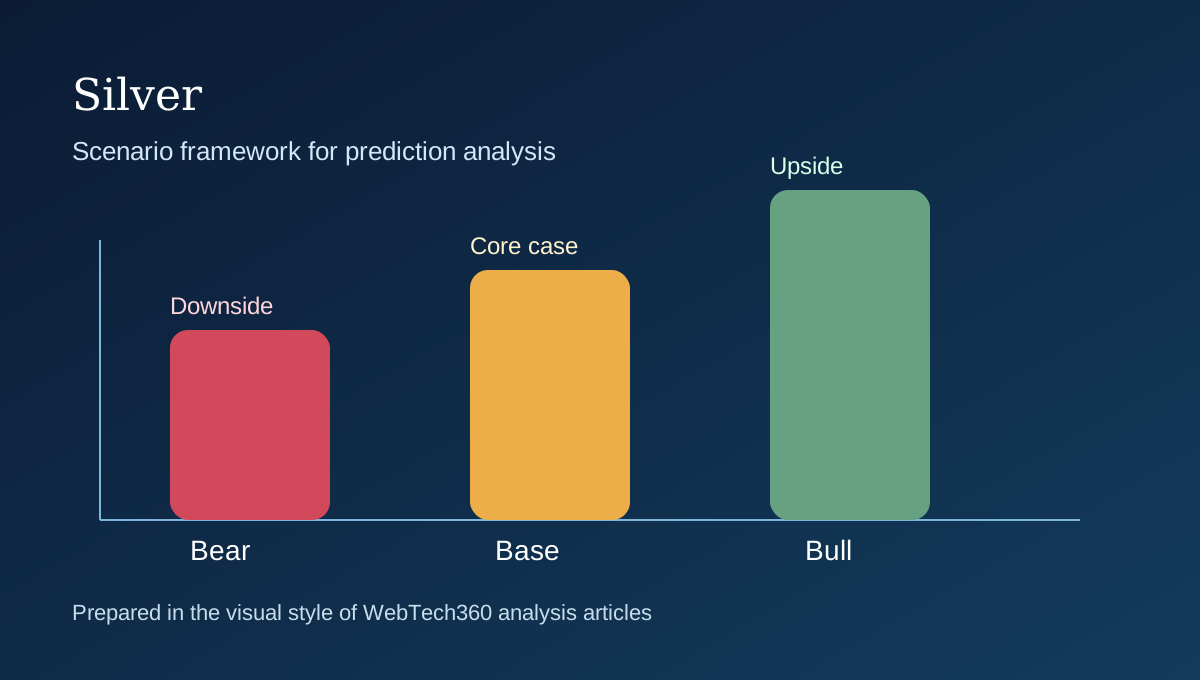
| Bull case | 20% | Deficits persist through multiple cycles, new industrial uses scale, inflation normalizes, and the monetary bid remains strong | $160-$240 | Review after each annual supply-demand update and macro regime change |
| Base case | 55% | Silver stays strategically important, but substitution and policy cycles cap the rate of rerating | $105-$155 | Review yearly, with interim checks on inflation and relative valuation |
| Bear case | 25% | Supply response, recycling, substitution, and higher real rates keep silver in a wide but flatter regime | $55-$95 | Review immediately if deficit years end or the ratio trends back above 70 for a prolonged period |
The base case is deliberately less dramatic than many retail silver narratives. That is not a bearish call. It is an attempt to respect both the structural tightness and the metal's history of giving back large gains when macro conditions turn.
References
Sources
- Yahoo Finance quote page for Silver futures (SI=F)
- Yahoo Finance 10-year chart data endpoint for Silver futures
- Silver Institute, World Silver Survey 2026 release, April 15, 2026
- Silver Institute 2026 market outlook, February 10, 2026
- IMF World Economic Outlook, April 2026
- U.S. Bureau of Labor Statistics CPI release for April 2026, published May 12, 2026
- U.S. BEA Personal Consumption Expenditures Price Index
- World Bank Commodity Markets Outlook, April 2026
- LBMA Alchemist summary of the 2026 Precious Metals Forecast Survey