01. Historical Context
Silver is entering 2027 from a high-volatility, high-conviction setup
Silver is not cheap or expensive in the same way as an equity because it has no earnings stream, so trailing P/E, forward P/E, EPS estimates, and EPS growth do not exist for the metal itself. The cleaner starting point is price, relative price, and physical balance. Yahoo Finance monthly data show silver at about $18.58 in June 2016 and about $77.55 in the latest 10-year monthly close, a roughly 15.4% annualized gain from a low base, while the 10-year monthly-close range runs from about $14.09 to $77.55. Daily data show a much wider two-year band, from about $26.83 to $115.08, which is the better reminder of how violently silver can reprice.
| Horizon | What matters most | Current assessment | What would strengthen the thesis | What would weaken the thesis |
|---|---|---|---|---|
| 1-3 months | Inflation, dollar, positioning | Volatile neutral after the May 2026 pullback | CPI and PCE cool while silver holds $75-$80 | Another inflation surprise and a break below $75 |
| 6-18 months | Physical deficit and real rates | Constructive but not clean | Deficit stays above 40 Moz and real rates stop rising | Industrial demand keeps falling and the deficit shrinks sharply |
| To 2027 | Macro regime and inventory tightness | Base case is higher than pre-2025, not straight-line bullish | Broader precious-metals demand and stable growth | Sticky inflation, firmer dollar, and a re-rating lower |
The macro backdrop is not trivial. The IMF's April 14, 2026 World Economic Outlook projects global growth of 3.1% in 2026 and 3.2% in 2027, but with downside risks dominant. That matters because silver trades partly like a precious metal and partly like an industrial input. It usually performs best when growth avoids a hard landing while inflation pressure eases enough to cap real yields.
The short version is that silver already had its easy re-pricing. From here, 2027 upside needs fresh evidence rather than a repeat of the January squeeze. That is why the range for 2027 is wide, but still narrower than the market's most emotional narratives imply.
02. Key Forces
Five forces that matter most for the path to 2027
First, the physical market is still supportive. The Silver Institute said on April 15, 2026 that 2025 was the fifth consecutive deficit year and that 2026 is expected to remain in deficit by 46.3 million ounces. That is smaller than the preliminary 67 Moz estimate the Institute published on February 10, 2026, but it still means the market is relying on above-ground stocks rather than on fresh supply alone.
Second, demand quality is mixed. The same April 15, 2026 Silver Institute update said total silver demand fell 2% in 2025 to 1.13 billion ounces and industrial demand fell 3% to 657.4 Moz. The problem area is photovoltaic thrifting and substitution, while support is coming from AI infrastructure, automotive demand, electrical applications, and grid investment. Into 2027, silver does not need perfect industrial demand, but it does need the non-PV uses to keep offsetting the slowdown in solar loading.
Third, inflation is still a live constraint. The BLS reported on May 12, 2026 that April CPI rose 3.8% year over year and core CPI rose 2.8%. BEA's latest monthly release shows the March 2026 PCE price index at 3.5% year over year, and BEA's advance GDP release showed the Q1 2026 annualized PCE inflation rate at 4.5%. Silver can tolerate inflation when it helps safe-haven demand, but persistently high inflation also raises the risk of tighter policy and higher real yields.
Fourth, relative valuation still matters even without earnings metrics. On May 15, 2026 the gold-to-silver ratio using Yahoo Finance futures closes was about 59.0, well below the triple-digit readings seen during stress periods but not yet at an extreme that automatically argues for mean reversion. For silver, relative valuation is better read through that ratio, inventory tightness, and how far price has moved from the prior cycle base than through any earnings multiple.
Fifth, price volatility has become part of the thesis. The World Bank said in its April 2026 Commodity Markets Outlook that silver prices leapt 55% quarter over quarter in 2026Q1, reached record levels in January, and then fell back sharply. That kind of move can signal scarcity and investor urgency, but it also means the path to 2027 is likely to be range-based rather than smooth.
| Factor | Why it matters | Current assessment | Bias | Bullish read | Bearish read |
|---|---|---|---|---|---|
| Physical balance | Deficits tighten available metal | 2026 deficit forecast at 46.3 Moz | Bullish | Deficit persists and inventories keep tightening | Deficit shrinks faster than expected |
| Industrial demand | Supports silver's non-monetary bid | Mixed after 2025 industrial demand fell to 657.4 Moz | Neutral | AI, electronics, autos, and grid demand offset PV weakness | PV substitution dominates and demand slips again |
| Inflation and rates | Drive the opportunity cost of holding silver | April CPI 3.8%, March PCE 3.5% | Bearish | Disinflation resumes and real rates ease | Sticky inflation keeps policy tight |
| Relative valuation | Gold-silver ratio signals stretch or catch-up | Ratio near 59 on May 15, 2026 | Neutral | Ratio stays under 65 as silver keeps leadership | Ratio snaps back above 70 |
| Price action | Shows whether buyers still absorb volatility | Very volatile after January spike | Neutral | Price stabilizes above $75 and reclaims $85 | Break below $75 turns into trend damage |
None of these forces should be read in isolation. Silver can rally with mediocre industrial data if monetary demand accelerates, and it can fall despite a deficit if real rates rise faster than the physical market tightens. The 2027 call therefore has to stay conditional.
03. Countercase
What would break the 2027 thesis
The first risk is that inflation stays too hot for too long. April 2026 CPI at 3.8% and March 2026 PCE at 3.5% are not recessionary numbers, but they are also not low enough to guarantee a durable drop in real yields. If that pattern continues through the second half of 2026, silver can remain volatile and struggle to hold high-$70s pricing.
The second risk is that the industrial side does not re-accelerate. The Silver Institute's April 2026 data already show industrial demand down 3% in 2025 and expect another decline in 2026 because photovoltaic demand is being hit by thrifting and substitution. If AI, power-grid, electronics, and auto demand prove too small to offset that weakness, silver's hybrid precious-industrial identity becomes less helpful.
Third, volatility can turn into de-risking. Silver closed at $88.89 on May 13, 2026 and $77.16 on May 15, 2026 in Yahoo Finance daily data. A market that can lose more than $11 in two sessions can easily overshoot both ways. If the next leg lower takes the gold-silver ratio back above 70, that would suggest investors are rotating back toward gold rather than staying committed to silver.
Fourth, the deficit itself is not a guaranteed price floor. The February 2026 Silver Institute update used a 67 Moz 2026 deficit estimate, but the April 15, 2026 update revised the expected 2026 deficit to 46.3 Moz. That is still supportive, yet it is a reminder that the market can stay tight without justifying the most aggressive bull narratives.
| Investor type | Main risk | Suggested posture | What to monitor next |
|---|---|---|---|
| Already profitable | Giving back gains after a volatility spike | Reduce size if silver loses $75 and the ratio rises | CPI, PCE, and the next Silver Institute update |
| Currently losing | Averaging into a macro-driven drawdown | Add only if inflation cools and price stabilizes | Real rates, dollar strength, and $70 support |
| No position | Buying into unresolved volatility | Wait for either a cleaner macro setup or a capitulation washout | Monthly inflation data and whether $85 is reclaimed |
The key discipline is to distinguish between a structurally bullish metal and a tactically poor entry. Silver can still have a constructive 2027 outlook even if the next several months remain messy.
04. Institutional Lens
What the current institutional evidence actually says
The IMF updated its macro baseline on April 14, 2026 and projected 3.1% global growth in 2026 and 3.2% in 2027, while stressing that downside risks dominate. That is a modestly constructive backdrop for silver because it allows industrial demand to stay alive, but it is not strong enough to ignore policy risk.
The Silver Institute's April 15, 2026 World Silver Survey release is the clearest physical-market input. It said 2025 total silver demand was 1.13 billion ounces, industrial demand was 657.4 Moz, and the market remained in deficit for a fifth straight year. For 2026, it expects the deficit to continue at 46.3 Moz. Its earlier February 10, 2026 market outlook had pointed to a 67 Moz deficit, so the April update should be treated as the more current figure.
The World Bank added the volatility context in its April 2026 Commodity Markets Outlook, stating that silver prices jumped 55% quarter over quarter in 2026Q1, reached record levels in January, and then fell back sharply. LBMA's 2026 survey commentary, published in January 2026 and summarized again by LBMA in March, said analysts were looking for an average 2026 silver price of $79.57 and expected highs as extreme as $160. That is useful not because it predicts the exact path, but because it shows how wide professional dispersion still is.
| Source | Latest update | What it says | Why it matters here |
|---|---|---|---|
| IMF | April 14, 2026 | Global growth 3.1% in 2026 and 3.2% in 2027 | Supports a no-recession base case, but not a carefree one |
| Silver Institute | April 15, 2026 | 2026 deficit forecast 46.3 Moz after a 2025 deficit year | Keeps the physical backdrop constructive |
| World Bank | April 2026 | Silver jumped 55% q/q in 2026Q1 and remains deficit-supported | Confirms both tightness and abnormal volatility |
| LBMA survey | January-March 2026 commentary | Analysts see a 2026 average of $79.57 with very wide highs and lows | Shows there is no narrow market consensus |
The practical takeaway is straightforward: the bullish argument is real, but it is an argument about range support and upside optionality, not about certainty. The institutional data do not justify a single heroic 2027 number.
05. Scenarios
Probability-weighted scenarios investors can actually monitor
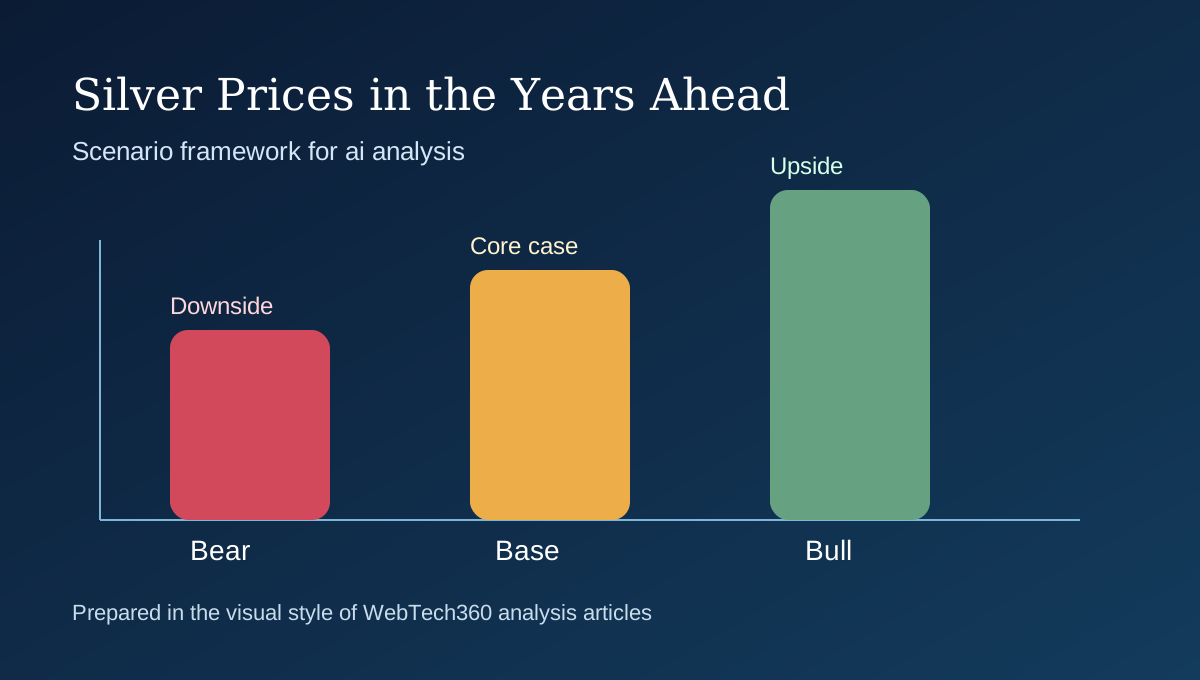
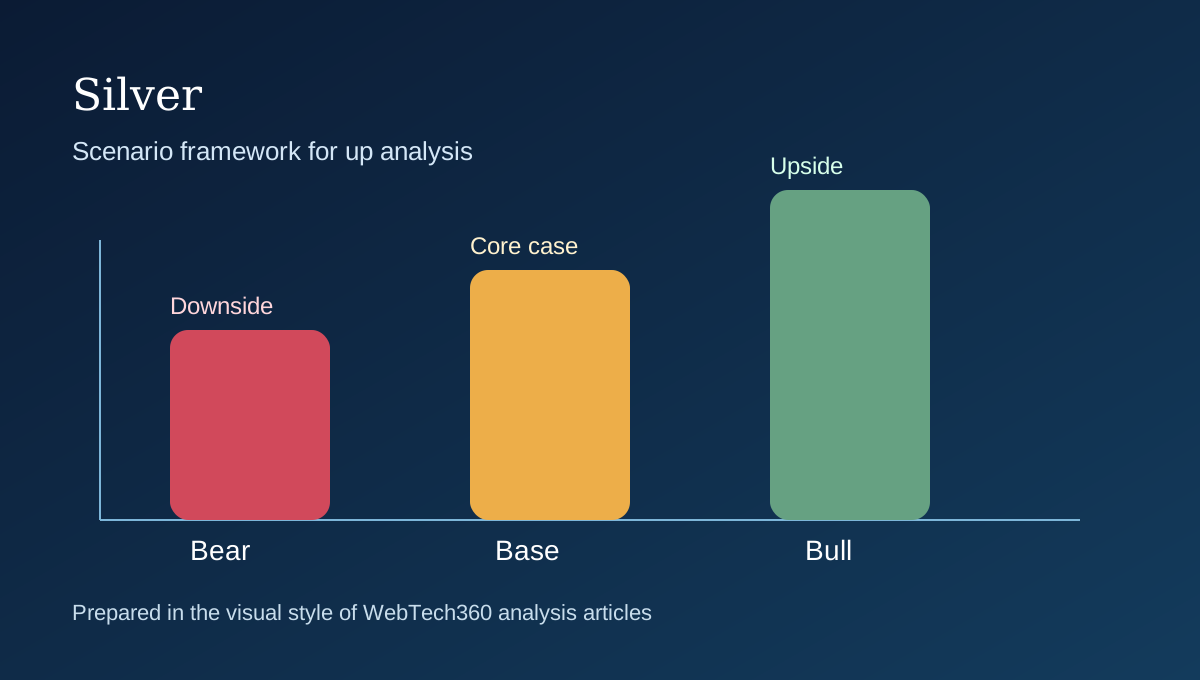
The cleanest way to frame 2027 is through conditions and review points rather than through conviction language. These scenarios assume year-end 2027 ranges, with the thesis reviewed after each monthly CPI and PCE release, after the July 2026 and April 2027 Silver Institute updates if published, and after each IMF World Economic Outlook revision.
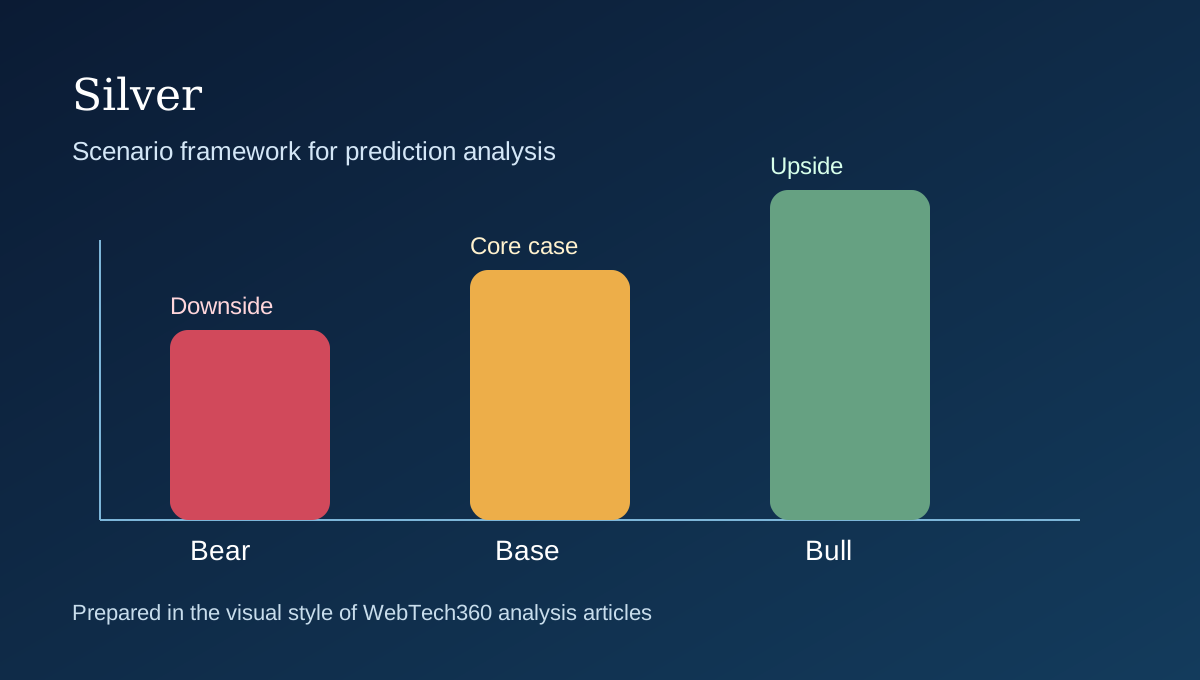
| Scenario | Probability | Trigger conditions | 2027 target range | Next review point |
|---|---|---|---|---|
| Bull case | 30% | Silver holds above $75, reclaims $85, the gold-silver ratio stays below 65, and inflation cools enough to ease real-rate pressure while the deficit remains material | $95-$120 | Reassess after the next two CPI and PCE releases and after any updated Silver Institute deficit data |
| Base case | 45% | Deficits persist, but industrial demand stays mixed and macro remains noisy rather than clearly easing | $68-$95 | Reassess at each IMF WEO and quarterly price-structure check |
| Bear case | 25% | Inflation stays sticky, price breaks below $75 and then $70, the ratio moves back above 70, and industrial weakness deepens | $45-$68 | Reassess immediately if support breaks on heavy volume or if CPI/PCE re-accelerate again |
For investors with gains, the base case argues for respecting volatility rather than assuming every drawdown is a buying gift. For investors with no position, the better setup is either confirmed stabilization above the mid-$70s or a deeper washout that resets sentiment. For investors already underwater, the wrong move is to treat structural deficit headlines as a substitute for risk control.
References
Sources
- Yahoo Finance quote page for Silver futures (SI=F)
- Yahoo Finance 10-year chart data endpoint for Silver futures
- Silver Institute, World Silver Survey 2026 release, April 15, 2026
- Silver Institute 2026 market outlook, February 10, 2026
- IMF World Economic Outlook, April 2026
- U.S. Bureau of Labor Statistics CPI release for April 2026, published May 12, 2026
- U.S. BEA Personal Consumption Expenditures Price Index
- U.S. BEA GDP advance estimate for Q1 2026
- World Bank Commodity Markets Outlook, April 2026
- LBMA Alchemist summary of the 2026 Precious Metals Forecast Survey