01. Silver Price Timeline
Silver's price history 2020–2026: the metal that moves faster and further than gold
Silver's behavior relative to gold over 2020–2026 illustrates both its opportunity and its risk. It underperformed gold during the 2022 rate shock, but when conditions aligned in 2025–2026, it moved approximately 2x as fast in percentage terms. This is the "leverage" characteristic that makes silver simultaneously more attractive and more dangerous than gold as a long-duration position.
| Year | Annual avg (approx.) | YoY change | Key event |
|---|---|---|---|
| 2020 | $20.55 | +47% | COVID stimulus; Reddit WallStreetBets silver squeeze attempt |
| 2021 | $25.14 | +22% | SolarPower surging; supply deficit begins |
| 2022 | $21.73 | −14% | Fed rate hikes reduce monetary demand; industrial demand holds |
| 2023 | $23.35 | +7% | Gradual recovery; deficit continues; solar demand accelerates |
| 2024 | ~$29.00 | +24% | Gold/silver ratio compression; ETF inflows return; EV demand growth |
| 2025 | ~$40.00 | +42% | Industrial demand record 680.5 Moz; 5th consecutive deficit year |
| 2026 (peak) | ~$95 intraday high | +138% from 2024 | CME margin hike triggered correction; current ~$73–80/oz |
The 2022 divergence between silver and gold is important to understand. Gold's resilience during the 2022 rate-hiking cycle was partly driven by the structural central bank bid — a buyer category that does not exist for silver. Silver, by contrast, fell 14% in 2022 because it is more sensitive to industrial demand expectations and real yield movements. This is the fundamental difference: when recession risk rises, silver falls harder than gold. When growth and green-energy investment accelerate, silver can significantly outperform.
| Period | Silver return | Gold return | Silver/Gold ratio |
|---|---|---|---|
| 2009–2011 bull market | +400% | +166% | 2.4x gold |
| 2020 COVID rally (Mar→Aug 2020) | +140% | +35% | 4x gold |
| 2022 rate-shock decline | −14% | 0% | Underperformed |
| 2024–2025 bull run | +175% (from 2023 avg) | +77% (from 2023 avg) | 2.3x gold |
Silver's historical tendency to deliver 2–4x gold's percentage return in bull markets is not accidental. It reflects silver's smaller market size, its dual role as precious metal and industrial commodity, and the amplifying effect of speculative and ETF flows when the momentum signal turns positive. The same factors make it more volatile on the downside.
02. The Supply Deficit — The Engine Nobody Is Talking About
Six consecutive years of deficit: 762 million ounces of cumulative drawdown
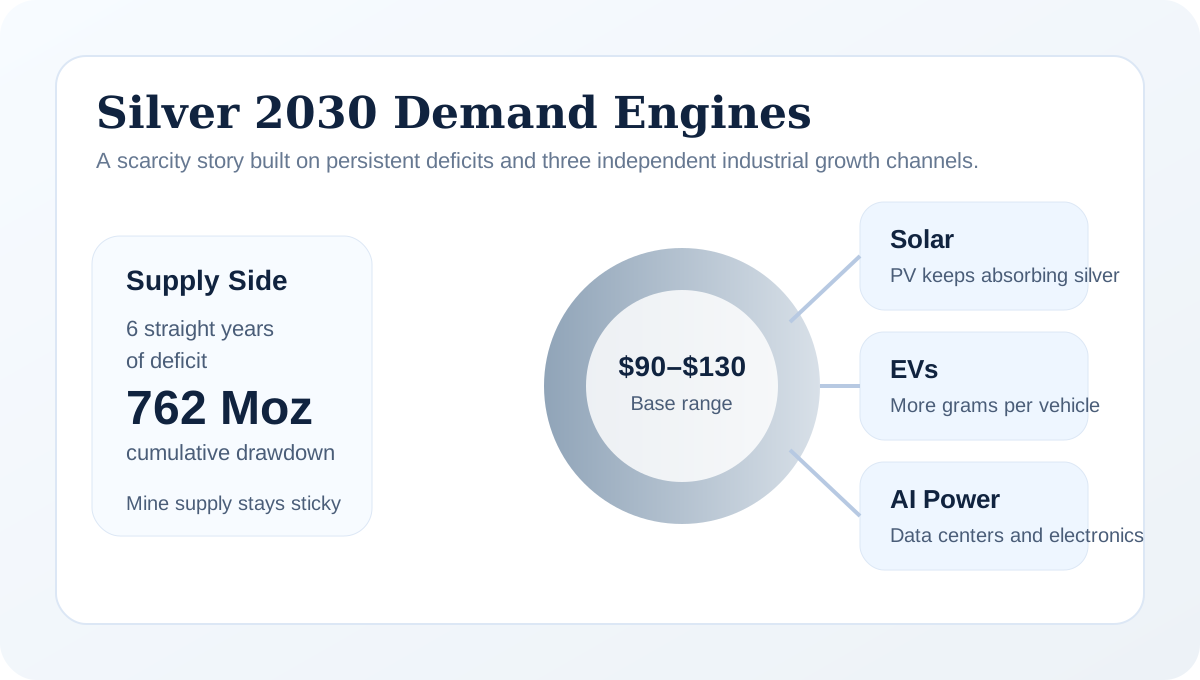
The supply deficit story is not new to silver markets, but the scale and persistence of the current imbalance is without modern precedent. The Silver Institute's World Silver Survey 2026 reports that 2026 will mark the sixth consecutive year of structural market deficit, with a cumulative shortfall of 762.1 million ounces (23,705 tonnes) over the 2021–2026 period.
To put that in perspective: global mine production is approximately 820–840 million ounces per year. A cumulative deficit of 762 Moz means the world has consumed approximately one full year's worth of global mine supply more than it produced over the past six years, drawing down stockpiles held in vaults, exchange warehouses, and industrial inventories.
| Year | Mine supply (Moz) | Total demand (Moz) | Annual deficit (Moz) | Cumulative deficit (Moz) |
|---|---|---|---|---|
| 2021 | ~829 | ~1,059 | ~51 | ~51 |
| 2022 | ~843 | ~1,242 | ~237 | ~288 |
| 2023 | ~835 | ~1,167 | ~123 | ~411 |
| 2024 | ~836 | ~1,197 | ~182 | ~593 |
| 2025 | ~813 | ~1,125 | ~40 | ~633 |
| 2026 (forecast) | ~820 | ~886 | ~67 (projected) | ~762 |
Why supply cannot recover quickly
Three structural reasons explain why silver mine supply cannot simply ramp up in response to higher prices:
1. Silver is mostly a byproduct metal. Approximately 70–75% of global silver production comes as a byproduct of mining copper, lead, zinc, and gold. The volume of silver extracted depends primarily on how much of those other metals are being mined — not on silver's own price. This means that even at $95/oz silver, a producer's incentive to increase silver output is limited unless the primary metal (copper, zinc) economics also justify expansion.
2. Mexico, the world's largest producer, is in decline. Mexico accounts for approximately 23–25% of global silver production. Output there has been falling due to a combination of declining ore grades, mine closures, labor disputes, and regulatory changes under successive administrations. Some analyses suggest Mexico could see continued double-digit annual production declines if remediation investment does not increase significantly. No equivalent large new supply base is currently under development.
3. New silver mines take a decade or more to develop. From discovery to first production, the typical new silver mine requires 10–15 years of permitting, environmental review, financing, and construction. The industry response to today's high prices will not arrive in meaningful volume before 2030–2035. This structural lag means that even sustained high prices do not solve the deficit within the forecast horizon.
03. Three Industrial Demand Engines
Solar, EVs, and AI data centers: three independent drivers, each growing structurally
Silver's industrial demand story is what fundamentally separates it from gold as a 2030 investment thesis. More than 50% of silver demand is industrial — meaning even if investment demand collapsed entirely, industrial consumption alone would create a structural floor. And unlike most industrial metals, silver's industrial demand is not cyclical; it is driven by energy transition and technology investment that have their own multi-decade policy tailwind.
Engine 1: Solar photovoltaic cells — from 11% to 29% of industrial demand in a decade
Silver is a critical input in solar panel manufacturing because of its unique combination of electrical conductivity, corrosion resistance, and paste formability. In 2014, solar accounted for approximately 11% of silver's total industrial demand. By 2024, that share had risen to 29%, consuming an estimated 230–232 million ounces in a single year — a number projected to exceed 300 million ounces annually by 2030.
The global solar installation base reached approximately 2,000 GW in 2024. The EU's target of 700 GW by 2030 alone would require substantial silver input. More importantly, the industry is transitioning toward more silver-intensive cell technologies: TOPCon and Heterojunction (SHJ) cells use 1.5–2x more silver per panel than the older PERC technology they are replacing. While manufacturers are working on "silver thrifting" (reducing silver per cell), the increase in installation volumes has historically more than offset thrifting efficiency gains.
A ScienceDirect academic paper forecasting silver demand by 2030 modeled scenarios where total silver demand for PV could reach 300–500 million ounces per year depending on installation pace and thrifting effectiveness. Even the conservative scenario represents a 30% increase from 2024's record-high solar demand.
Engine 2: Electric vehicles — more silver per car, far more cars
Internal combustion engine vehicles use approximately 15–28 grams of silver per vehicle, primarily in electronics and connectors. Battery Electric Vehicles (BEVs) use approximately 25–50 grams — roughly 2x as much — due to their higher electrical system complexity, power management systems, and the greater number of circuit boards and connectors required. Hybrid vehicles fall in between at 18–34 grams.
Global EV production is expected to grow at a compound annual growth rate of approximately 13% through 2031, with EVs overtaking ICE vehicles as the primary automotive sector silver demand source by 2027. If EV production reaches 40–50 million vehicles per year by 2030 (from approximately 14 million in 2023), and each uses an average 35 grams of silver, automotive silver demand could reach 1,400–1,750 million grams (45–56 million ounces) from EVs alone — more than double the automotive contribution from the ICE era.
Engine 3: AI data centers and power infrastructure
The AI infrastructure buildout is, at its core, an electricity infrastructure buildout — and electricity infrastructure uses silver. IT power capacity globally has grown from 0.93 GW in 2000 to approximately 50 GW in 2025, a 53x increase. AI data centers require not just the servers themselves (which contain silver-bearing circuit boards, connectors, and memory), but also the cooling systems, power distribution units, and backup systems that all rely on silver's unmatched electrical and thermal conductivity.
Silver is the most electrically conductive element on Earth — marginally more than copper, and with superior corrosion resistance for high-precision applications. In data center environments where reliability requirements are extreme and failure costs are enormous, silver-bearing components are not easily substituted. The Silver Institute's 2025 report "Silver: The Next Generation Metal" identifies AI infrastructure as a new, structurally growing demand category that was not a material factor before 2023.
| Sector | 2020 (Moz) | 2024 (Moz) | 2030E (Moz) | 2020→2030 change |
|---|---|---|---|---|
| Solar / PV | ~100 | ~232 | ~300–500 | +200–400% |
| Electric vehicles & automotive | ~50 | ~80 | ~120–160 | +140–220% |
| AI / data centers / electronics | ~175 | ~230 | ~280–350 | +60–100% |
| Other industrial | ~230 | ~140 | ~120–140 | −40 to 0% |
| Total industrial | ~555 | ~680 | ~820–1,050 | +48–89% |
The critical point in this table is that total industrial demand could reach 820–1,050 million ounces by 2030 — compared to a mine supply that is projected to plateau at approximately 820–840 Moz. Industrial demand alone could consume the entire global silver mine supply by the end of the decade, leaving investment demand (bar, coin, ETF) to be supplied entirely from recycling and existing stockpiles. That is the structural scarcity thesis in its starkest form.
04. The Gold/Silver Ratio
History's most reliable signals for silver's relative value — and its implied price scenarios
The gold-to-silver ratio — how many ounces of silver it takes to buy one ounce of gold — is one of the oldest and most closely watched metrics in precious metals markets. It does not predict absolute prices, but it quantifies silver's relative valuation compared to gold at any given moment.
| Period | Gold/silver ratio | Context | Implied silver at $5,000 gold |
|---|---|---|---|
| Ancient/pre-industrial era | ~15:1 | Bimetallic monetary standard; natural ground ratio | $333 |
| 1980 bull market peak | ~17:1 | Both metals simultaneously at historic highs during inflation | $294 |
| 2011 bull market peak | ~32:1 | Silver peaked at $49; gold still rising; silver outperformed | $156 |
| 2020 COVID peak (silver) | ~68:1 | Both rallied; silver less correlated to CB demand | $74 |
| Historical 20th century avg | ~47:1 | Post-silver standard; industrial use era begins | $106 |
| Current (April–May 2026) | ~64:1 | Silver at ~$73–80; gold at ~$4,600–5,000 | $78 (at 64:1) |
| Bull case target (ratio compression) | 35–40:1 | Consistent with prior bull market peaks | $125–$143 |
The current ratio of approximately 64:1 means silver is relatively cheap compared to its historical relationship with gold, and especially cheap compared to the 2011 or 1980 bull market peaks (32:1 and 17:1). If gold stays near $5,000 and the ratio compresses to 40:1 — consistent with prior bull markets — silver would trade at $125. If the ratio compresses to 30:1 (still above the 1980 level), silver would trade at $167.
The ratio is not deterministic. It can remain wide for extended periods. But the structural argument that silver is undervalued relative to gold is supported by: (1) its unique combination of precious and industrial metal characteristics, (2) the supply deficit that creates incremental physical scarcity, and (3) the historical precedent of ratio compression during sustained precious metals bull markets.
05. Institutional 2030 Forecasts
Why the range is so wide — and how to interpret it
Silver price forecasts for 2030 are dramatically more dispersed than gold forecasts, because silver has two additional sources of uncertainty: (1) the pace of solar/EV demand growth, and (2) the rate at which manufacturers can reduce silver-per-unit through technology (thrifting). Small differences in these assumptions produce large differences in the 2030 price.
| Source | 2030 forecast (USD/oz) | Methodology / key assumption | Bias |
|---|---|---|---|
| Bank of America / J.P. Morgan (consensus) | $100–$150 | Industrial demand structural; macro support; moderate thrifting | Base |
| Metals Focus / Kitco | ~$80–$100 | Conservative; partial thrifting offset; USD resilience | Cautious base |
| CME Futures implied (long-dated) | ~$97 | Market-implied futures pricing; consensus bid | Market neutral |
| Traders Union statistical model | ~$127 | Trend regression + industrial demand projections | Moderate bull |
| WalletInvestor | $141–$149 | Algorithm-based; historical pattern extrapolation | Bull |
| InvestingHaven | $77–$88 (conservative) / $150+ (base) | Scenario-dependent; macro sensitivity | Wide range |
| LiteFinance scenario model | $127–$289 | Highly scenario-dependent; bull includes supply squeeze | Wide range / speculative bull |
| CoinPriceForecast | $241 | Aggressive bull; assumes deficit compounds and ETF surge | Aggressive bull |
The wide dispersion — from $77 to $289 — reflects three genuine uncertainties that no analyst can resolve with current data: (1) how aggressively solar manufacturers will "thrift" silver out of their panels using emerging technologies like perovskite cells; (2) how quickly EV adoption proceeds globally; and (3) whether the gold/silver ratio compresses toward historical averages or remains wide. An investor who cherry-picks the $241 or $289 forecast without understanding these conditions is making a speculative bet, not an informed allocation. The honest base case is $90–$150, with the midpoint around $115–$120 reflecting current industrial demand trends without heroic assumptions.
06. The Bear Case
Four conditions that could kill silver's 2030 thesis
Bear risk 1: Technology substitution in solar (thrifting and perovskite). This is the single most credible structural bear risk for silver. Solar manufacturers have strong economic incentives to reduce their silver consumption because silver is their largest material cost. Research into perovskite solar cells — which do not require silver contacts at all — is advancing. If perovskite cells achieve commercial viability at scale by 2027–2028, the portion of solar demand growth currently assumed to drive silver could partially or substantially disappear. The ScienceDirect academic paper on silver demand by 2030 models this explicitly: in a "high thrifting" scenario, total 2030 silver demand falls significantly below base case. This is not a prediction; it is a credible risk that deserves explicit weight in any forecast.
Bear risk 2: Recession kills industrial demand. Silver's dual nature is also its greatest vulnerability. In the 2008–2009 recession, silver fell more than 50% from its pre-crisis levels while gold only fell 30% before recovering. The reason: industrial demand collapsed as manufacturing and electronics production slowed sharply. A recession in 2027–2028 — which some cycle analysts consider a non-trivial probability given credit conditions — would hit silver far harder than gold. Unlike gold's central-bank demand floor, there is no institutional buyer standing ready to absorb silver in a recession-driven demand collapse.
Bear risk 3: USD strength and elevated real yields. Like gold, silver has no yield of its own. But silver is more sensitive to real yield changes than gold, because its industrial demand has a relatively fixed price elasticity while its investment demand (the flexible component) responds strongly to the opportunity cost of holding non-yielding assets. If the Fed maintains higher-for-longer rates into 2027 and the DXY strengthens above 110, both the investment and the price-sensitive Asian retail component of silver demand would be suppressed simultaneously.
Bear risk 4: Supply substitution in industrial applications. At prices above $100/oz, manufacturers have more incentive to engineer silver out of their products. Copper and aluminum can substitute for silver in some lower-precision electrical applications. Gold can substitute in some high-reliability connectors. If silver sustains very high prices for several years, a gradual substitution process similar to what happened in photographic film (where silver was largely eliminated) could reduce industrial demand in some segments. This is a slow-moving risk — silver's conductivity advantage means substitution is difficult in precision applications — but it is not zero.
07. 2030 Scenarios
Silver's 2030 price range: three scenarios with explicit conditions
| Scenario | 2030 price range | Required conditions | Probability estimate |
|---|---|---|---|
| Bull | $150–$200 | Solar demand grows at 15%+ CAGR through 2030 with minimal thrifting offset; EV penetration exceeds 40% of new vehicles by 2029; gold/silver ratio compresses to 30–35; Fed easing environment; AI data center demand adds 50–100 Moz of new demand; Mexico decline accelerates supply squeeze. | 25% |
| Base | $90–$130 | Current industrial demand trends continue; moderate thrifting partially offsets solar demand growth; supply marginally improves from new mines; gold/silver ratio stabilizes at 45–55; macro environment neutral. Deficit continues but narrows from recent extremes. | 50% |
| Bear | $50–$70 | Recession 2027–2028 reduces industrial demand sharply; perovskite solar technology achieves commercial scale by 2028; USD strengthens to DXY 115+; central bank precious metals selling reduces safe-haven demand; thrifting eliminates 30%+ of solar silver demand. | 25% |
Silver vs gold: which performs better by 2030? This is the question most investors holding a precious metals allocation actually need to answer. The honest answer is that it depends on macroeconomic conditions in ways that are difficult to predict with confidence. But the framework is clear:
| If your priority is... | Choose... | Reason |
|---|---|---|
| Capital preservation + store of value | Gold | Central bank bid provides structural floor; less recession sensitivity |
| Maximum upside leverage to bull case | Silver | Historical 2–4x gold's % move in bull markets; ratio compression potential |
| Indirect green energy / electrification exposure | Silver | Unique intersection of precious metal + industrial commodity; no equivalent alternative |
| Protection in a recession | Gold (much safer) | Silver's industrial demand collapses in recessions; gold's central bank bid holds |
| Balanced precious metals allocation | Both (70/30 or 60/40 gold/silver) | Gold provides stability floor; silver provides asymmetric upside leverage |
The "forgotten metal" asymmetric argument
Silver's most compelling long-run investment characteristic is what analysts sometimes call its "asymmetric" profile: the downside in a bear scenario ($50–$70) represents a loss of approximately 30–40% from current prices near $75. The upside in a bull scenario ($150–$200) represents a gain of approximately 100–165%. The risk-reward ratio — if you assign equal probability to each scenario — is approximately 2:1 favorable, which is unusual in a market where most assets trade closer to symmetric risk.
The reason for this asymmetry is that industrial demand provides a floor. At $50/oz silver, industrial manufacturers would continue buying because their demand is largely price-inelastic below ~$100/oz. That demand floor limits the downside. The upside is not similarly capped — if the industrial scarcity narrative intensifies and investment demand returns simultaneously (as it did in 2025), the price response can be very large very quickly.
08. Conclusion
Silver's unique position — and what investors need to watch
Silver enters its 2030 horizon with a fundamentally different story than gold. It does not have a central bank bid. It cannot rely on de-dollarization as a structural driver. What it has instead is a structural supply-demand imbalance that six consecutive years of deficit have made undeniable, combined with three independent industrial demand drivers — solar, EVs, and AI infrastructure — each of which is growing on its own multi-decade policy and technology cycle.
The 2030 base case of $90–$130 requires no heroic assumptions. It simply requires that the current deficit continues, solar demand grows at roughly its current pace, and the gold/silver ratio normalizes moderately from 64:1 toward its historical average. The bull case requires acceleration in at least two of those variables. The bear case requires a recession and a technology substitution breakthrough simultaneously — possible, but requiring two improbable things to happen at the same time.
For investors evaluating precious metals allocation, silver's combination of monetary hedge characteristics (like gold) and industrial commodity characteristics (like copper or lithium) — without yet being priced correctly as either — represents the "asymmetric opportunity" case. The downside is real and real-yields-sensitive. But the 762 Moz of cumulative deficit, the 820 Moz mine supply ceiling, and the 820–1,050 Moz industrial demand projection for 2030 are not narratives. They are measurements from the Silver Institute and Metals Focus. Investors who understand these numbers can make informed decisions; those who rely only on price momentum are operating with far less information than the data provides.
References
Sources
- Silver Institute press release 2026 — sixth consecutive deficit; cumulative 762.1 Moz drawdown
- World Silver Survey 2026 (Metals Focus) — comprehensive annual supply, demand, and price data
- Silver Institute — silver demand forecast across solar, EV, AI technology sectors
- Silver Institute — record 680.5 Moz industrial demand in 2024
- Reuters, April 15, 2026 — silver sixth deficit year; stock drawdown and squeeze risks
- ScienceDirect — "Forecasting silver demand and supply by 2030: Impact of silver-intensive PV cells and sectoral competition" — academic demand modeling
- J.P. Morgan Global Research — silver price outlook and industrial demand analysis
- Finance Magnates — BofA, Citi, Reuters silver price analysis 2026; COMEX inventory tightening
- GoldSilver.com — silver 2026 predictions after 144% surge; institutional targets compilation
- InvestingCube — silver price prediction 2026–2040, supply deficit structural analysis
- SilverSeek — Mexico silver production decline; supply deficit worsening analysis