01. Historical Context
The 2027 setup starts with the current valuation and the next guidance bridge
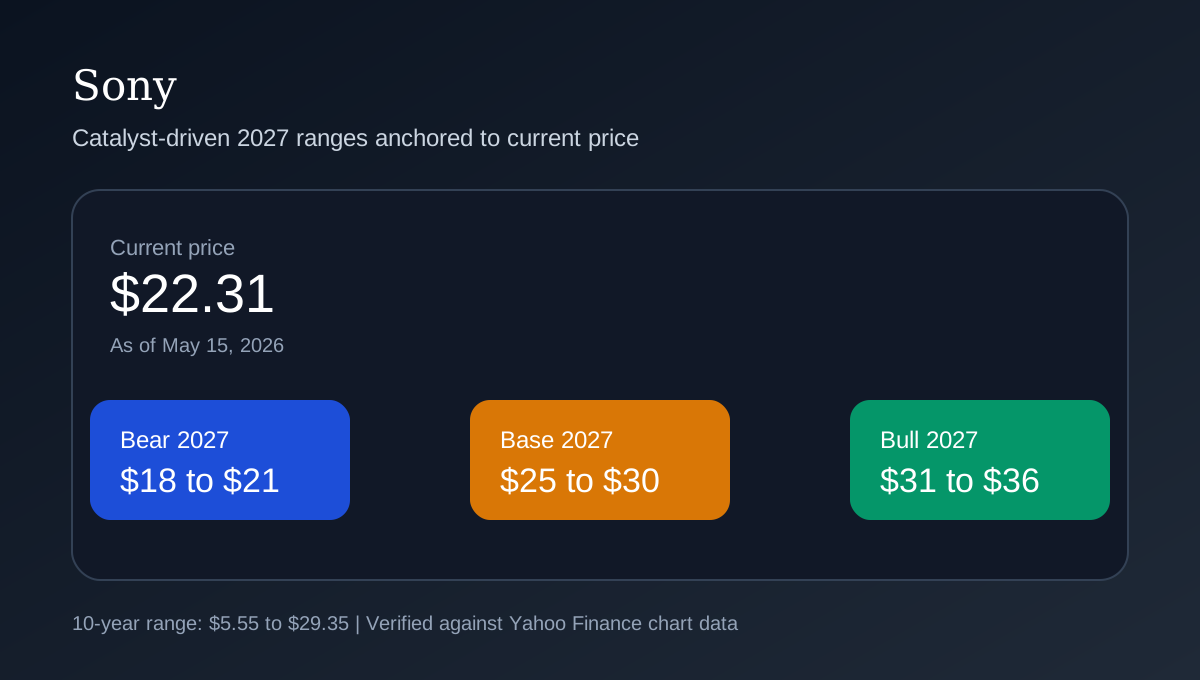
Sony trades at $22.31 as of May 15, 2026. Over the last 10 years the ADR ranged from $5.55 to $29.35, so the stock has already proven it can compound, but it is now much closer to the upper end of that long-cycle range than to the floor.
For the fiscal year ended March 31, 2026, Sony reported sales of yen 12.48 trillion and operating income from continuing operations of yen 1.4475 trillion, up 13.4% year over year. Reuters reported on May 8, 2026 that Sony expects operating profit to rise again to yen 1.6 trillion for the year ending March 2027.
For a 2027 call, the relevant anchors are current price, current earnings power, next-fiscal-year guidance, and whether the stock can move closer to the verified one-year target estimate without needing a heroic multiple expansion.
| Horizon | What matters most | What would strengthen the thesis | What would weaken the thesis |
|---|---|---|---|
| 1-3 months | Price action versus $22.31 and the next guidance update | Revisions stabilize and the stock holds support | Price breaks support and revisions weaken |
| 6-18 months | Delivery against earnings guidance and margin resilience | Revenue and profit stay within management guidance bands | Guidance is cut or key segments miss |
| To 2027 | Capital allocation, valuation, and industry structure | Execution compounds and valuation stays disciplined | The thesis becomes too dependent on multiple expansion alone |
02. Key Forces
The measurable catalysts that matter most into 2027
Yahoo Finance showed a trailing P/E of 15.18x, TTM EPS of $1.31, and a one-year target estimate of $28.54.
The first catalyst is estimate revision direction. If analysts start lifting revenue or earnings assumptions after the next result cycle, the stock can re-rate faster than the broader market.
The second catalyst is management execution against the current fiscal-year guide. If the company starts above plan, the 2027 bull case becomes more credible quickly.
Sony is more company-specific than macro-sensitive, but the macro still matters. IMF staff cut Japan growth expectations to 0.8% for 2026 in the April 3, 2026 Article IV release, while the BOJ remains in a gradual normalization phase. That backdrop is manageable for Sony if image sensors, music, and pictures offset a softer console cycle.
The last catalyst is capital allocation. Buybacks, dividends, and disciplined spending matter more when valuation is no longer distressed.
| Factor | Why it matters | Current assessment | Bias | What would change it |
|---|---|---|---|---|
| Valuation | Trailing P/E 15.18x; forward P/E not consistently surfaced in the latest live quote mirrors we could verify | Still investable, but less forgiving if execution slips | Neutral to bull | A cheaper entry or faster earnings growth would improve it |
| Earnings setup | TTM EPS $1.31; 1-year target estimate $28.54 | Upside exists, but the target needs earnings delivery to close the gap | Neutral | Upward estimate revisions would turn this more bullish |
| Macro | IMF sees Japan growth slowing to 0.8% in 2026, while the BOJ is still normalizing policy. | Japan is still growing, but the corridor is narrower than in 2024 | Neutral | A cleaner growth and inflation mix would help |
| 10-year trend | Range $5.55 to $29.35; total return about 302% | Long-run compounding is proven, so the debate is about entry and slope | Bull | A break below long-cycle support would weaken that read |
| Catalysts | Earnings, guidance, capital return, and policy | Plenty of review points remain on the calendar | Neutral | A positive guidance revision or a policy surprise would matter |
03. Countercase
What could keep 2027 from playing out well
The stock is still well below its 52-week high of $30.34, while Yahoo Finance showed a trailing P/E of 15.18x and a one-year target estimate of $28.54 on the live quote page crawled in May 2026.
A second failure path would be that the company hits revenue but misses margin, which usually matters more for rerating than top-line growth alone.
A third failure path would be a valuation ceiling. If the stock reaches consensus target territory before earnings catch up, upside can stall even without outright bad news.
| Risk | Latest data point | Current assessment | Bias |
|---|---|---|---|
| Valuation reset | Trailing P/E 15.18x | Not expensive enough to panic, but no longer gives a free pass | Neutral |
| Guidance risk | The next fiscal-year guide is already public, so misses will be visible quickly. | The next 12 months matter because management has already set a clear bar | Bearish if missed |
| Macro slowdown | Japan and global growth assumptions are softer than they were a year ago. | A softer Japan or global demand backdrop would pressure multiples and estimates | Neutral to bear |
| Narrative fatigue | The stock already sits much closer to the top of the 10-year range than the bottom. | If the story stops improving, the stock can de-rate even with okay results | Neutral |
04. Institutional Lens
Institutional lens for a 2027 call
The institutional-grade way to handle a 2027 forecast is to track guidance, revisions, and macro rather than to force a single exact year-end number.
Sony is more company-specific than macro-sensitive, but the macro still matters. IMF staff cut Japan growth expectations to 0.8% for 2026 in the April 3, 2026 Article IV release, while the BOJ remains in a gradual normalization phase. That backdrop is manageable for Sony if image sensors, music, and pictures offset a softer console cycle.
That makes 2027 a live process: every quarterly result either confirms the base case or pushes probability toward the bull or bear range.
| Source | What it said | Why it matters here | Updated |
|---|---|---|---|
| Company filings | For the fiscal year ended March 31, 2026, Sony reported sales of yen 12.48 trillion and operating income from continuing operations of yen 1.4475 trillion, up 13.4% year over year. Reuters reported on May 8, 2026 that Sony expects operating profit to rise again to yen 1.6 trillion for the year ending March 2027. | This is the anchor for the operating case | May 15, 2026 |
| IMF Japan Article IV | Sony is more company-specific than macro-sensitive, but the macro still matters. IMF staff cut Japan growth expectations to 0.8% for 2026 in the April 3, 2026 Article IV release, while the BOJ remains in a gradual normalization phase. That backdrop is manageable for Sony if image sensors, music, and pictures offset a softer console cycle. | Defines the macro corridor that should frame valuation | April 3, 2026 |
| Bank of Japan | The BOJ continued policy normalization in 2026 instead of returning to emergency settings. | Critical for discount rates and bank or exporter sentiment in Japan | 2026 releases |
| Yahoo Finance | Live quote pages showed price $22.31, TTM EPS $1.31, and long-run price history. | Useful for valuation framing and long-cycle context | May 15, 2026 |
05. Scenarios
2027 scenarios with explicit triggers
The ranges below assume that the current price of $22.31 is the starting point and that the next 12 to 18 months will be dominated by earnings delivery, not by a structural valuation regime shift. Review the thesis after each quarterly result and again after the next full-year guide.
| Scenario | Probability | Trigger and target range | Review point |
|---|---|---|---|
| Bull case | 30% | Guidance is met or raised, revisions turn positive, and price sustains a breakout above recent resistance; target range $31 to $36 | Review after each quarterly result and after the next full-year guide |
| Base case | 50% | Results broadly track plan and the stock remains around current valuation multiples; target range $25 to $30 | Review after each quarterly result and after the next full-year guide |
| Bear case | 20% | Guidance is cut, revisions deteriorate, or price loses support with broader macro pressure; target range $18 to $21 | Review after each quarterly result and after the next full-year guide |
References
Sources
- Yahoo Finance quote page for SONY
- Yahoo Finance 10-year chart endpoint for SONY
- Sony Investor Relations page showing FY2026 filings, accessed May 2026
- Sony Group Corporate Strategy 2026 blog post, published May 8, 2026
- Reuters on Sony FY2027 outlook, published May 8, 2026
- IMF Article IV for Japan, published April 3, 2026
- Bank of Japan statements on monetary policy, 2026 releases