Short answer: Texas Instruments (NASDAQ: TXN) was quoted at $298.20 at 17:41 UTC on October 6, 2026, about 1.1% above the prior close of $294.90. That is a one-session snapshot, not enough evidence to call a durable uptrend. TI’s investor-relations historical-price page listed an adjusted October 5 close of $294.90; the next important test is the company’s third-quarter report on October 21, when investors can compare actual revenue and earnings with management’s July guidance and look for evidence that industrial, data-center, and automotive demand remains broad. TI stock quote and historical-price lookup.
Prices move during the trading day, and market-data feeds may differ slightly in timing or adjustment methodology. The October 6 quote above is a dated snapshot, not a live price or a forecast. This analysis uses information available as of October 7, 2026; October’s full-month performance cannot yet be known.
What is driving the TXN stock trend in October?
The central question is whether the recent earnings recovery can support the expectations already reflected in the share price. TI’s second-quarter 2026 revenue was $5.463 billion, up 23% from a year earlier and 13% sequentially. Net income was $1.980 billion, and diluted earnings per share were $2.14. The company said growth was broad, led by industrial, data center, and automotive markets. Those are encouraging operating signals, but one quarter does not establish that every end market has returned to a steady growth path.
TI’s July outlook called for third-quarter revenue of $5.65 billion to $6.15 billion and earnings per share of $2.23 to $2.57. Those are company guidance ranges, not reported results. The earnings release also noted that Q2 EPS included a five-cent benefit that had not been part of the original guidance, so investors should avoid treating the entire reported increase as a repeatable run rate. See the official Q2 2026 results and guidance.
What should investors watch at the October 21 earnings event?
TI has scheduled its Q3 2026 earnings conference call for October 21 at 3:30 p.m. Central Time. Before the call, the latest public quarterly results are still from Q2. For a trend decision, compare the new report with the July guidance and then listen for management’s comments on orders, customer inventory, and demand by end market. The date and webcast details are on TI’s Q3 earnings-call notice.
- Revenue: Is Q3 revenue within or above the $5.65 billion–$6.15 billion range?
- EPS quality: How much of any change comes from operating performance, and how much from tax or other one-time items?
- End-market breadth: Are industrial and automotive customers sustaining orders, or is growth concentrated in data centers?
- Next-quarter outlook: Does management describe improving demand, stable conditions, or renewed customer caution?
A result near the midpoint could still disappoint if investors were positioned for a stronger beat. Conversely, a modest headline miss may matter less if forward demand commentary improves. The stock reaction depends on expectations as well as reported numbers.
How do TI’s factories affect the investment case?
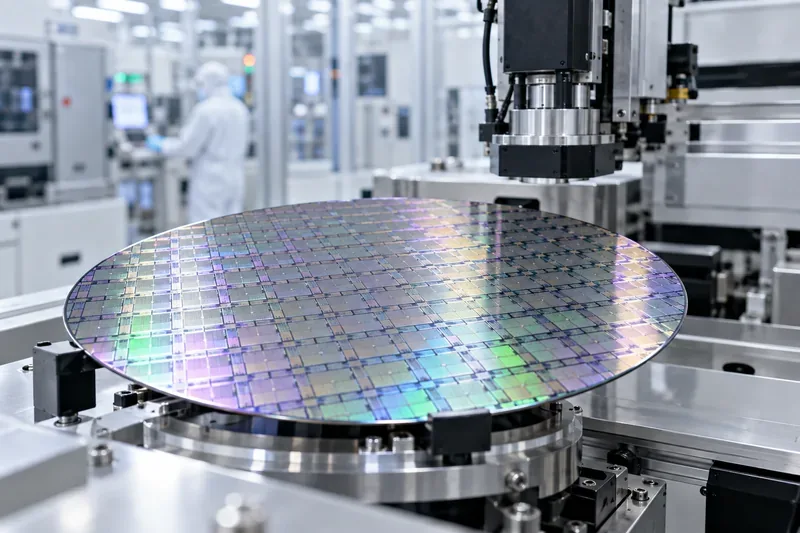
Manufacturing is a long-term advantage and a near-term financial commitment. TI designs and manufactures analog and embedded-processing chips used across industrial, automotive, data-center, personal-electronics, and communications equipment. Its 2025 annual report says the company continued qualifying and ramping 300-millimeter wafer fabs in Richardson and Sherman, Texas, and Lehi, Utah. Larger wafers can improve manufacturing economics, but new capacity requires equipment, ramp time, and customer demand before it contributes fully to cash generation.
In the twelve months through Q2 2026, TI reported $8.667 billion in cash from operations and $3.3 billion in capital expenditures. These figures show why investors should look beyond revenue: factory spending affects free cash flow while capacity is being built, while utilization and production efficiency influence returns later. TI reported $6.5 billion in trailing-twelve-month free cash flow under its stated calculation, which includes proceeds from U.S. CHIPS Act incentives. Read the 2025 annual report alongside the latest quarterly filing rather than assuming every announced fab will immediately lift margins.
Does the Silicon Labs deal change the TXN outlook?
It adds a separate catalyst and a financing trade-off. TI agreed to acquire Silicon Labs for $231 per share in cash, with an announced enterprise value of about $7.5 billion. TI expects the deal to close in the first half of 2027, subject to regulatory and shareholder approvals. The company said it expects roughly $450 million in annual manufacturing and operating synergies within three years after closing, and expects the transaction to be accretive to EPS in the first full year after closing, excluding transaction costs. Those are company expectations, not completed outcomes.
For TXN shareholders, the strategic case is broader embedded wireless connectivity and potential use of TI’s manufacturing and customer channels. The counterweight is execution: integration, debt financing, approval timing, and the time required to realize synergies. The transaction announcement provides TI’s stated terms. Investors should revisit the assumptions if approval timing or funding details change.
Which indicators help confirm a price trend?
A single quote should not decide whether the stock is trending. For a short-term view, review daily closes and trading volume over several weeks; for a longer-term thesis, compare the price with its 50-day and 200-day moving averages and the prior swing highs and lows. A rising price with higher highs and stronger volume is more convincing than a one-day jump that quickly fades. No technical level guarantees a future move.
Pair the chart with the operating evidence. A bullish case requires more than AI-related data-center interest: it is stronger if Q3 delivery meets guidance, industrial and automotive demand remains broad, and cash generation keeps pace with capital spending. A cautious case becomes more plausible if guidance resets lower, demand is concentrated in a narrow customer group, or the factory ramp consumes cash faster than expected.
Is TXN suitable for every investor?
TXN may suit investors seeking exposure to a diversified analog and embedded chipmaker who can tolerate semiconductor cycles and multi-year manufacturing investments. It may be less suitable for someone who needs a predictable near-term return or is buying solely on an AI narrative. In September, TI announced a 7% increase in its quarterly dividend to $1.52 per share, or $6.08 annualized, subject to formal board declaration at its October meeting; the announced payment date is November 10 for shareholders of record on October 30. A dividend does not prevent a share-price decline and should be assessed against an investor’s goals and the company’s cash needs. See the September dividend announcement.
Before acting, set a time horizon and a price-risk limit, decide whether you are investing for business growth, income, or a short-term trade, and avoid treating management guidance as a guarantee. Recheck the October 21 report, subsequent filings, and the price chart after the event. If the operating thesis weakens while the valuation remains demanding, the original reason for holding TXN may need to be reconsidered. This article is informational and is not personalized investment advice.