Home
» Today
»
Trevor Storys Late Homer Flips Red Sox-Rangers Finale: Matchup and Key Takeaways
Trevor Storys Late Homer Flips Red Sox-Rangers Finale: Matchup and Key Takeaways
Updated September 18, 2026: Trevor Story supplied the biggest swing of Boston's series finale in Texas, turning a late deficit into a 4-3 Red Sox win with a three-run homer in the eighth inning. The blast came one day after Boston had dropped the first two games of the series, so the immediate takeaway is not that the matchup suddenly became easy for the Red Sox. It is that Story delivered in the exact kind of high-leverage spot Boston needed after a difficult two-game stretch.
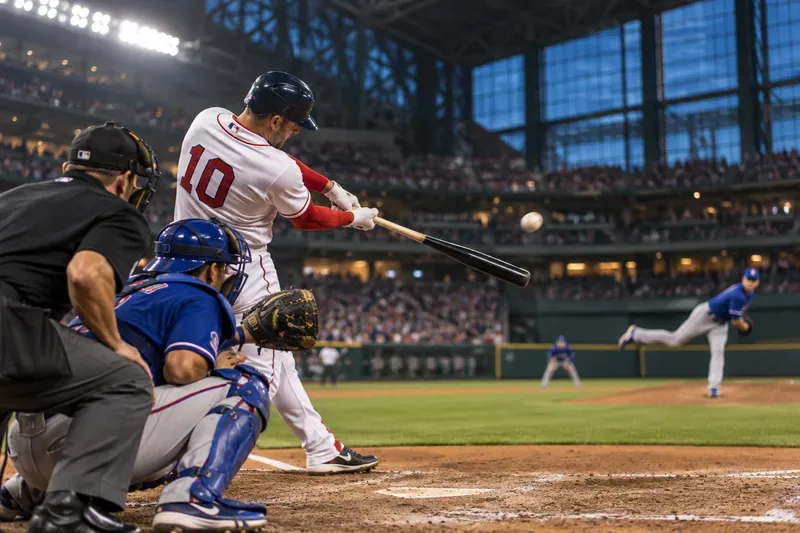
A right-handed batter makes contact during a night game as the catcher and umpire work behind the plate. The image illustrates the type of late-inning matchup that decided the Red Sox-Rangers finale.
What changed in the latest Red Sox vs. Rangers game?
Boston entered the September 17 finale at Globe Life Field after losing 4-2 on September 15 and 7-3 on September 16. Texas then built a 3-0 lead in the finale before the Red Sox finally broke through. Boston scored once in the seventh, then Story came to the plate in the eighth with two runners aboard and one out.
According to MLB's official video and Statcast data, Story drove an 80.3 mph Jacob Latz curveball 394 feet to left field. The ball left his bat at 108.2 mph with a 21-degree launch angle. The three-run homer gave Boston a 4-3 lead, which became the final score. It was Story's fourth home run of the season.
The larger context matters. MLB's game story noted that it was Story's first home run since May 13. That gap was heavily influenced by injury: Story underwent sports hernia surgery in May and spent more than three months away from the major-league lineup before returning at the end of August.
Trevor Story's matchup: why the Latz at-bat mattered
The important part of the Story-Latz matchup was not simply that Story homered. It was how he handled a breaking ball in a leverage situation. Latz went to an 80.3 mph curveball with a 2-2 count. Story did not merely put it in play; he hit it with the kind of exit velocity associated with authoritative contact. A 108.2 mph batted ball is evidence that he squared the pitch up rather than benefiting from a defensive mistake or a softly hit ball finding grass.
That distinction is useful when evaluating a hitter coming back from a long layoff. Results such as batting average can move dramatically in a small sample, while quality-of-contact events can provide a more direct look at whether a hitter is catching the ball cleanly. One swing does not prove that Story is fully back to his best offensive form, but this swing was a much stronger signal than a bloop single would have been.
It is also worth separating the pitch from the broader Rangers staff. Story's decisive homer came against Latz, not against Texas' starter. So the useful conclusion is specific: Story won one important late-game matchup against a left-handed reliever's breaking ball. It would be too broad to treat that as proof that he now has every Rangers pitcher figured out.
How Story's recent return changes the way to read the result
The Red Sox officially reinstated Story from the 60-day injured list on August 30. The club's roster announcement confirmed that transaction after his rehab assignment. That makes the September 17 homer especially relevant: it came less than three weeks after his return to the active roster.
Before the injury, Story's 2026 season had been interrupted just as Boston was trying to settle its infield and lineup. After returning, the question was not only whether he could play shortstop regularly, but whether his bat speed and timing would recover quickly enough to help in meaningful September games.
The homer does not answer every part of that question. It does, however, show that Story was capable of turning around a breaking ball with enough force to change a game. For readers tracking his return, that is more informative than simply noting that he was back in the lineup.
What the three-game series says about Boston
The series result should be read with some balance. Texas won the first two games, so Boston did not solve the Rangers over the full set. The Red Sox were held to two runs in the opener and three in the second game before scoring four in the finale. The three official final scores were 4-2 Texas, 7-3 Texas, and 4-3 Boston.
That pattern produces two practical takeaways. First, Boston's offense did not consistently create separation against Texas pitching. Second, the Red Sox still found enough late-game offense to avoid a sweep. Those are different conclusions, and both can be true at the same time.
Story's role also changed within the batting order during the series. MLB's official lineup pages show him hitting sixth in the September 15 opener and seventh on September 16. That placement reflects the fact that Boston was not treating him as the sole engine of the offense. He was part of a deeper lineup structure, and his biggest contribution came from the lower-middle portion of the order.
Key takeaways from the Story-Rangers matchup
The latest verified development is a real one: Story hit a go-ahead three-run homer in the eighth inning on September 17, turning a 3-1 deficit into a 4-3 Boston lead.
The contact quality was notable: MLB Statcast measured the homer at 108.2 mph off the bat and 394 feet.
The pitch was a curveball: Latz's 80.3 mph breaking ball was the pitch Story drove out, making the at-bat useful when evaluating his ability to handle spin after returning from injury.
It was not evidence that Boston dominated the series: Texas had already won the first two games, so the Red Sox left Arlington with one win in three games.
The homer mattered because of timing as much as distance: it came in the eighth inning with Boston trailing and two runners on.
Story's comeback remains a developing sample: he returned from the injured list on August 30 after sports hernia surgery, so his post-return body of work is still relatively small.
What to watch next with Trevor Story
The most useful next step is to watch for repeatable signs rather than treating one dramatic swing as a complete verdict. Three areas stand out.
1. Contact against breaking pitches
The Latz homer came on a curveball, so future at-bats against sliders and curves will help show whether Story is consistently seeing spin early enough. One well-hit curve is encouraging; a run of hard contact against breaking stuff would be more meaningful.
2. Quality of contact, not just hits
Story can produce value even when individual balls in play become outs. Readers can use Baseball Savant's Trevor Story page to track exit velocity and other batted-ball information rather than relying only on traditional box-score results.
3. Lineup position and playing time
Where Boston hits Story can reveal how the club is balancing his experience, current production and the rest of the lineup. A move higher or lower in the order should be read alongside who is healthy, which pitcher Boston is facing and how Story is performing over multiple games.
Bottom line
The most important current fact in the Red Sox-Rangers matchup is straightforward: Trevor Story changed the September 17 finale with a three-run homer off Jacob Latz, helping Boston win 4-3 and avoid a sweep. The swing was especially meaningful because Story had recently returned from a long injury absence and had not homered since May.
At the same time, the series offers a useful warning against overreaction. Texas won two of three, and one clutch homer does not erase the uneven offensive performance that came before it. The durable takeaway is narrower and more useful: Story showed he could still produce elite-quality contact in a high-pressure spot, and the next question is whether that quality becomes repeatable as Boston moves through the rest of September.
Official sources checked
This article was updated using MLB's official September 17 game data, the Red Sox roster transaction notice and Baseball Savant's player data. Game and player information can change as official records are corrected or updated.