01. Historical Context
Forecasting to 2035 means accepting mean reversion as a serious possibility
DXY is an ICE-managed fixed basket, not a business, so corporate valuation metrics do not exist for it. The right long-term tools are inflation differentials, policy differentials, trade and capital-flow regimes, and the basket structure itself, where the euro alone accounts for 57.6% of the index.
| Horizon | What matters most | What would strengthen the thesis | What would weaken the thesis |
|---|---|---|---|
| 2026-2028 | Inflation, Fed path, and near-term growth gap | Sticky inflation and slower foreign growth | Faster Fed easing and euro recovery |
| 2029-2032 | Productivity and capital flows | U.S. AI-led productivity stays dominant | AI gains diffuse globally and narrow the U.S. edge |
| 2033-2035 | Structural demand for dollar assets | Renewed safe-haven demand or wider rate differentials | Persistent softening versus the euro and yen |
ICE notes that the USDX reached an all-time high of 164.72 in February 1985 and a low of 70.698 in March 2008. More recent Yahoo Finance data show a 10-year monthly closing range from 89.13 in January 2018 to 112.12 in September 2022. That history argues for humility: even long cycles in the dollar can reverse faster than narratives suggest.
The long-horizon base case therefore should not assume that the post-2022 dollar premium lasts unchanged through 2035. It should assume periodic mean reversion unless new structural evidence appears.
02. Key Forces
Five structural forces that will shape DXY through 2035
The first force is the long-run path of U.S. rates. The Fed's March 2026 projections already show policy normalization to a 3.1% median by 2027. If that path continues through the next cycle, a large part of the dollar's current yield support fades over time.
The second force is U.S. productivity. Goldman Sachs expects U.S. potential GDP growth to average about 2.1% in 2025-2029 and accelerate to 2.3% in the early 2030s as AI boosts growth further. That is the most credible long-horizon reason DXY could remain firmer than current dollar-bear narratives imply.
The third force is global growth distribution. IMF projects world growth at 3.1% in 2026 and 3.2% in 2027, but with downside risks from conflict, fragmentation, and trade tensions. A weaker and more fragmented world usually supports the dollar; a broader recovery weakens that support.
The fourth force is institutional portfolio positioning. J.P. Morgan Asset Management's 2026 long-term assumptions project the dollar weakening 0.6% annualized versus the euro. That is modest, but over a decade it compounds into a meaningful headwind for DXY.
The fifth force is basket composition. DXY can look like a broad dollar call, but in practice it is highly sensitive to the euro. That means long-term DXY bulls need a durable case for euro underperformance, not just a durable case for U.S. resilience.
| Factor | Current Assessment | Bias | What to watch |
|---|---|---|---|
| U.S. rate advantage | Still positive, but the Fed's path points lower | Neutral | How far terminal real rates settle |
| Productivity / AI | Potential U.S. support if Goldman is broadly right | Neutral to bull | Whether AI raises U.S. output more than peer output |
| Global fragmentation | IMF still warns downside risks dominate | Mild bull | Conflict, trade policy, and commodity shocks |
| Institutional dollar view | Goldman and J.P. Morgan lean weaker USD over time | Mild bear | Changes in asset-demand assumptions |
| Basket concentration | Euro still dominates DXY | Mild bear | Long-run euro cycle versus the dollar |
Put differently, the 2035 case is a contest between U.S. productivity leadership and the market's growing assumption that the dollar's exceptional post-pandemic premium will fade.
03. Countercase
What would push DXY into the low 90s or 80s by 2035
The cleanest bear case is a world in which the U.S. remains solid but no longer clearly superior. If the Fed normalizes, inflation stays contained, and euro-area and Japanese growth stop lagging so badly, DXY can bleed lower without a crisis. That is the core logic behind mild institutional dollar-bear frameworks.
A second risk is that AI-led productivity is not uniquely American. IMF says AI could lift global productivity by up to 0.8 percentage points per year with the right policies, while OECD says recent generative AI tools can improve performance on specific tasks by roughly 20% to 40% depending on context. If those gains diffuse globally, the relative U.S. advantage shrinks.
The third risk is that long-term capital flows diversify more than expected. DXY bulls often assume persistent demand for U.S. assets; that assumption needs to be re-earned over a decade, not assumed by default.
| Risk | Current Assessment | Why it matters | Bias |
|---|---|---|---|
| Global AI catch-up | IMF and OECD both see productivity spillovers as plausible | Shrinks the U.S. relative advantage | Neutral to bear |
| Lower U.S. rates | Fed median already points lower by 2027 | Removes carry support over time | Bear |
| Euro-led DXY drag | 57.6% basket weight remains the dominant structural feature | Euro strength can push DXY lower even with decent U.S. data | Mild bear |
| Capital-flow diversification | Goldman cites diminishing demand for U.S. assets | Long-run asset demand drives the strategic trend | Mild bear |
The long-term bear case becomes much stronger if the dollar is weakening at the same time that U.S. growth is merely average and global productivity gains are broadening. That is different from a short-term tactical dip.
04. Institutional Lens
What institutional research implies for the 2035 debate
Goldman Sachs' 2026 outlook says the dollar should continue weakening in 2026, but the same research platform also forecasts U.S. potential GDP growth above 2% through the next several years and 2.3% in the early 2030s as AI boosts growth. That is a useful combination: tactically softer dollar, strategically still-solid U.S. macro capacity.
J.P. Morgan Asset Management's 2026 LTCMA gives a more explicit currency number, projecting 0.6% annualized dollar weakening versus the euro over its forecast horizon. That is one of the clearest published institutional datapoints for a long-term DXY bear drift, especially because of the euro's weight in the basket.
IMF's April 2026 WEO and later AI work keep the other side of the argument alive. The IMF says downside global risks remain dominant, but also argues AI could materially lift global productivity if countries are prepared. Those two forces work in opposite directions for DXY and are exactly why a wide 2035 range is more defensible than a single-number forecast.
| Institution | Updated | What it says | Implication for DXY |
|---|---|---|---|
| Goldman Sachs | 2026 outlooks and October 2025 productivity work | Dollar weaker in 2026, but U.S. potential GDP around 2.1% through 2029 and 2.3% in the early 2030s | Near-term softness, longer-term support if productivity leadership holds |
| J.P. Morgan Asset Management | 2026 LTCMA | Dollar weakening 0.6% annualized versus the euro | Secular drag on DXY |
| IMF | April 2026 WEO and February 2026 AI note | Global growth 3.1% in 2026 and 3.2% in 2027; AI could boost global productivity up to 0.8 percentage points per year | Both volatility support and long-run convergence risk |
| OECD | 2026 AI materials | Generative AI can improve specific task performance by about 20%-40%, but macro effects depend on diffusion | Broad AI adoption could erode U.S.-only advantage |
The institutional picture is not uniformly bearish or bullish. It is conditional, which is why the forecast should stay scenario-based.
05. Scenarios
Probability-weighted ranges into 2035
Long-range scenarios only help if the triggers are explicit enough to test over time.
| Scenario | Probability | Target range | Trigger conditions | When to revisit |
|---|---|---|---|---|
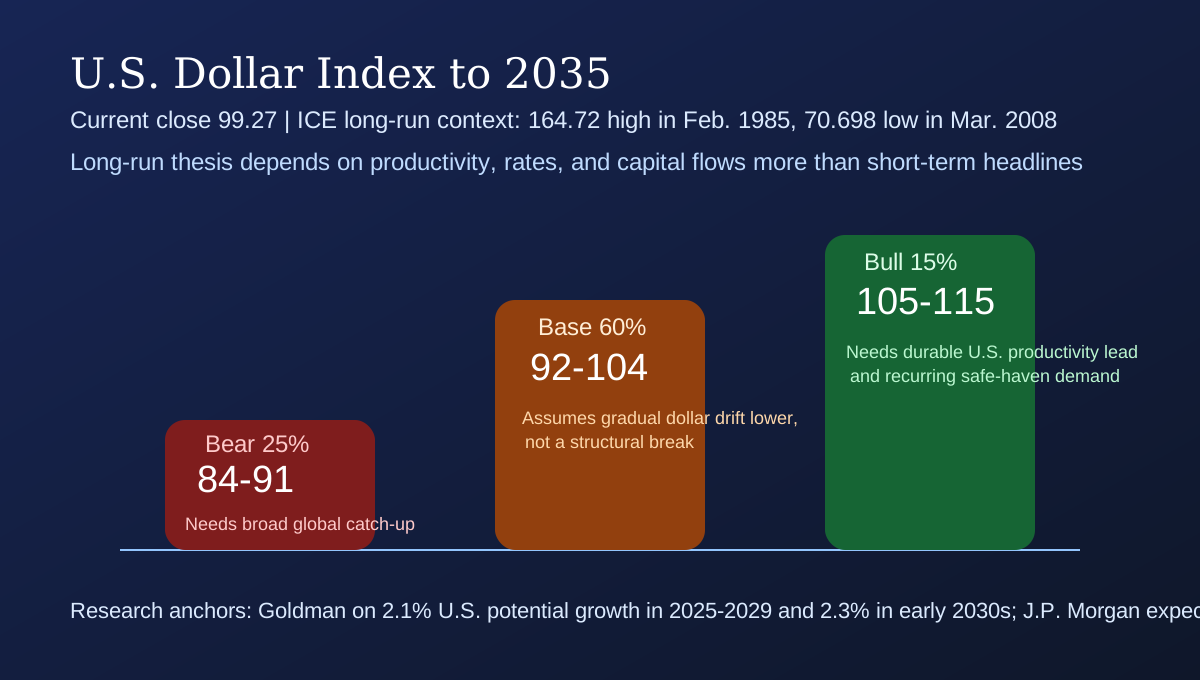
| Base case | 60% | 92-104 | Fed normalizes, U.S. productivity stays decent, but institutional dollar softening continues gradually | Annual review each December |
| Bull case | 15% | 105-115 | U.S. productivity materially outperforms peers, global shocks keep safe-haven demand high, and rate gaps stay wide | Reassess after major productivity or inflation regime shifts |
| Bear case | 25% | 84-91 | Fed eases more than expected, AI gains diffuse globally, and euro or yen recover over multiple cycles | Reassess if DXY spends a year below 92 |
By 2035, a reading above 115 would likely require another crisis-style dollar regime. A move into the mid-80s would likely require more than simple Fed easing; it would require a persistent narrowing of the U.S. macro and capital-flow premium.
The disciplined conclusion is that DXY should still be treated as a macro balance-of-power indicator. Forecasts this long out should be refreshed regularly, not admired for false precision.
References
Sources
- Yahoo Finance chart data for U.S. Dollar Index (10-year monthly series)
- ICE U.S. Dollar Index overview
- ICE FX Indexes methodology
- Federal Reserve FOMC statement, April 29, 2026
- Federal Reserve Summary of Economic Projections, March 18, 2026
- IMF World Economic Outlook, April 2026
- IMF on AI preparedness and productivity, February 2026
- Goldman Sachs 2026 outlooks page
- Goldman Sachs on U.S. potential growth and AI productivity
- J.P. Morgan Asset Management 2026 Long-Term Capital Market Assumptions
- OECD artificial intelligence and productivity overview