01. Historical Context
DXY starts from a neutral middle, not from an extreme
DXY is a fixed-weight ICE currency basket, not an operating company, so valuation metrics such as trailing P/E, forward P/E, EPS estimate, and EPS growth do not apply. What matters instead is the path of relative growth, relative inflation, and relative policy rates across its six currencies, with the euro carrying a 57.6% weight, followed by the yen at 13.6% and the pound at 11.9%.
| Horizon | Current setup | What would strengthen the thesis | When to review |
|---|---|---|---|
| 1-3 months | DXY rebounded from 97.84 on May 8 to 99.27 on May 15, 2026 | U.S. inflation stays sticky and Fed remains cautious | After the May 28 PCE release and June 16-17 FOMC |
| 6-18 months | Fed funds target range is 3.50%-3.75% after April 29, 2026 | U.S. growth stays above peers while cuts remain shallow | Each SEP update and every quarterly GDP release |
| To Q4 2027 | Index is near the middle of its 10-year monthly closing band | Repeated upside inflation surprises or wider rate differentials | Reassess by December 2026 and June 2027 |
Price history argues against heroic point forecasts. Yahoo Finance chart data show a 10-year monthly closing low of 89.13 in January 2018, a high of 112.12 in September 2022, and a latest close of 99.27 on May 15, 2026. That range is wide enough to reward scenario work and narrow enough to reject careless extrapolation.
The structural complication is that DXY can weaken even when the U.S. economy looks solid if the market begins pricing a smaller U.S. advantage. That is why 2027 should be framed around measured triggers rather than a single headline target.
02. Key Forces
Five forces that will decide whether DXY breaks out or mean reverts
The first driver is inflation persistence. BLS reported April 2026 CPI at 3.8% year over year, with core CPI at 2.8%, while BEA reported March 2026 PCE at 3.5% and core PCE at 3.2%. Those readings are still above the Fed's 2% target and keep a floor under U.S. real-rate support.
The second driver is policy. The Fed kept the target range for the federal funds rate at 3.50%-3.75% on April 29, 2026. In the March 18, 2026 Summary of Economic Projections, the median policymaker still saw year-end 2026 PCE inflation at 2.7%, core PCE at 2.7%, and the federal funds rate at 3.4%, which implies easing, but not an aggressive cutting cycle.
The third driver is U.S. growth versus the rest of the world. BEA's advance estimate showed real GDP grew at a 2.0% annualized rate in Q1 2026, with real final sales to private domestic purchasers up 2.5%. IMF's April 2026 WEO projected global growth of 3.1% in 2026 and 3.2% in 2027, so the dollar still has support if U.S. domestic demand remains firmer than external demand.
The fourth driver is the composition of DXY itself. Because the euro holds 57.6% of the basket, a change in euro-zone growth, energy pricing, or ECB rate expectations can move DXY even when the domestic U.S. story is unchanged. This is why a broad anti-dollar narrative often fails unless the euro is doing real work on the other side of the trade.
The fifth driver is institutional conviction. Goldman Sachs says the dollar should continue weakening in 2026 as demand for U.S. assets diminishes, while J.P. Morgan Asset Management's 2026 long-term assumptions forecast the dollar weakening 0.6% annualized versus the euro over its horizon. Those views argue against a structural bull thesis unless incoming inflation or growth data force them to change.
| Factor | Current Assessment | Bias | What changes it |
|---|---|---|---|
| U.S. inflation | CPI 3.8%, core CPI 2.8%, PCE 3.5%, core PCE 3.2% | Mild bull | A sustained move back toward 2.5% or lower |
| Fed policy | Target range 3.50%-3.75%; April statement kept policy unchanged | Mild bull | Two or more faster-than-expected cuts |
| U.S. growth | Q1 2026 GDP 2.0%; private domestic final sales 2.5% | Neutral to bull | Sub-1% GDP prints or sharper labor weakening |
| Global backdrop | IMF sees world growth at 3.1% in 2026 and 3.2% in 2027 | Neutral | Clear reacceleration outside the U.S. |
| Long-term institutional bias | Goldman and J.P. Morgan both lean weaker USD over time | Mild bear | Renewed U.S. asset demand or wider rate differentials |
On balance, the short-term macro mix is firmer than the long-term institutional narrative. That combination supports a broad 2027 range rather than a one-way trend.
03. Countercase
What would break the range-bound base case
The first risk to the base case is faster disinflation. If core PCE drops materially below the Fed's March median of 2.7% for 2026 and policymakers turn more comfortable easing, rate differentials could narrow faster than DXY bulls expect. That matters because April 29 policy was still restrictive enough to support the dollar.
The second risk is a softer U.S. growth profile. GDP grew 2.0% annualized in the first quarter, but consumer spending slowed to 1.6% and residential investment fell 8.0%. If private demand rolls over while Europe stabilizes, the middle of the DXY range can shift lower quickly.
The third risk is basket concentration. With the euro at 57.6% of DXY, a better euro-area cyclical backdrop can pull the index lower even without a U.S. recession. That is one reason long-term dollar-down calls should not be dismissed outright just because U.S. data remain decent.
| Risk | Latest data point | Why it matters | Current bias |
|---|---|---|---|
| Disinflation resumes | Fed median sees PCE at 2.7% by Q4 2026 | Would justify more rate cuts | Neutral |
| Growth differential narrows | IMF global growth 3.1% in 2026, 3.2% in 2027 | Less U.S. exceptionalism usually hurts DXY | Neutral to bear |
| Policy easing accelerates | Fed funds target currently 3.50%-3.75% | Lower carry tends to compress the dollar | Neutral |
| Positioning mean reversion | DXY is well below the 112.12 monthly peak from September 2022 | The index no longer has a crisis premium | Mild bear |
The base case fails if two things happen together: inflation slows enough to make the Fed more dovish, and non-U.S. growth improves enough to reduce the dollar's relative appeal. Without both, the downside case is incomplete.
04. Institutional Lens
What credible institutions are actually saying
Goldman Sachs' 2026 outlook page, updated in 2026, says the dollar should continue weakening in 2026 as demand for U.S. assets diminishes. In a separate March 2026 economics piece, Goldman projected U.S. GDP growth at 2.6% in 2026 and said core PCE inflation could fall to 2.2% by December 2026. That is a softer-dollar medium-term view, but not one built on imminent U.S. recession.
J.P. Morgan Asset Management's 2026 Long-Term Capital Market Assumptions, published in late 2025 with data as of September 30, 2025, forecast the dollar weakening 0.6% annualized versus the euro over its horizon. That matters because the euro dominates DXY, so even modest euro appreciation can weigh on the index.
IMF's April 2026 World Economic Outlook projected global growth at 3.1% in 2026 and 3.2% in 2027, while warning that geopolitical fragmentation and higher commodity prices could disrupt disinflation. In other words, the IMF backdrop supports volatility in DXY, not a clean one-directional trade.
| Institution | Latest relevant update | What it says | Implication for DXY |
|---|---|---|---|
| Federal Reserve | March 18 and April 29, 2026 | Median 2026 PCE 2.7%, core PCE 2.7%, policy rate 3.4%; current target 3.50%-3.75% | Near-term support, but easing path still points to capped upside |
| Goldman Sachs | March 2026 and 2026 outlook page | U.S. GDP 2.6% in 2026; core PCE 2.2% by December 2026; dollar to keep weakening in 2026 | Structurally mild bear, tactically not collapse |
| J.P. Morgan Asset Management | 2026 LTCMA | Dollar weakening 0.6% annualized versus the euro over the forecast horizon | Long-term drag on DXY if euro firms |
| IMF | April 2026 WEO | World growth 3.1% in 2026 and 3.2% in 2027, with downside geopolitical risks | Supports range trading and event-driven volatility |
The useful takeaway is not that institutions agree on the exact number. They do not. The useful takeaway is that most official and institutional inputs point to a still-firm but not runaway dollar, which matches a 97-103 base case better than an extreme call.
05. Scenarios
Probability-weighted ranges for 2027
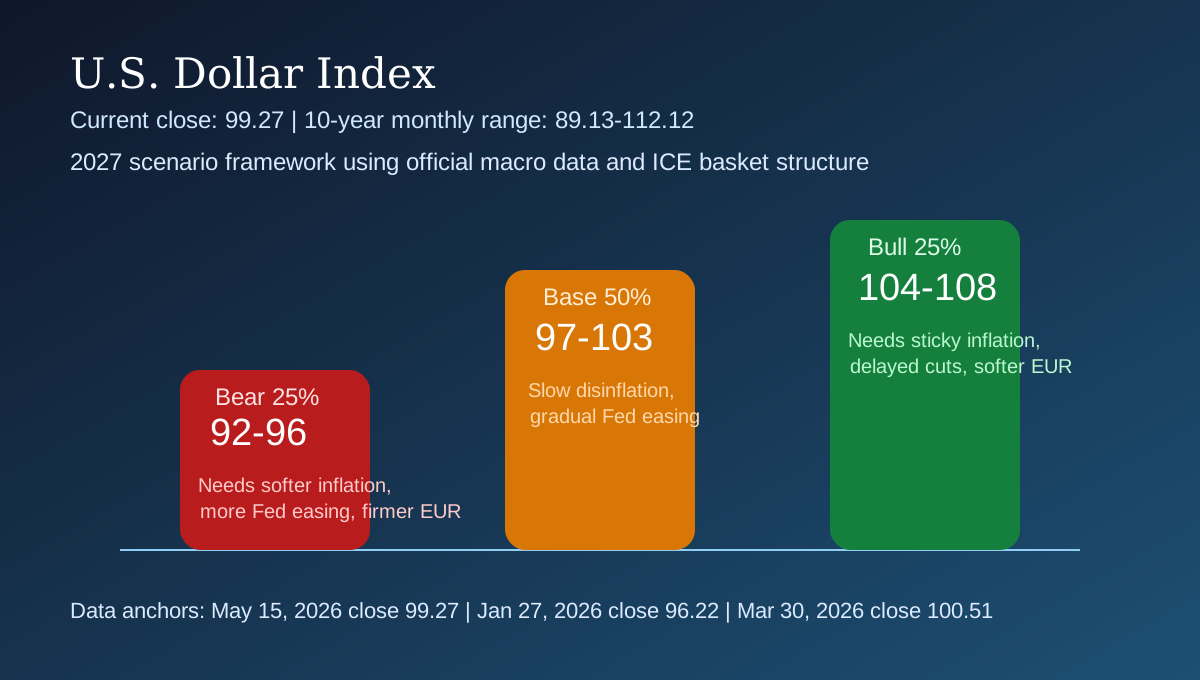
The actionable framework is to tie each scenario to measurable triggers and a review date. That makes the thesis testable instead of rhetorical.
| Scenario | Probability | Target range | Trigger conditions | Review point |
|---|---|---|---|---|
| Base case | 50% | 97-103 | Fed eases gradually, inflation cools only slowly, U.S. growth stays around trend | December 2026 SEP and June 2027 FOMC |
| Bull case | 25% | 104-108 | Core inflation stays sticky above 3%, Fed cuts lag expectations, and euro-area growth disappoints | After each CPI/PCE cycle through Q1 2027 |
| Bear case | 25% | 92-96 | Core PCE falls materially, Fed turns more dovish, and non-U.S. growth broadens | Reassess after two consecutive soft inflation prints |
The cleanest sign that the bull case is taking over would be a durable move back above the 2026 high close of 100.51 from March 30. The cleanest sign that the bear case is gaining control would be a break below the 2026 low close of 96.22 from January 27.
For readers using this as a process input, the main discipline is simple: do not treat DXY like a stock and do not force equity-style valuation language onto a currency basket. Relative inflation, policy, and growth are the real levers.
References
Sources
- Yahoo Finance chart data for U.S. Dollar Index (10-year monthly series)
- ICE U.S. Dollar Index overview and historical benchmark notes
- ICE FX Indexes methodology and basket weights
- BLS Consumer Price Index, April 2026
- BEA Personal Income and Outlays, March 2026
- BEA GDP Advance Estimate, 1st Quarter 2026
- Federal Reserve FOMC statement, April 29, 2026
- Federal Reserve Summary of Economic Projections, March 18, 2026
- IMF World Economic Outlook, April 2026
- Goldman Sachs 2026 outlooks page
- Goldman Sachs forecasts for the biggest economies in 2026
- J.P. Morgan Asset Management 2026 Long-Term Capital Market Assumptions