Updated: November 24, 2026, at 17:15 UTC (12:15 p.m. EST)
The UEFA Champions League league phase has completely transformed European club soccer, dismantling the traditional four-team group stage in favor of an expansive 36-team single-table competition. Entering the critical winter stretch of the 2026–27 campaign, every fixture carries massive mathematical significance as clubs battle across an eight-match gauntlet to secure automatic knockout berths, navigate high-stakes playoff seeds, or avoid outright continental elimination.
Unlike previous seasons where clubs could afford to rotate rosters after securing qualification across six familiar group-stage encounters, the 36-team single-table architecture pairs each club against eight distinct opponents—four at home and four away. With all 36 teams ranked together in a shared standings ledger, single-goal margins, away scoring records, and opponent schedule strength now determine who punches an immediate ticket to the Round of 16 and who must endure the grueling two-legged knockout play-off round.
Destaques
- Unified 36-Team Standings: All competing clubs now feature on a single league table, playing eight different opponents (four home, four away) drawn evenly from four seeded pots.
- Top Eight Advance Directly: Clubs finishing in positions 1 through 8 bypass the playoff round entirely, securing seeded spots directly in the Round of 16.
- Playoff Crucible (9th–24th): Teams finishing 9th to 24th must contest a two-legged knockout play-off tie in February to claim the remaining eight Round of 16 places.
- Zero Safety Net: Clubs finishing 25th to 36th are permanently eliminated from European competition for the remainder of the season, with no relegation transfer to the UEFA Europa League.
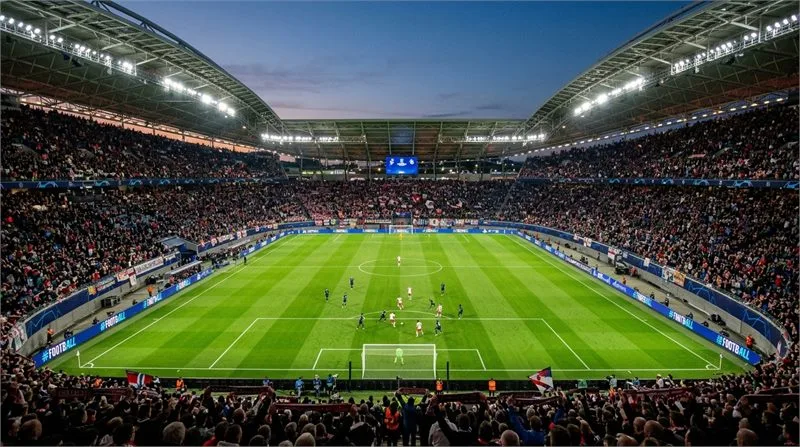
Illustrative photo: An atmospheric evening matchday under the floodlights during a UEFA Champions League encounter.
How Does the UEFA Champions League League Phase Format Work?
The league phase, widely dubbed the "Swiss-model system," expands the competition from 32 to 36 elite clubs. Ahead of the tournament draw, clubs are divided into four seeding pots of nine teams based on their official UEFA five-year club coefficients. Each participant is drawn against two distinct opponents from each pot, including two from Pot 1, ensuring balanced schedules where European heavyweights collide from Matchday 1.
Every match awards standard football points: three points for a victory, one point for a draw, and zero for a defeat. Because clubs do not play round-robin rematches against their league-phase rivals, cumulative points and goal differential across all eight fixtures dictate placement in the universal table.
What Do the League Phase Cutoff Zones Mean for the Knockouts?
The final league standings table divides the 36 clubs into three critical qualification zones that dictate their postseason pathway:
- Top 8 (Direct Round of 16 Qualification): Finishing inside the top eight is the gold standard. These eight clubs earn direct entry into the Round of 16 in March, gain seeded status, and host the decisive second leg of the Round of 16 at home. They also earn several weeks of fixture relief in February.
- 9th to 24th (Knockout Phase Play-offs): Teams in this bracket enter a high-tension two-legged playoff round. Clubs finishing 9th through 16th are seeded and paired against unseeded finishers ranked 17th through 24th. The seeded side enjoys home advantage for the return leg. The eight aggregate winners advance to join the top eight in the Round of 16.
- 25th to 36th (Complete Elimination): UEFA has abolished the traditional "safety valve" of dropping into the UEFA Europa League. Any club finishing 25th or lower sees its continental campaign terminate immediately at the conclusion of the league phase in January.
How Are Ties Broken in the League Phase Standings?
With 36 clubs competing in a congested table over only eight matches, point ties are frequent. UEFA has established strict, multi-tiered tiebreaking criteria to rank clubs level on points.
During the league phase and upon its final conclusion, deadlocks are separated via the following hierarchy:
- Superior goal difference: Total goals scored minus total goals conceded across all eight league-phase fixtures.
- Higher number of goals scored: Total offensive output across the phase.
- Higher number of away goals scored: Rewarding attacking efficiency on the road.
- Higher number of total wins: Rewarding decisive match victories over accumulated draws.
- Higher number of away wins: Rewarding road victories in hostile European venues.
- Opponent schedule strength: If still tied at the end of the phase, UEFA aggregates the total points accumulated by each tied team's eight opponents. The club facing the more successful slate of opponents receives the higher rank.
- Opponent collective goal difference: Combined goal differential of all eight opponents.
- Disciplinary points: Lower penalty points total based on cards received (1 point for yellow, 3 points for red or two yellows).
- UEFA Club Coefficient: The club’s historical five-year UEFA ranking serves as the ultimate decider.
Strategic Impact: Why Every Goal Matters Until the Final Whistle
Under the previous format, European giants frequently wrapped up group advancement with two matches to spare, resting starters and coasting into the winter break. The single-table standings have eliminated dead-rubber encounters entirely. Because overall goal difference and away goals sit higher than head-to-head records—which cannot be applied universally since teams play different opposition—managers cannot take their foot off the gas.
A club sitting in 7th place heading into Matchday 8 can easily slide down to 12th on an unlucky 90th-minute concession, forcing them into two extra knockout playoff matches in an already congested domestic calendar. Conversely, mid-table underdogs fighting for 24th position routinely throw players forward in stoppage time, knowing a single extra goal scored could mean the difference between surviving into February or packing their bags until next autumn.
Frequently Asked Questions (FAQ)
Do teams still drop into the Europa League if they finish outside the top 24?
No. Under the updated UEFA competition regulations, there is no transfer of teams between European competitions during the season. Teams that finish between 25th and 36th in the Champions League are eliminated from Europe entirely.
Can teams from the same country play each other in the league phase?
In general, teams cannot play opponents from their own domestic national association during the league phase. Additionally, a team can face a maximum of two opponents from any single other country.
How is the Round of 16 bracket formed after the playoffs?
The knockout bracket follows a seeded tennis-style draw. The top eight clubs from the league phase are seeded according to their finishing rank (e.g., 1st and 2nd on opposite sides of the bracket) and paired against the winners emerging from the February knockout play-off ties.