Home
» Today
»
UK BMI Misclassification: New Studies Find Missed Obesity Risks — Nov. 12, 2026
UK BMI Misclassification: New Studies Find Missed Obesity Risks — Nov. 12, 2026
Information checked: November 12, 2026, at 1:34 a.m. Greenwich Mean Time (GMT, UTC+00:00) in London; 1:34 a.m. UTC.
Two studies published November 11, 2026, have strengthened the case for looking beyond body mass index (BMI) when assessing obesity in the United Kingdom. An international study led by King's College London found that BMI alone can miss some people with obesity-level body fat while placing others in an obesity category that additional measurements do not support. A separate study of nearly 7,000 British adults found that BMI labels frequently did not match a newer definition based on excess body fat and evidence of illness.
The immediate implication is not that BMI has been abolished or that NHS patients have received new diagnoses overnight. It is that a person's weight-to-height ratio is an incomplete basis for judging individual health, particularly when clinical decisions depend on whether excess fat is already affecting organs or daily life.
Destaques
The November 11 Nature study analysed 844,108 adults across the UK, China, the US and Spain; BMI alone underestimated obesity in 5.2%–8.6% and overestimated it in 1.2%–3.1% across the cohorts studied.
A separate British cohort analysis of 6,978 adults aged 46 found that 31.4% of those labeled obese by BMI met the study's criteria for clinical obesity; another 68.6% were classified as preclinical obesity.
These categories are not interchangeable: preclinical obesity still involves excess body fat and possible future health risks, even when overt obesity-related dysfunction is absent.
UK NICE guidance already supports using waist-to-height ratio alongside BMI in appropriate adults; the November findings do not, by themselves, change NHS treatment or eligibility rules.
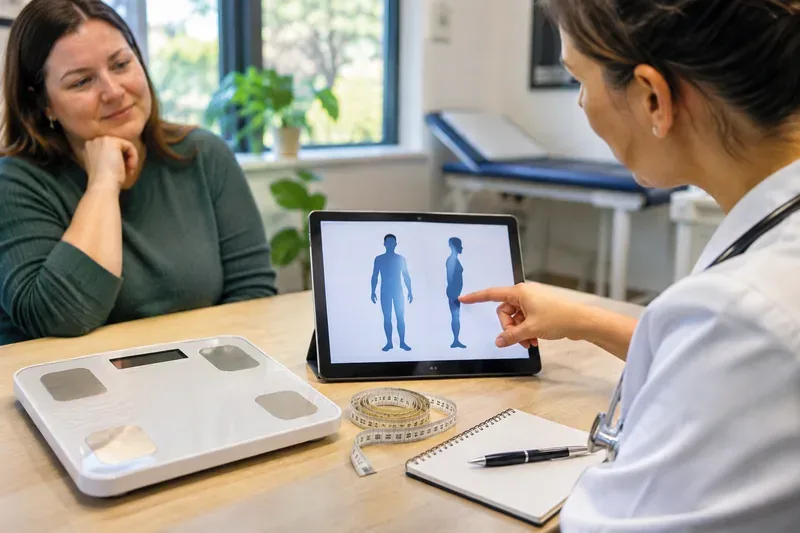
Illustration: A clinician discusses body composition and waist measurements during a consultation. The scene is illustrative, not a photograph from either research study or an NHS facility.
What did the new UK-led BMI research find on November 11?
The international paper, Validation of clinical and preclinical obesity across global cohorts, was published in Nature on November 11. Researchers assessed 844,108 participants from four cohorts, including the UK Biobank. When waist circumference and waist-to-height ratio were considered alongside BMI, the number and identity of people meeting obesity criteria changed substantially. Across cohorts, BMI on its own underestimated obesity in 5.2% to 8.6% of participants and overestimated it in 1.2% to 3.1%. These are ranges across different populations, not percentages measured solely among UK residents.
Importantly, the study examined more than body shape. It also used available health information to separate people with clinical obesity—excess adiposity linked to impaired organ function or daily activities—from those with preclinical obesity, where excess adiposity is present but those functions remain preserved. Clinical obesity represented approximately 23%–31% of obesity cases across the cohorts and was associated with a substantially higher mortality risk. The researchers also reported that 77%–91% of participants with preclinical obesity did not progress to clinical obesity over a ten-year observation period, although that does not mean their future risk was zero.
What did the separate British study reveal about BMI labels?
Also published November 11, a study in the International Journal of Obesity examined 6,978 people from the 1970 British Cohort Study using measurements gathered when participants were about 46. Standard BMI thresholds classified 32.4% as having obesity. Under the researchers' version of the newer clinical framework, 17.7% of all participants met criteria for clinical obesity, 52.5% for preclinical obesity and 29.8% for no obesity.
Among people in the BMI-defined obesity category, only 31.4% met clinical-obesity criteria; 68.6% fell in the preclinical group. That is not evidence that 68.6% were incorrectly labeled as having excess body fat, nor that they were free of future cardiovascular or metabolic risk. Rather, the newer framework distinguishes excess adiposity from an active illness attributed to that adiposity. Within the BMI-overweight group, 16.6% met the study's clinical-obesity criteria and 18% were categorized as having no obesity, illustrating mismatch in both directions.
The British study had important limitations: it focused on one birth cohort at midlife; participants with missing measurements tended to have higher BMIs; and the number of deaths was small, creating uncertainty around the mortality comparisons. Its authors called for validation in other age and demographic groups before applying the framework to individual treatment decisions. Read the British cohort study in the International Journal of Obesity.
Why can BMI misclassify obesity or health risk?
BMI divides a person's weight in kilograms by height in meters squared. The calculation is simple and useful for population monitoring, but the result does not distinguish fat from muscle, identify where fat is stored, or establish whether a condition is damaging an organ. Two individuals with the same BMI may have very different waist measurements, muscle mass, health conditions and physical functioning. Someone with a BMI below the usual obesity cutoff may carry more central fat than the number suggests, while someone with high muscle mass may cross a BMI threshold without comparable body-fat levels.
The 2025 Lancet Commission proposal on defining clinical obesity recommended using BMI as a screening measure, confirming excess adiposity with additional measurements when appropriate, then assessing organ dysfunction and functional limitations. The new November studies test aspects of that framework; they do not prove that every individual can be accurately reclassified using a waist measurement alone.
Has the NHS or NICE changed its BMI guidance?
The November research is new evidence, not an announcement that NHS diagnostic or treatment eligibility requirements have been rewritten. The current NICE guidance on assessing overweight, obesity and central adiposity continues to describe BMI as a practical screening measure, interpreted with caution. For adults whose BMI is below 35, NICE recommends considering waist-to-height ratio alongside BMI to estimate central adiposity and help evaluate cardiometabolic risks.
NICE generally advises keeping waist circumference below half of height: a waist-to-height ratio of 0.5 or more can flag increased central-adiposity risk. That 0.5 risk-screening threshold is not identical to the obesity-confirmation thresholds used in the new research, which considered population- and ethnicity-appropriate values. NICE also uses lower BMI thresholds for some ethnic groups, recognizing that cardiometabolic risk can arise at a lower BMI. The published research should not be read as replacing those existing clinical rules.
The NHS waist-to-height calculator is an educational assessment aid, not a diagnostic test. It is unsuitable for certain groups, including pregnant people and adults with BMI over 35, as explained on the tool page.
What should UK patients do if their BMI seems misleading?
There is no need to assume a BMI label is a diagnosis of illness—or proof that everything is fine. If a result conflicts with your medical history or concerns, ask a GP or another qualified healthcare professional what additional assessment would be useful. Depending on the circumstances, that conversation may include waist measurement, blood pressure, blood glucose or other clinically indicated tests, existing conditions, medications, symptoms and family history. Do not change prescribed treatment solely because of a news report or an online BMI calculator.
For clinicians and policy makers, the next question is whether the new framework improves patient outcomes and can be implemented reliably at scale. The two November 11 studies support closer assessment, but UK-wide adoption, service capacity, costs, standardized cutoffs and treatment pathways require further evaluation. No nationwide replacement date or new blanket eligibility rule was established by these papers.
FAQ
Does a normal BMI mean I have no obesity-related health risk?
No. BMI cannot directly measure visceral or central body fat, and a seemingly typical BMI does not rule out other cardiometabolic risks. A healthcare professional can assess concerns in context.
Does preclinical obesity mean a person is healthy?
Not necessarily. In the proposed framework, preclinical obesity means excess body fat is present but obesity-related organ dysfunction or functional limitations have not been established. Future risk may still warrant monitoring or preventive care.
Should people in the UK stop using BMI after these studies?
No. BMI remains a useful first-pass tool, but it should not be used as the sole judgment of an individual's health. Current NICE guidance supports additional assessment, including waist-to-height ratio in suitable adults.