01. Historical Context
Unilever's past decade argues for realism, not complacency
UL's 10-year adjusted monthly range of $32.63 to $72.50 shows how defensive consumer staples actually behave over full cycles: they can protect capital well, but they rarely sustain extreme valuations without unusually strong mix upgrades or margin surprises. That history is useful because a 2035 forecast should start from what the business has demonstrated, not from an arbitrary terminal price.
| Horizon | What matters most | What would strengthen the thesis | What would weaken the thesis |
|---|---|---|---|
| 2026-2027 | Guidance delivery and repurchases | Growth remains in the guided range and buybacks continue | Estimate cuts or weaker volume |
| 2028-2030 | Portfolio quality and margin durability | Better mix in Beauty, Wellbeing, and Personal Care | Restructuring drag and low-growth categories holding back returns |
| 2031-2035 | Per-share compounding | EPS outgrows revenue through productivity and capital returns | Valuation falls toward low-teens earnings with slower cash growth |
The hard numbers today support a disciplined long-term base case. Unilever ended 2025 with EUR50.5 billion of turnover, a 20.0% underlying operating margin, and EUR5.9 billion of free cash flow. Q1 2026 kept the business on a positive volume trajectory. That is enough to support a compounding framework through 2035, but not enough to justify assuming the market will pay a structurally rising multiple every year.
02. Key Forces
The long-term debate is about compounding quality, not headline growth
First, consensus still points to respectable earnings growth. MarketScreener's European-line estimates imply EPS moving from EUR2.59 in 2025 to EUR3.03 in 2026 and EUR3.261 in 2027. That is a healthy short-term bridge, but a 2035 forecast needs to assume growth normalizes after that burst. The realistic question is whether Unilever can hold enough volume, mix, and margin discipline to keep per-share earnings climbing over a decade.
Second, buybacks matter more over a nine-year horizon than a one-year horizon. Management's current EUR1.5 billion repurchase and the disclosed potential for up to EUR6 billion of buybacks between 2026 and 2029 meaningfully improve the long-run per-share path, especially if the stock stays closer to the middle of its historical valuation band rather than the top.
Third, the macro regime is likely to stay less forgiving than the 2010s. The IMF now sees 3.1% global growth in 2026 and 3.2% in 2027, while inflation remains sticky enough to keep the discount-rate debate active. For a defensive stock, that does not destroy the thesis, but it does keep a lid on how much multiple expansion can do for shareholders over time.
| Factor | Current Assessment | Bias | 2035 implication |
|---|---|---|---|
| Organic growth quality | Q1 2026 volume up 2.9%; FY2026 guide still positive | Bullish | Supports a steady compounding path if sustained through cycles |
| Margin profile | 2025 underlying operating margin at 20.0% | Neutral to Bullish | Needs to remain around or above 20% to justify long-run upside |
| Capital returns | Buybacks are active and potentially large through 2029 | Bullish | Can materially improve long-run EPS even in a modest growth environment |
| Valuation starting point | 11.15x trailing PE and 15.12x forward PE | Neutral | Allows gains, but does not give the stock a large valuation cushion |
| Macro regime | Growth is positive, but inflation and rates remain sticky | Neutral to Bearish | Suggests future returns should lean more on earnings than on rerating |
The crucial point is that Unilever can still be a good 2035 stock without being a spectacular one. A long stretch of mid-single-digit business growth, selective portfolio pruning, and ongoing share shrink can produce solid shareholder returns even if the valuation multiple only holds steady.
03. Countercase
The long-range bear case is a slow erosion story, not a collapse story
The most realistic bear case is not that Unilever stops making money. It is that growth gradually slows, pricing power normalizes, and investors decide the stock deserves a lower multiple because inflation stays structurally higher and volume growth becomes harder to maintain.
That risk is visible in current data. U.S. CPI is still 3.8%, first-quarter PCE inflation was 4.5%, and euro-area inflation is 3.0%. If that backdrop persists, the market can cap Unilever at a low-to-mid teens earnings multiple even while the company continues to execute reasonably well.
A second risk is that portfolio actions fail to create enough incremental value. The Foods combination with McCormick could sharpen focus, but it also creates stranded-cost and restructuring obligations. If those costs are real while the strategic upside arrives slowly, the stock's long-range upside narrows quickly.
| Risk | Latest data point | Current Assessment | Bias |
|---|---|---|---|
| Inflation persistence | U.S. CPI 3.8%, euro-area CPI 3.0% | Still a headwind to long-duration multiples | Bearish |
| Volume fatigue | Q1 2026 volume rose 2.9%, but the guide floor is only 2% | Healthy now, but worth monitoring | Neutral |
| Portfolio execution | Foods transaction comes with stranded-cost and restructuring charges | Strategically positive, execution-sensitive | Neutral to Bearish |
| Valuation reset | Forward PE around 15x is fair, not distressed | Leaves room for compression if growth disappoints | Neutral |
A 2035 bear case of $60 to $80 therefore does not require franchise damage. It only requires the market to value Unilever as a stable but slower-growth staples company for most of the next decade.
04. Institutional Lens
Long-term upside depends on what institutions are already signaling
The IMF's April 2026 update tells investors to expect moderate global growth rather than an extraordinary demand backdrop. J.P. Morgan's 2026 outlook adds an important nuance: even if inflation and growth cool, markets can still correct along the way. That combination matters for 2035 because it argues for a choppier road, not for a broken thesis.
Stock-specific consensus also points to moderation rather than exuberance. MarketScreener's analyst set still sees upside from current levels and higher EPS through 2027, while MarketBeat's ADR target band of $60.10 to $71.00 frames the near-term sell-side corridor. A serious 2035 forecast should extend that logic gradually, not extrapolate a short-term target straight into a heroic terminal price.
| Source | Updated | What it says | Implication |
|---|---|---|---|
| IMF WEO | April 14, 2026 | World growth at 3.1% in 2026 and 3.2% in 2027 | Supports a stable-demand but not high-growth backdrop |
| J.P. Morgan AM | 2026 outlook | Growth and inflation should moderate, but volatility remains likely | Long-run holders should expect resets, not a straight line |
| MarketScreener | May 2026 | 2026 EPS EUR3.03 and 2027 EPS EUR3.261 | Short-term consensus supports a compounding thesis |
| MarketBeat | May 2026 | ADR target range of $60.10 to $71.00 | Near-term upside exists, but the sell side is not calling for a huge rerating |
The institutional message is consistent: Unilever looks investable as a long-duration quality compounder, but the case rests on repeated operational delivery rather than on one big macro call.
05. Scenarios
2035 price paths with explicit triggers
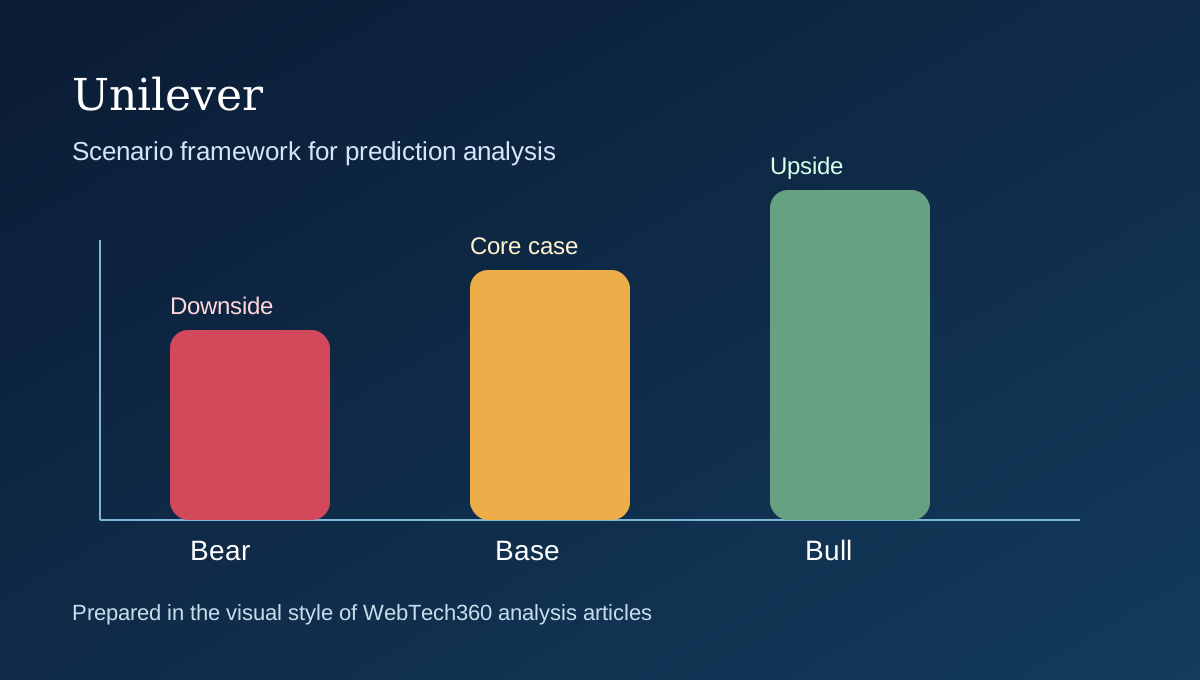
Because the forecast horizon is long, the scenario ranges matter more than any point estimate. Each path below assumes the current price of $56.24 as the starting anchor and then changes the outcome based on whether Unilever compounds through volume, margin, and capital returns or stalls into a lower multiple.
| Scenario | Probability | Trigger | Target range | Review point |
|---|---|---|---|---|
| Bull | 25% | Volume stays durably above 2%, mix improves in higher-growth categories, and repurchases remain large enough to drive per-share growth | $120 to $145 | Reassess after each full-year report, with 2027 the first proof point for whether the stronger EPS path is holding |
| Base | 40% | Sales growth stays around mid-single digits, margins remain close to 20%, and valuation holds around a mid-teens forward multiple | $90 to $115 | Review after FY2026 and then every two years against EPS and free-cash-flow delivery |
| Bear | 35% | Inflation stays sticky, growth drifts lower, and the stock trades more like a low-growth staples asset than a premium compounder | $60 to $80 | Review if annual volume growth trends below 2% or if valuation compresses below the current long-run band |
The base case remains the highest-probability path because Unilever already has the cash generation and category breadth to keep compounding. The limiting factor is that long-run staples returns are usually earned patiently, not explosively.
References
Sources
- Yahoo Finance 10-year chart data for UL
- StockAnalysis valuation statistics for UL
- Unilever FY2025 full-year announcement
- Unilever Q1 2026 trading statement
- Unilever Annual Report and Accounts 2025
- IMF World Economic Outlook, April 2026
- J.P. Morgan Asset Management 2026 investment outlook
- U.S. Bureau of Labor Statistics CPI release for April 2026
- U.S. Bureau of Economic Analysis advance GDP estimate for Q1 2026
- Eurostat flash estimate for euro-area inflation in April 2026
- MarketScreener earnings estimates for Unilever's European line
- MarketBeat analyst target range for UL