01. Historical Context
The 2027 case is mostly about whether 2026 guidance survives intact
Unilever's current 2027 setup is not starting from a broken base. The company exited 2025 with EUR50.5 billion of turnover, a 20.0% underlying operating margin, and EUR5.9 billion of free cash flow. Q1 2026 then delivered EUR12.6 billion of turnover, 3.8% underlying sales growth, and 2.9% volume growth, which is why management kept its 4% to 6% full-year growth outlook and volume expectation of at least 2%.
| Horizon | What matters most | What would strengthen the thesis | What would weaken the thesis |
|---|---|---|---|
| Next 3 months | Whether Q2 trends confirm Q1 volume | Another quarter of positive volume and resilient mix | Growth slowing toward the bottom of guidance |
| 6-12 months | FY2026 EPS delivery and buybacks | Consensus EPS upgrades and continued repurchases | Estimate cuts or weaker free-cash-flow conversion |
| To 2027 | Execution quality | 2027 EPS follows the EUR3.261 consensus path | Margin or portfolio friction interrupts the current estimate path |
That setup matters because the stock is no longer a deep-value recovery trade. At 11.15x trailing earnings and 15.12x forward earnings, UL can still rise, but the upside depends on management proving that positive volume, productivity savings, and capital returns can hold together at the same time.
02. Key Forces
The 2027 catalysts are visible and measurable
The clearest catalyst is earnings delivery. MarketScreener's estimate path of EUR3.03 EPS for 2026 and EUR3.261 for 2027 still implies solid per-share growth. If those estimates hold or rise after the next two results cycles, the stock has room to move toward the upper end of the current analyst range.
The second catalyst is productivity. Unilever said by Q1 2026 it had delivered EUR750 million of the EUR800 million productivity target due by the end of 2026. That is a meaningful margin lever for a stock whose short-term upside is more likely to come from earnings quality than from a big change in the market multiple.
The third catalyst is capital return. The EUR1.5 billion buyback already in progress and the disclosed potential for up to EUR6 billion in repurchases through 2029 improve the 2027 per-share setup if the company can keep free cash flow healthy.
| Factor | Current Assessment | Bias | Why it matters for 2027 |
|---|---|---|---|
| Volume momentum | Q1 2026 volume up 2.9% | Bullish | Positive volume is the cleanest proof that growth quality is improving |
| Guidance credibility | FY2026 growth guidance remains 4% to 6% | Bullish | Holding that range through 2026 supports the base case |
| Productivity savings | EUR750 million of EUR800 million target already delivered | Mild Bullish | Supports margin protection and EPS delivery |
| Valuation | Forward PE around 15x | Neutral | Allows upside, but only if estimates hold |
| Macro and rates | Inflation remains sticky across the U.S. and euro area | Neutral to Bearish | Can limit how far investors are willing to rerate a staples name |
The stock therefore has enough catalysts to work in 2027, but they are ordinary-corporate catalysts, not dramatic narrative ones. Investors should watch results, margins, and buybacks more closely than broad sentiment.
03. Countercase
What could stop the 2027 case from playing out
The first risk is that inflation remains sticky enough to keep rates higher for longer. U.S. CPI was 3.8% in April 2026, first-quarter PCE inflation was 4.5%, core PCE was 4.3%, and euro-area inflation was 3.0%. For Unilever, that matters less for demand than for valuation: a 15x forward multiple can compress if the rate backdrop stays uncomfortable.
The second risk is a growth miss against management's own yardstick. If underlying sales growth drops below 4% or volume slips below 2%, the market will start questioning whether consensus EPS for 2027 is too high.
The third risk is that portfolio simplification becomes more expensive than expected. The Foods combination with McCormick comes with stranded-overhead and restructuring costs, which are manageable in a stable environment but more painful if growth softens.
| Risk | Latest data point | Current Assessment | Bias |
|---|---|---|---|
| Rate pressure | Inflation remains above central-bank comfort in the U.S. and euro area | Still a live valuation risk | Bearish |
| Growth miss | Q1 sales growth was 3.8% versus a full-year guide of 4% to 6% | Needs better follow-through in the remaining quarters | Neutral |
| Execution drag | Foods transaction includes restructuring and stranded costs | Manageable, but not immaterial | Neutral |
| Valuation cushion | Forward PE near 15x | Not cheap enough to ignore misses | Neutral |
That is why the 2027 bear case does not need a recession. It only needs a combination of softer volume, stickier inflation, and a market unwilling to pay more for a defensive name.
04. Institutional Lens
The current research backdrop is constructive, but not euphoric
The IMF's April 2026 forecast of 3.1% global growth in 2026 and 3.2% in 2027 supports a modest-demand backdrop for staples. J.P. Morgan Asset Management's 2026 outlook adds that even with moderation in inflation and growth, market corrections remain plausible. For Unilever, that points to a reasonable operating environment paired with a still-debatable multiple.
On stock-specific expectations, MarketScreener showed 17 analysts with an average target of EUR59.64 on the European line, while MarketBeat showed a $65.55 average target on the ADR with a $60.10 low and $71.00 high. That sell-side corridor is the cleanest external anchor for a 2027 range because it already incorporates the current estimate set.
| Source | Updated | What it says | Why it matters for 2027 |
|---|---|---|---|
| IMF WEO | April 14, 2026 | Global growth at 3.1% in 2026 and 3.2% in 2027 | Supports demand stability rather than a sharp downturn |
| J.P. Morgan AM | 2026 outlook | Disinflation can coexist with periodic market corrections | Explains why Unilever can execute well and still trade choppily |
| MarketScreener | May 2026 | 2026 EPS EUR3.03 and 2027 EPS EUR3.261 | Current consensus still leans constructive |
| MarketBeat | May 2026 | ADR target range of $60.10 to $71.00 | Frames the most realistic near-term upside corridor |
The message from institutional inputs is that the 2027 upside is real, but it is earned through steady delivery and not through an aggressive macro bet.
05. Scenarios
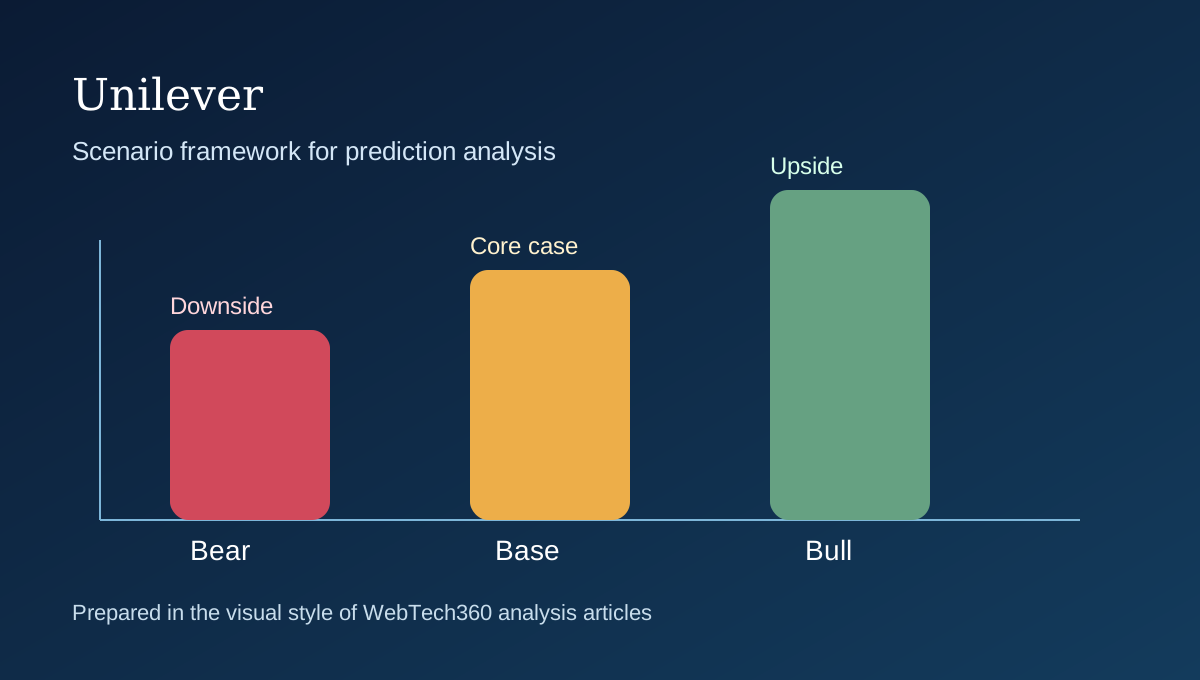
Probability-weighted 2027 scenarios
The most useful 2027 setup is one that ties price ranges to operational thresholds investors can actually monitor over the next year.
| Scenario | Probability | Trigger | Target range | Review point |
|---|---|---|---|---|
| Bull | 25% | FY2026 growth lands near the top of the 4% to 6% range, volume stays above 2.5%, and buybacks help keep EPS estimates rising | $69 to $78 | Review after the July 2026 half-year update, the Q3 2026 trading update, and the November 4, 2026 Capital Markets Day |
| Base | 45% | Guidance is delivered, volume remains positive, and valuation stays near current forward multiples | $60 to $68 | Reassess at FY2026 results when the 2027 earnings bridge is clearer |
| Bear | 30% | Growth slows below 4%, inflation stays sticky, or the market derates staples multiples | $48 to $55 | Review quickly if volume slips below the 2% guide floor or if estimates are cut |
For now, the base case remains the best fit because the company is still meeting enough of its own milestones to justify a higher 2027 range, but not yet enough to justify a major rerating above that range.
References
Sources
- Yahoo Finance 10-year chart data for UL
- StockAnalysis valuation statistics for UL
- Unilever FY2025 full-year announcement
- Unilever Q1 2026 trading statement
- Unilever Annual Report and Accounts 2025
- IMF World Economic Outlook, April 2026
- J.P. Morgan Asset Management 2026 investment outlook
- U.S. Bureau of Labor Statistics CPI release for April 2026
- U.S. Bureau of Economic Analysis advance GDP estimate for Q1 2026
- Eurostat flash estimate for euro-area inflation in April 2026
- MarketScreener earnings estimates for Unilever's European line
- MarketBeat analyst target range for UL