Home
» Today
»
Vera C. Rubin Observatory Could Test Planet X2 Beyond Neptune | Nov. 23, 2026
Vera C. Rubin Observatory Could Test Planet X2 Beyond Neptune | Nov. 23, 2026
Information checked: November 23, 2026, 3:30 p.m. Pacific Standard Time (PST, UTC−08:00); November 23, 2026, 23:30 UTC.
A new study published November 23 lays out a testable possibility: a still-undiscovered planet beyond Neptune could be responsible for distinctive orbits of distant icy objects. The Vera C. Rubin Observatory in Chile is already collecting the kind of repeated, wide-field observations that could make this theory measurable—and possibly reveal the planet itself. Crucially, no discovery of the proposed “Planet X2” has been confirmed.
The immediate change is not an addition to the list of known planets. It is a clearer set of predictions against which new telescope discoveries can be compared. Rubin's Legacy Survey of Space and Time (LSST), which began in June 2026, offers an important way to check those predictions through both direct searches for faint moving points and an expanding catalog of trans-Neptunian objects.
Destaques
A November 23 peer-reviewed study models a hypothetical planet with approximately two Earth masses on a very distant orbit; this is a simulation result, not a sighting.
Rubin could search for a faint moving object directly, while tracking many smaller icy bodies to test whether their orbital patterns match the model.
The observatory has already reported hundreds of new trans-Neptunian objects from preparatory observations and a new distant dwarf-planet candidate; neither confirms Planet X2.
New discoveries can strengthen or weaken the proposal even if no planet is photographed.
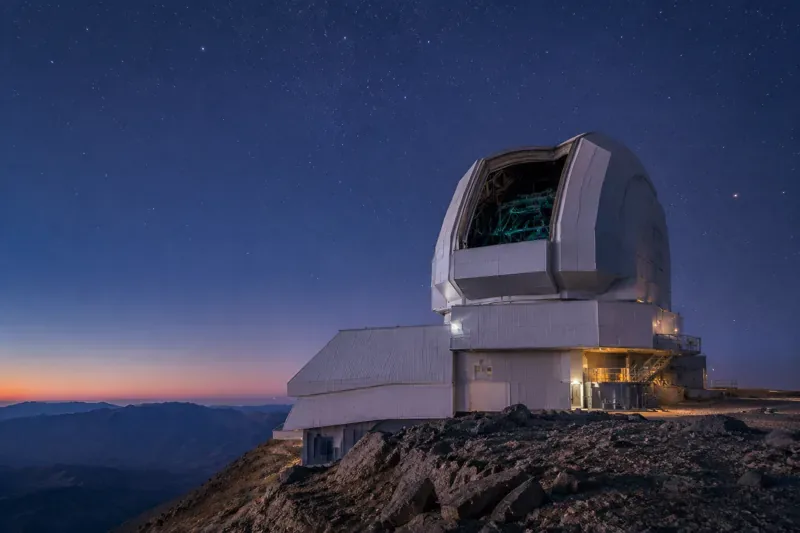
Illustrative observatory scene, not a documentary photograph of the Vera C. Rubin Observatory or a detected outer planet.
What changed in the search for planets beyond Neptune?
The paper, Signatures of an Earth-class Planet in the Distant Solar System, by Patryk Sofia Lykawka, Pedro Bernardinelli, and Jonathan Horner, compares billions of years of simulated solar-system development. The researchers tested whether migrating Neptune and early scattered planetary embryos can explain the present-day distribution of distant objects, or whether a surviving planet farther out fits better.
Their favored versions include a roughly two-Earth-mass body whose orbit has a semimajor axis of about 350–500 astronomical units (AU), a closest approach to the Sun near 200 AU, and a relatively modest orbital inclination of approximately 1–15 degrees. One AU is roughly the Earth–Sun distance; Neptune orbits at about 30 AU. These are model parameters, not measurements of an observed world.
The simulations reproduced several populations that have been difficult to explain together, including detached objects, objects on steeply inclined orbits, and extreme trans-Neptunian objects such as Sedna. However, the authors also identify a mismatch in the modeled distribution of orbital semimajor axes relative to Dark Energy Survey detections. Their favored explanation is promising but not complete. See the original research in Monthly Notices of the Royal Astronomical Society and the research team's university announcement.
How can the Vera C. Rubin Observatory actually detect a hidden planet?
Method one: find a very faint object moving against the stars
Rubin repeatedly photographs large areas of the southern sky from Cerro Pachón, Chile. A possible planet hundreds of AU away would reflect very little sunlight and creep across the sky much more slowly than typical nearby asteroids. Comparing images over time allows software to distinguish a moving solar-system body from fixed background stars and galaxies.
But discovery is conditional. An outer planet must be sufficiently bright, appear in the areas covered by the survey, and be identified despite its extremely slow apparent movement. A single unexplained point of light would not suffice. Astronomers would need repeat observations, an orbital solution, and independent follow-up to exclude asteroids, processing artifacts, or another smaller body. A non-detection would also need careful interpretation: faintness, sky coverage, and orbit assumptions matter.
Method two: test the gravitational fingerprints in smaller worlds
The more powerful near-term result may be statistical. A massive distant planet could alter the paths of many small objects over immense timescales. Astronomers can examine orbital inclinations, perihelion distances (closest approaches to the Sun), and the abundance of detached and extreme populations. The Planet X2 proposal predicts particular combinations of these properties.
Rubin's repeated images can discover new trans-Neptunian objects and extend observations of known ones. More precisely measured orbits produce a more useful comparison between planetary models and the actual solar system. Importantly, researchers must model the survey's detection biases: a telescope does not see every faint body equally, and an apparent orbital clustering can arise from where and how observers look.
What has Rubin Observatory already discovered in 2026?
According to the observatory, before LSST formally began in June 2026, its solar-system team submitted more than 11,000 new asteroid observations to the Minor Planet Center, including approximately 380 new trans-Neptunian objects. Rubin subsequently announced a distant object designated 2025 ED138 as its first dwarf-planet candidate. A candidate is not the same as a formally confirmed dwarf planet, much less an unseen massive Planet X2.
These achievements matter because the question has long been limited by sample size. A well-measured population—not just one unusual orbit—can distinguish between competing stories about the outer solar system. Rubin also supports searching earlier images for an object after its initial discovery, a process called precovery, to lengthen its observed arc and refine its orbit. The Rubin Observatory's official report describes these early results.
Is Planet X2 the same as Planet Nine?
No. Planet X2 is the name used for the comparatively Earth-class planet tested in this study. The familiar Planet Nine hypothesis generally refers to a different, more massive distant planet proposed to account for certain unusual orbital arrangements. Different assumptions lead to different masses, locations, and observable signatures. The new paper includes a limited Planet Nine comparison, but it does not conclusively rule that hypothesis out or establish that either planet exists.
What happens next—and how can readers follow reliable evidence?
As LSST accumulates repeated sky coverage, researchers can compare newly discovered distant bodies with the predicted orbital distributions and refine the computer models. If a plausible planetary point source appears, additional imaging and orbit determination will be essential before a discovery announcement is justified. If the growing population fails the model's predictions, the case for this particular Planet X2 configuration could weaken even without a direct observation.
For readers, the useful distinction is between a proposed gravitational explanation, a telescope candidate, and a confirmed planet. Look for the original journal study, official Rubin Observatory notices, follow-up measurements, and independent confirmation. Be skeptical of headlines that promote a modeled mass or orbital distance into a measured fact. The public can also explore Rubin's reported discoveries through the observatory's official site and its Orbitviewer links.
There is no established date by which Rubin must identify Planet X2, and no verified sighting as of this information check. What the telescope can deliver is a more decisive test: either a credible new world to investigate, or much better evidence about whether one is needed to explain the distant solar system at all.
FAQ
Has the Vera C. Rubin Observatory found Planet X2?
No. As of November 23, 2026, Planet X2 is a hypothesis tested with computer simulations, not a confirmed detection.
Could Rubin find a planet farther away than Neptune?
Potentially. Its repeated, sensitive sky imaging could reveal a distant moving object if it is bright enough and within the survey's coverage. It can also test indirect orbital signatures.
Why do astronomers study tiny icy objects to search for a planet?
Their long-term orbital patterns may preserve evidence of gravitational disturbances. A large, carefully analyzed sample helps test whether a hidden massive planet explains those patterns better than alternatives.