01. Historical Context
Visa in context: what the last decade says about the next move
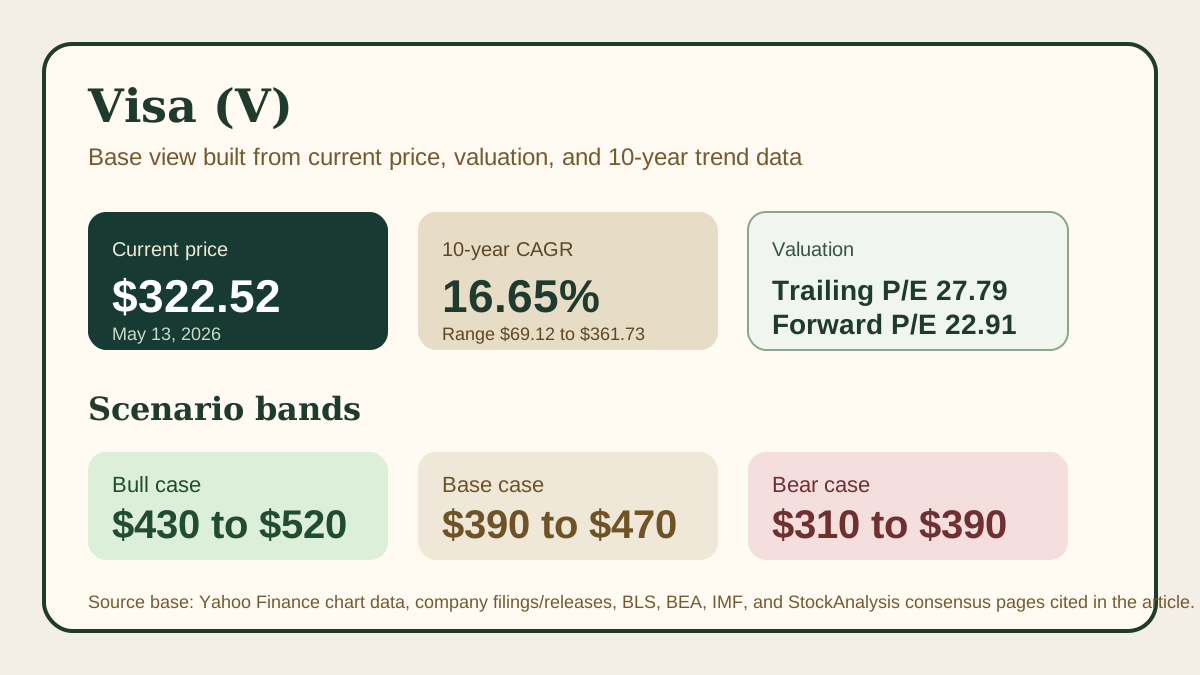
Visa has already shown what durable compounding looks like over a full cycle. Adjusted chart data from Yahoo Finance puts the stock at $69.12 ten years ago and $322.52 on May 13, 2026, a roughly 16.65% annualized gain, with a 10-year trading corridor from $69.12 to $361.73.
| Horizon | What matters most | What would strengthen the thesis | What would weaken the thesis |
|---|---|---|---|
| 1-3 months | Price action versus $322.52, revisions, and macro prints | EPS revisions stabilize and inflation cools | Hot inflation or weaker spending data |
| 6-18 months | Whether EPS tracks 13.44 for this year and 14.61 next year | Execution, capital returns, and cleaner macro | Multiple compression or guidance resets |
| To 2030 | 10-year CAGR of 16.65% and capital allocation durability | Sustained compounding with disciplined valuation | Structural slowdown or premium-rating loss |
That history matters because it anchors what is realistic. A stock that has compounded for a decade can keep rising, but future returns usually come from a mix of earnings growth and disciplined re-rating, not from narrative alone.
The practical takeaway is that investors should start with current earning power, the range of plausible multiples, and the macro corridor rather than with a single headline target.
02. Key Forces
Five forces that matter most for the path ahead
Valuation is the first checkpoint. Recent StockAnalysis data put Visa at a trailing P/E of 27.79 and a forward P/E of 22.91, while consensus EPS stands at 11.47 on a trailing basis, 13.44 for the current fiscal year, and 14.61 for the next. That is enough to support upside, but not enough to excuse weak execution.
Macro is the second checkpoint. U.S. real GDP rose at a 2.0% annualized pace in the first quarter of 2026, but inflation moved the wrong way: headline CPI rose 3.8% year over year in April 2026 and the PCE price index was up 3.5% year over year in March, with core PCE at 3.2%. That mix keeps the soft-landing thesis alive while making the market less tolerant of valuation excess.
The third force is company-specific execution. Visa reported fiscal second-quarter 2026 net revenue of $11.2 billion, up 17% year over year. GAAP EPS was $3.14 and non-GAAP EPS was $3.31. That latest print matters more than macro rhetoric because the next rerating has to be earned in the income statement.
Fourth, consensus matters because expectations now move faster than fundamentals. A bullish setup is healthiest when revisions, breadth, and valuation all improve together. A bearish setup appears when one of those legs breaks first and the multiple no longer absorbs disappointment.
Fifth, scenario discipline matters more than point forecasts. A realistic price range should be built from earnings power, the multiple investors have recently been willing to pay, and the evidence needed to defend either a re-rating or a de-rating.
| Factor | Latest evidence | Current assessment | Bias |
|---|---|---|---|
| Valuation | Trailing P/E 27.79 and forward P/E 22.91 on May 8, 2026. | A premium multiple is still justified by network economics, but not by perfection. | Neutral |
| Earnings power | Consensus EPS is $13.44 for FY2026 and $14.61 for FY2027. | Double-digit EPS compounding is still intact. | Bullish |
| Transaction growth | 2Q26 payments volume +9%, cross-border ex-Europe +11%, processed transactions +9%. | Demand trends still support high-quality top-line growth. | Bullish |
| Macro backdrop | 1Q26 U.S. GDP +2.0% annualized; March PCE inflation 3.5%. | Spending is holding up, but inflation pressure can squeeze real consumption mix. | Neutral |
| Street expectations | Average 12-month target was $395.05 on May 8, 2026. | Consensus still sees upside, but expectations are already high. | Bullish |
The stock does not need every factor to turn positive at once. It does need the positive factors to stay strong enough that the market keeps paying the current multiple, or a higher one, with evidence rather than hope.
03. Countercase
What would break the thesis
Visa's premium multiple compresses quickly if real consumer spending slows. That risk is more relevant after April 2026 CPI re-accelerated to 3.8% year over year and March PCE inflation ran at 3.5%.
Cross-border is one of Visa's most profitable growth vectors, so any travel slowdown or FX shock can hit earnings quality more than revenue alone suggests.
Regulatory and litigation pressure never fully disappears for global payments networks. The business model is strong, but the multiple assumes political noise remains manageable.
With trailing P/E near 28x, Visa does not need an earnings miss to fall; it only needs growth to look ordinary for a quarter or two.
| Investor type | Main risk | Suggested posture | What to monitor next |
|---|---|---|---|
| Already profitable | Multiple compression after a strong run | Trim into strength if the premium outruns revisions | Inflation prints, EPS revisions, and valuation |
| Currently losing | Averaging into a thesis that is merely getting cheaper | Only add if fresh data improves the thesis | Guidance, capital returns, and macro follow-through |
| No position | Buying a quality stock at the wrong part of the cycle | Wait for valuation or momentum confirmation | Support zone, estimates, and breadth |
The point of a countercase is not to manufacture fear. It is to define the conditions under which today's valuation stops being deserved and starts becoming fragile.
04. Institutional Lens
What current institutional and primary-source evidence says
Institutional research is useful only when it is specific enough to test. In this case, the most relevant external lenses are the latest company results, U.S. macro releases, IMF baseline work, Goldman Sachs Research on growth and market leadership, and current consensus earnings estimates.
Base case remains bullish because Visa still combines double-digit earnings growth with a high-quality global network, but the multiple leaves less margin for error if spending data cools or regulation bites.
The common thread across these sources is that the macro backdrop is still supportive enough for quality franchises, but not so easy that investors can ignore valuation or operating execution.
| Source | Updated | What it said | Why it matters now |
|---|---|---|---|
| Visa fiscal 2Q26 results | April 28, 2026 | Revenue $11.2B, GAAP EPS $3.14, payments volume +9%, cross-border ex-Europe +11%, processed transactions 66.1B. | Confirms the network is still compounding at scale. |
| Goldman Sachs Research | April 29, 2026 | Goldman said U.S. stocks can rise 6% in 2026, with AI investment driving roughly 40% of S&P 500 earnings growth and capex by major cloud firms reaching $670B. | A still-healthy corporate and consumer backdrop supports payment volumes, but also keeps expectations elevated. |
| IMF U.S. Article IV | April 1-2, 2026 | The IMF expects unemployment to stay near 4% in 2026-27 while inflation risks stay tilted upward. | That is constructive for volume growth but a reminder that real spending can narrow if inflation persists. |
| StockAnalysis consensus | May 8, 2026 | Consensus EPS $13.44 in FY2026 and $14.61 in FY2027; average target $395.05. | Implies room for upside if the premium multiple holds. |
This is why the base case should be expressed as a range with explicit review triggers, not as a heroic single-number forecast.
05. Scenarios
Scenario analysis and review triggers
The cleanest way to turn this analysis into action is to tie price ranges to explicit probabilities, triggers, and review points. That keeps the thesis falsifiable.
| Scenario | Probability | Target range | Measurable trigger | Review point |
|---|---|---|---|---|
| Bull case | 30% | $430 to $520 | Cross-border volume stays in the double digits and processed transactions keep compounding near recent levels. | Re-underwrite after each full-year result and the 2027 macro reset |
| Base case | 50% | $390 to $470 | Current earnings and macro data stay close to consensus without a deep valuation reset. | Re-underwrite after each full-year result and the 2027 macro reset |
| Bear case | 20% | $310 to $390 | Consumer spending softens as inflation stays hot and real discretionary budgets narrow. | Re-underwrite after each full-year result and the 2027 macro reset |
The value of the framework is that it tells investors exactly what would force an upgrade, a downgrade, or a full reset of the thesis.
References
Sources
- Yahoo Finance 10-year chart data for Visa
- Visa announces second quarter 2026 financial results
- Visa second-quarter 2026 earnings release on SEC
- StockAnalysis Visa statistics
- StockAnalysis Visa forecast
- BLS CPI April 2026 release
- BEA GDP advance estimate, 1Q26
- BEA PCE price index data
- IMF U.S. 2026 Article IV consultation
- Goldman Sachs Research on U.S. stocks in 2026