01. Historical Context
Volkswagen in context: why 2030 depends on compounding, not on one headline
The base case is straightforward: Volkswagen still has enough operating evidence to justify a constructive stance, but the return path depends on whether execution continues to outrun a tougher macro backdrop. Recent price action matters only because it now sits on top of specific, checkable numbers rather than on a vague story.
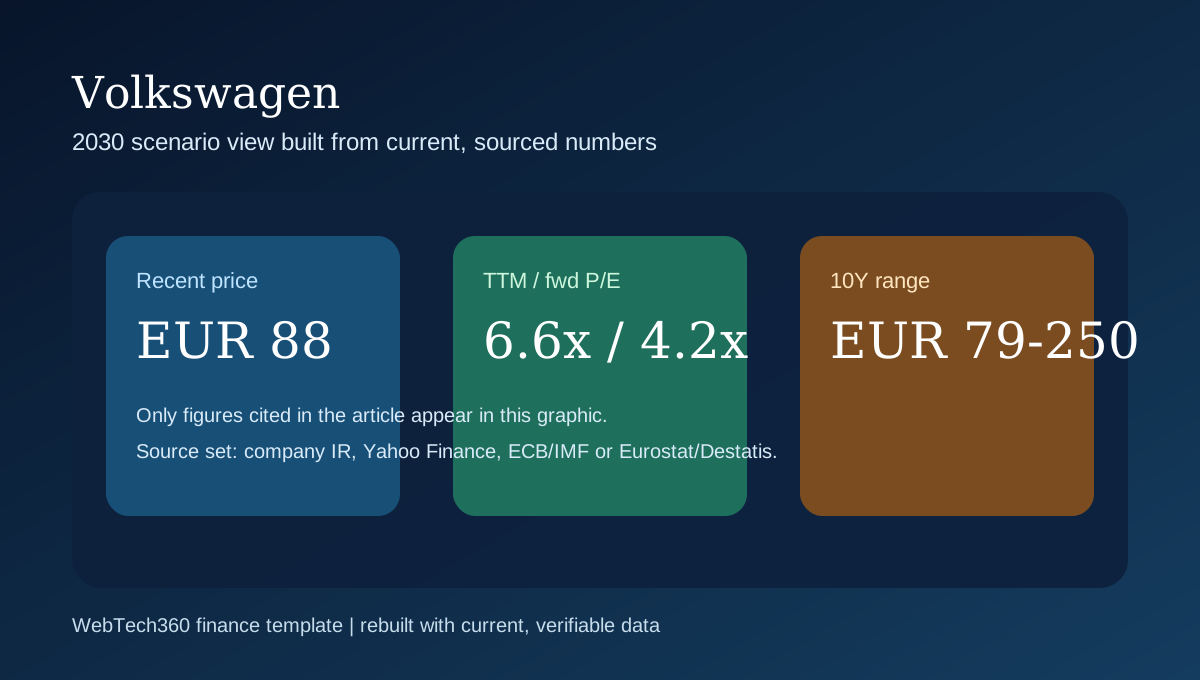
As of May 6, 2026, recent Yahoo Finance quote pages showed Volkswagen around EUR 88.46, with a 52-week range of EUR 83.24 to EUR 108.90. The longer context is important too. MarketScreener's ten-year range snapshot put the stock between EUR 79.2 to EUR 250.0, which is why the next move should be judged against long-cycle valuation discipline, not just the last quarter.
| Horizon | What matters most | What would strengthen the thesis | What would weaken the thesis |
|---|---|---|---|
| 1-3 months | Whether Europe orders can offset China weakness and tariff noise | Europe order bank stays above year-end 2025, group margin improves from the 3.3% Q1 FY2026 starting point, and tariff assumptions do not worsen | China keeps falling faster than Europe can absorb and tariff effects widen beyond what guidance assumes |
| 6-18 months | Margin rebuild and software-defined-vehicle execution | The group moves back toward its 4.0%-5.5% operating margin guide while CARIAD losses narrow and Europe BEV demand stays constructive | Low-margin volumes persist and cash flow improvement proves temporary |
| To 2030/2035 | Capital discipline in a structurally difficult auto market | Cheap valuation converges with stronger execution, especially in Europe and software | The stock stays optically cheap because returns and China mix never normalize |
02. Key Forces
The five forces that matter most from here to 2030
The first question is valuation. Volkswagen does not trade in a vacuum. The market is already expressing a view about the durability of earnings through today's multiple, and that multiple must be reconciled with current guidance, not with optimistic language. Recent Yahoo Finance statistics placed the stock near 6.6x trailing earnings and 4.2x forward earnings.
The second question is whether macro conditions are helping or hurting the next leg. ECB staff projections from March 2026 still point to euro area GDP growth of 0.9% in 2026, while Eurostat's flash estimate showed euro area inflation at 3.0% in April 2026. That is not recessionary, but it is not a clean disinflation backdrop either.
The third question is quality of execution. A stock can absorb macro noise when orders, margins, and cash conversion keep beating expectations. It struggles when investors have to defend the thesis with adjectives instead of data.
| Factor | Current Assessment | Bias | What the latest data says |
|---|---|---|---|
| Valuation | Cheap | Bullish | Recent Yahoo Finance snapshots placed Volkswagen near 6.6x trailing and 4.2x forward earnings. |
| Europe demand | Improving | Bullish | Q1 2026 order bank in Europe was roughly 15% above year-end 2025; BEV order intake rose 4%. |
| China exposure | Weak | Bearish | Q1 2026 vehicle sales in China were down 20%. |
| Cash flow and liquidity | Recovered in Q1 but must hold | Neutral | Automotive net cash flow improved to EUR 2.0 billion in Q1 2026 and net liquidity stayed solid at EUR 34.2 billion. |
| Margin repair | Incomplete | Neutral to bearish | Group operating margin was 3.3% in Q1 2026 versus 3.7% a year earlier, still below the 4.0%-5.5% full-year guide. |
03. Countercase
What would break the 2030 thesis
The main bearish case is not that the business suddenly stops working. It is that the market asks for a lower multiple at the same time that one or two operating lines soften. When inflation stops falling cleanly and investors have already paid up for a good story, the downside can come from valuation first and fundamentals second.
The other risk is timing. Guidance is only useful if investors trust that it still fits the environment. That trust usually weakens quickly once tariffs, input costs, or regional demand stop behaving the way management assumed at the beginning of the year.
| Risk | Latest data point | Why it matters now |
|---|---|---|
| China weakness | Q1 2026 vehicle sales fell 7% overall, with China down 20%. | If the largest problem geography does not stabilize, cheap valuation can stay cheap. |
| Tariff risk | Volkswagen explicitly said the impact of a Middle East escalation is excluded from guidance and current tariff assumptions are baked in. | A worse tariff regime would hit both margins and investor confidence. |
| Thin profitability | 2025 operating margin was 2.8%; Q1 2026 margin was 3.3%. | The path back to 4.0%-5.5% is improvement, not delivery yet. |
| Macro sensitivity | Germany CPI was 2.9% in April 2026 and euro area inflation 3.0%. | Sticky inflation keeps financing costs and consumer affordability under pressure. |
| Execution complexity | CARIAD still lost EUR 420 million in Q1 2026 despite improvement from -EUR 755 million. | Software improvement is real, but the turnaround is unfinished. |
04. Institutional Lens
What current institutional data says about the long-range setup
The institutional picture is clearest when sources are separated. IMF and ECB publications define the macro corridor. Company releases define what management is actually delivering. Market data services such as Yahoo Finance define what investors are already pricing.
For Volkswagen, the numbers currently point to a market that is neither blind nor complacent. The stock is not priced as a distressed asset. It is also not priced for perfection in the same way a hyper-growth software name might be. That is why scenario analysis remains more useful than a single heroic target.
| Source | Updated | What it says | Type |
|---|---|---|---|
| Volkswagen Group | April 30, 2026 | Q1 2026 revenue EUR 75.7 billion, operating result EUR 2.5 billion, margin 3.3%, automotive net cash flow EUR 2.0 billion, Europe order bank +15%. | Company release |
| Volkswagen Annual Report | Fiscal 2025 | Revenue EUR 321.9 billion, operating result EUR 8.9 billion, operating margin 2.8%, automotive net liquidity EUR 34.5 billion. | Annual report |
| Volkswagen deliveries | Fiscal 2025 | Group delivered 8.98 million vehicles in 2025; BEV deliveries rose 32% to 983,120 and BEV share reached 10.9%. | Annual report |
| Yahoo Finance | Late April to early May 2026 snapshots | Recent market snapshots showed Volkswagen near EUR 88.46, trailing P/E near 6.6x, forward P/E near 4.2x, and a 1-year target estimate of EUR 112.90. | Market data and analyst consensus |
| ECB and IMF | March-April 2026 | ECB still sees euro area GDP growth of 0.9% in 2026, while IMF projects global growth of 3.1% in 2026. | Macro baseline |
05. Scenarios
Probability-weighted 2030 scenarios that can actually be monitored
The 2030 framework should start from current price, current valuation, and the past decade's trading history. For Volkswagen, that means using EUR 88.46 as the current anchor, EUR 79.2 to EUR 250.0 as the longer-cycle reference, and today's operating guidance as the bridge between those two points.
The purpose of the scenarios below is not to imply certainty. It is to define what would need to happen for each range to make sense, and when the thesis should be reviewed again.
| Scenario | Probability | Target range / outcome | Trigger | When to review |
|---|---|---|---|---|
| Bull | 25% | EUR 130-EUR 175 | Execution keeps beating guidance, valuation stays resilient, and the key growth engines keep taking mix share. | Review after each full-year report; major checkpoint at fiscal 2027 and fiscal 2028 results. |
| Base | 50% | EUR 90-EUR 120 | Growth stays positive, cash flow holds up, and multiples drift only modestly from today's levels. | Review after each full-year report; re-underwrite if two consecutive quarters miss the operating pattern. |
| Bear | 25% | EUR 45-EUR 70 | Inflation stays sticky, regional demand disappoints, and the market cuts the valuation range. | Reassess immediately after a guidance cut or after macro conditions move decisively against the thesis. |
References
Sources
- Yahoo Finance quote for Volkswagen (current price, 52-week range, target estimate)
- Yahoo Finance statistics snapshot for Volkswagen (valuation measures as of May 2026)
- Volkswagen Group Q1 2026 results
- Volkswagen Group Annual Report & Full Year Results 2025
- Volkswagen Group deliveries in 2025
- Volkswagen Group and Rivian progress update
- Qualcomm and Volkswagen software-defined vehicle announcement
- IMF World Economic Outlook, April 2026
- ECB staff macroeconomic projections for the euro area, March 2026
- Eurostat flash inflation for April 2026
- Destatis Germany CPI for April 2026
- MarketScreener Volkswagen quote page (10-year trading range snapshot)