Home
» Today
»
What Are Peptides? How They Work and Canada’s Latest Safety Warning (Nov. 7, 2026)
What Are Peptides? How They Work and Canada’s Latest Safety Warning (Nov. 7, 2026)
Information verified November 7, 2026, at 12:06 p.m. UTC (7:06 a.m. Toronto, EST, UTC−05:00).
Peptides are short chains of amino acids—the building blocks of proteins. Your body makes them naturally, and many act as messengers that help regulate processes such as hormones, blood sugar, and tissue repair. The word also appears on skin-care labels, supplement tubs, and prescription drug packaging. Those products do not necessarily work the same way or have the same evidence behind them.
For readers in Canada, there is an important current safety distinction. On November 6, 2026, Health Canada warned about bacterial contamination in unauthorized injectable peptide and other drug products sold online. That warning concerns particular unauthorized products, not all natural peptides, approved peptide medicines, or ordinary peptide skin-care ingredients. It is a reminder that knowing what a peptide is does not establish that a product is safe or effective.
Destaques
Peptides are linked amino acids; their sequence and shape help determine what, if anything, they do in the body.
Natural peptides, approved prescription peptide drugs, cosmetic peptides, and research chemicals are not interchangeable.
Some peptide-based medicines have proven uses, but anti-aging and performance claims for unauthorized injections are not established by their peptide label.
In Canada, check relevant product authorization and avoid unauthorized injectable peptides, including products marked “research use only.”
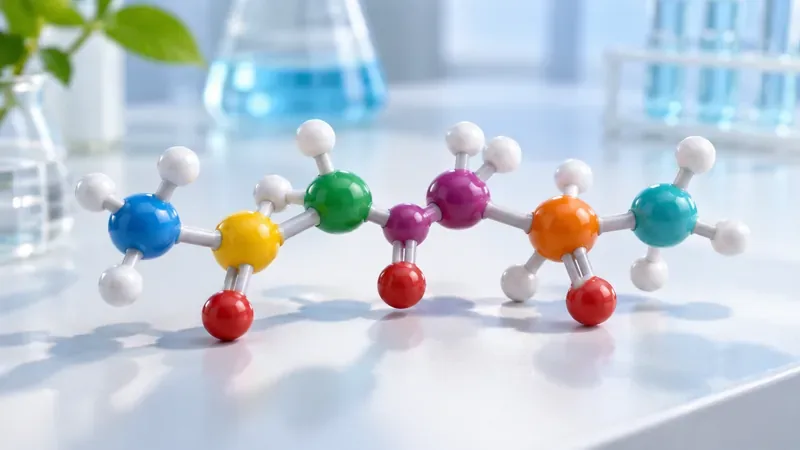
Conceptual laboratory illustration of an amino-acid chain; it is not the verified chemical structure of a particular drug or peptide.
What exactly is a peptide?
Imagine amino acids as beads on a string. A chemical link called a peptide bond joins one bead to the next. Two joined amino acids make a dipeptide; three make a tripeptide. Chains of varying lengths can fold or interact with other molecules in different ways. The U.S. National Human Genome Research Institute describes peptides as typically containing about 2 to 50 amino acids, while longer chains are often called polypeptides. This is a useful introduction, not a rigid scientific boundary between every peptide and protein.
The main difference between a small peptide and a larger protein is not simply that one is “good for skin” and the other “builds muscle.” Many proteins contain one or more long, folded polypeptide chains, and their precise three-dimensional shapes let them carry out structural, chemical, or regulatory jobs. A peptide can also have a specific biological role. The NHGRI peptide glossary offers a concise description of this relationship.
How do peptides work in the body?
There is no single “peptide effect.” A peptide's amino-acid sequence, structure, location, and ability to reach a particular target all matter. Some act as chemical signals that bind to receptors on cells, rather like a key fitting a specific lock. Others participate in immune responses or help regulate growth and tissue maintenance. When the signal is received, the cell may change how it processes nutrients, releases another substance, or responds to its environment.
Natural peptide hormones provide an everyday example. Insulin, commonly described as a peptide hormone, helps regulate blood glucose. Other signaling peptides participate in appetite and digestion. Some synthetic peptide medicines are designed to imitate or modify specific biological signals, but their effects are highly dependent on the molecule, dose, formulation, and clinical condition. Health Canada's peptides overview describes natural and manufactured peptides and explains that many oral peptides are broken down during digestion.
Where do you encounter peptides in everyday life?
Context
What it means
What to check
Inside the body
Natural signaling and functional molecules
Biological role, not a commercial health claim
Prescription medicines
Specific peptide-based therapies for diagnosed conditions
Canadian authorization, indication, risks, prescriber guidance
Skin-care products
Ingredients included in a topical cosmetic formulation
Actual ingredient, concentration, formulation, quality of evidence
Oral collagen peptides
Hydrolyzed protein fragments sold in food or supplement products
Product-specific evidence and applicable regulatory category
Online injectable “research peptides”
Often unapproved substances promoted for human use
Avoid unauthorized products; seek professional advice
Are peptide medications the same as peptide supplements?
No. A prescription medication is evaluated for specific approved indications, dosing, manufacturing quality, and known risks. Canada has authorized peptide-based medicines such as insulin and certain medicines involving the GLP-1 signaling pathway, including semaglutide and tirzepatide products. Whether a particular brand or formulation is appropriate depends on its approved labeling and individual medical circumstances. An online powder or injectable vial does not become an equivalent medication just because its seller lists a similar ingredient name.
Peptide products taken by mouth face another obstacle: digestive enzymes can break them into smaller fragments before they reach their intended target. Some prescription formulations use special approaches to delivery, but this cannot be assumed for ordinary supplements. Do not infer that swallowing, applying, or injecting the same named substance produces an equivalent effect.
Do peptide creams or collagen peptides reduce wrinkles?
Some cosmetic peptides are formulated to support the appearance of skin, while collagen peptides are typically consumed orally. Their effects differ from those of a prescription drug. A 2026 systematic review of 19 randomized trials involving 1,341 participants found some improvements in skin hydration and other measures, but effects on elasticity were inconsistent and results varied considerably across formulas. Only two of the reviewed trials studied topical products, so the findings should not be generalized to every peptide cream.
For Canadians shopping for skin care, look beyond a product's “peptide” marketing. Health Canada explains that cosmetic claims should not imply treatment of disease or alteration of body functions without the appropriate regulatory status. A skincare ingredient list, tolerability, and the study design supporting a claim matter more than a dramatic before-and-after image. See Health Canada's cosmetic advertising and labeling guidance.
Why is Health Canada warning about injectable peptides?
The November 6, 2026, advisory followed testing of unauthorized injectable products sold online. Health Canada reported finding bacteria in some seized products and warned that contamination can cause serious infection, potentially requiring hospitalization. The agency also identifies risks from mislabeled strength, unknown ingredients, and poor manufacturing or storage. Its findings should not be read as a claim that all peptide products have been contaminated.
Claims about accelerated injury recovery, muscle growth, anti-aging, or general wellness should be treated carefully when they concern unapproved peptide injections. Health Canada's regulatory guidance states that injectable peptides are classified as drugs in Canada, and that authorized drug and natural health products have an eight-digit Drug Identification Number (DIN) or Natural Product Number (NPN), as applicable. Cosmetics are regulated separately; not every cosmetic is expected to carry a DIN or NPN.
How can Canadians check a peptide product before buying it?
Identify the category. Is this a prescribed medicine, a cosmetic, a food or natural health product, or something sold as a research chemical?
Read the exact name and intended use. A familiar scientific-sounding peptide name alone says little about the tested formulation or approved purpose.
Question broad promises. “Anti-aging,” “recovery,” and “performance” are not substitutes for controlled human evidence.
Avoid unauthorized injections. “For research use only” does not certify safety for personal use. Use prescription medication only as directed by a licensed professional and obtain it from a licensed pharmacy.
If you have used an unauthorized injectable product and develop redness, swelling, pain at the injection site, fever, chills, or feel unwell, seek immediate medical care. Do not wait for a seller to confirm whether a vial was part of a reported seizure. For any peptide medicine you currently take under medical supervision, discuss concerns with your prescriber rather than changing treatment based on a social-media post.
What could change as peptide research advances?
Researchers are studying how to make peptides more stable, deliver them to the right tissues, and distinguish promising early laboratory results from meaningful benefits in people. Those advances may yield new treatments, but they do not establish the effectiveness of every compound advertised today. Health Canada notes that products under investigation in clinical trials are not necessarily proven safe or effective. The practical rule is to judge each peptide product by its identity, evidence, authorization, and intended route of use—not the popularity of peptides as a category.
FAQ
Are peptides just smaller proteins?
They are both made of amino acids, but peptides are generally shorter chains. Proteins are often longer, folded chains or assemblies that perform diverse functions.
Are all peptides safe to use?
No. Natural peptides in your body are not equivalent to an unauthorized injectable product. Safety depends on the substance, formulation, route, dose, manufacturing quality, and intended use.
Can I buy peptide injections online in Canada?
Do not buy unauthorized injectable peptides. Prescription peptide drugs should be obtained through licensed pharmacies under the care of a licensed healthcare professional, with Health Canada authorization verified when applicable.