Verified update: November 24, 2026, at 17:10 UTC (12:10 p.m. EST).
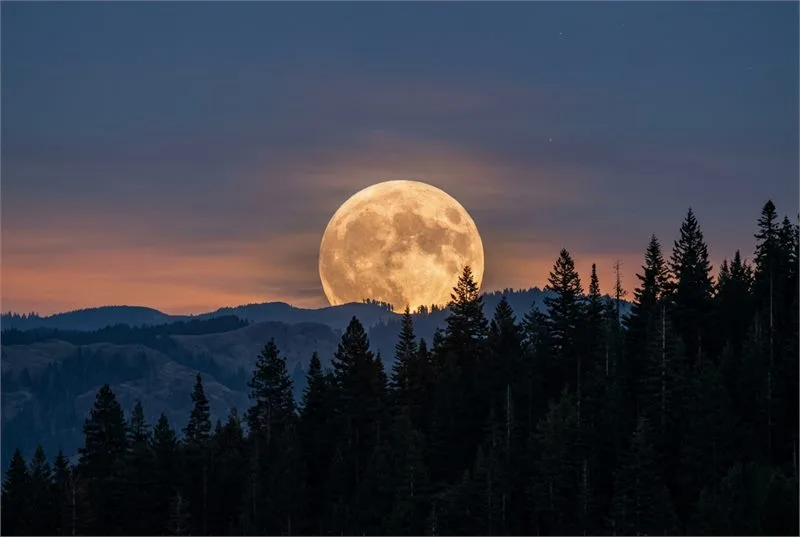
A dazzling full supermoon commands the night sky this evening, appearing noticeably larger and significantly more luminous than a standard monthly full moon. While folklore and seasonal naming often dub late-autumn lunar displays after nature—such as the Beaver Moon—the phenomenon captivating millions of skywatchers across North America is driven entirely by celestial mechanics: the intersection of an elliptical orbit and precise gravitational alignment.
Astronomically known as a perigee-syzygy, tonight's event marks the moment when the Moon reaches its closest orbital approach to Earth while simultaneously positioned directly opposite the Sun. This geometry brings the lunar surface tens of thousands of miles closer to Earth than its farthest orbital extremes, exerting a profound gravitational pull on Earth's oceans and delivering an unmistakable visual spectacle for observers worldwide.
Destaques
- Orbital Perigee: The Moon passes through its closest approach to Earth at approximately 225,800 miles (363,300 km), compared to its distant apogee of 251,700 miles.
- Syzygy Alignment: A straight-line geometric configuration aligns the Sun, Earth, and Moon, generating peak lunar illumination and stronger gravitational tides.
- Visual Scale & Luminance: Tonight's supermoon appears up to 14% larger in diameter and roughly 30% brighter than an apogee micromoon.
- Perigean Spring Tides: The combined gravitational tug elevates coastal high tides into King Tides along continental coastlines.
Why Is the Moon's Orbit Elliptical Instead of Circular?
The foundation of every supermoon lies in the geometry of the Moon's orbital path. Rather than tracing a static, perfect circle around Earth, the Moon follows an eccentric elliptical orbit, as first mathematically described by Johannes Kepler and later refined by Isaac Newton's laws of gravitation.
Because of this elliptical eccentricity, the distance separating Earth's center from the Moon continuously varies over the course of its roughly 27.3-day sidereal orbit. The orbit features two extreme points:
- Perigee: The closest orbital point to Earth, averaging roughly 225,800 miles (363,300 kilometers).
- Apogee: The farthest orbital point, averaging approximately 251,700 miles (405,500 kilometers).
This difference of nearly 30,000 miles (roughly 50,000 kilometers) represents a substantial physical variation. When the Moon swings past perigee, it traverses space noticeably closer to Earth's atmospheric envelope than during its apogee passage two weeks earlier or later.
What Is Syzygy and How Does It Trigger a Supermoon?
Proximity alone does not create a supermoon. A supermoon requires the confluence of two distinct astronomical phenomena: orbital proximity (perigee) and celestial alignment (syzygy).
In celestial mechanics, syzygy refers to the gravitational straight-line alignment of three astronomical bodies. In the Sun-Earth-Moon system, syzygy occurs twice during every 29.5-day synodic lunar cycle:
- New Moon: When the Moon passes between Earth and the Sun, presenting its darkened face to Earth.
- Full Moon: When Earth sits between the Sun and the Moon, allowing unobstructed sunlight to illuminate the entire lunar nearside.
Because the lunar orbital period from perigee to perigee (anomalistic month, ~27.55 days) does not match the lunar phase cycle from full moon to full moon (synodic month, ~29.53 days), perigee and the full moon phase do not always coincide. When the orbital timing synchronizes so that the full moon occurs within 90% of its closest approach to Earth, astronomers designate the event a perigee-syzygy—popularly known as a supermoon.
How Much Bigger and Brighter Does Tonight's Supermoon Actually Look?
Compared to a micromoon (a full moon occurring near apogee), tonight's perigee full moon subtends an apparent angular diameter up to 14% larger in the night sky. In terms of total surface area and reflected solar radiation, it reflects up to 30% more light toward Earth.
While a seasoned astrophotographer or telescope user can easily measure this diameter difference, casual backyard observers viewing the moon high overhead in open sky often find the visual size increase subtle. However, when the supermoon rises above the eastern horizon at dusk, a psychological phenomenon known as the "Moon illusion" magnifies its apparent dimensions against silhouetted foreground objects such as trees, hills, and architecture.
Physical Impacts: Perigean Spring Tides and Ocean Dynamics
The celestial mechanics behind tonight's supermoon extend far beyond optical aesthetics. Gravitational pull obeys the inverse-square law, meaning tidal forces scale inversely with the cube of the distance between bodies. As the Moon draws closer at perigee, its tidal pulling force spikes by roughly 18% compared to average distances.
During syzygy, the gravitational vectors of both the Sun and Moon pull along the same axis, generating "spring tides" characterized by unusually elevated high tides and notably recessed low tides. When compounded by perigee, these become perigean spring tides (frequently referred to as "King Tides"). Coastal communities and maritime operators experience noticeably wider tidal ranges over the 24 to 48 hours surrounding the peak alignment.
Frequently Asked Questions (FAQ)
What is the scientific term for a supermoon?
The formal astronomical term is perigee-syzygy of the Earth-Moon-Sun system, indicating that the full or new moon phase coincides closely with the Moon's point of nearest approach in its elliptical orbit.
How often do supermoons happen each year?
Supermoons typically occur three to four times in a given calendar year. Because the anomalistic and synodic cycles gradually align over seasonal periods, supermoons generally appear consecutively in clusters across several consecutive months.
Does a supermoon cause extreme weather or earthquakes?
No. Rigorous geological and meteorological research from agencies including NASA and the USGS confirms that while perigean syzygy elevates oceanic tides by a few inches, it does not trigger earthquakes, volcanic eruptions, or severe weather storms.