Home
» Today
»
Who Was Guy Fawkes? Why Guy Fawkes Day Is Observed (Nov. 5, 2026)
Who Was Guy Fawkes? Why Guy Fawkes Day Is Observed (Nov. 5, 2026)
Who Was Guy Fawkes? Why Guy Fawkes Day Is Observed (Nov. 5, 2026)
Fact-check timestamp: November 5, 2026, 9:06 p.m. UTC (Coordinated Universal Time). Guy Fawkes was a soldier recruited for his technical expertise in explosives to take part in the 1605 Gunpowder Plot. The conspirators planned to destroy the House of Lords during Parliament’s opening and kill King James I and other leaders. Fawkes became the best-known figure because he was caught guarding the gunpowder, but Robert Catesby—not Fawkes—was the plot’s principal organizer.
Guy Fawkes Day, also called Bonfire Night or Firework Night, is observed on November 5 because the failed plot was discovered just before the planned attack. In 1606, Parliament established an annual day of thanksgiving. Over time, church services and bells gave way to a broader public tradition of bonfires and fireworks. The observance also carries a history of anti-Catholic politics, which helps explain why its meaning has changed.
Destaques (Highlights)
Fawkes was born in 1570 and later served as a soldier for Spain in the conflict with the Dutch.
He was recruited as a gunpowder expert; Robert Catesby led the conspiracy.
A search of the House of Lords’ undercroft found Fawkes with 36 barrels of gunpowder before the planned attack.
Parliament made November 5 an annual thanksgiving day in 1606; bonfires and fireworks became part of the tradition.
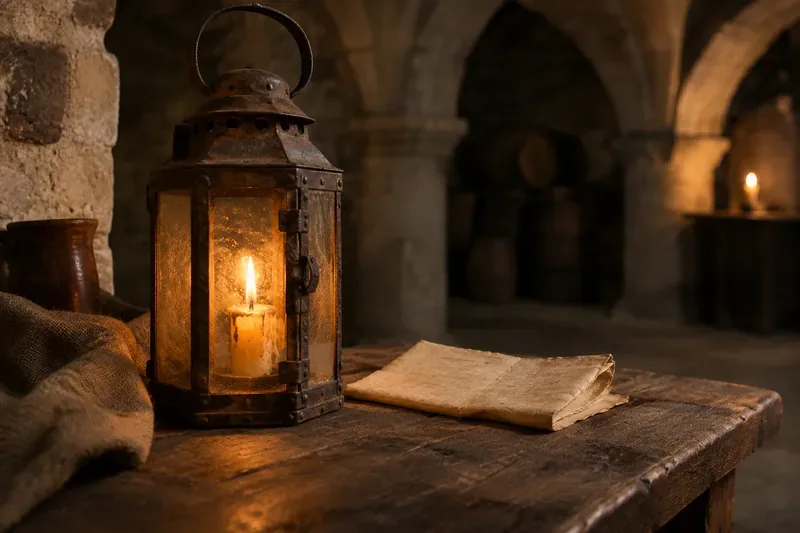
A period-inspired still life illustrating the Gunpowder Plot era; it is not a photograph of an original artifact.
Who was Guy Fawkes?
Guy Fawkes, also recorded as Guido Fawkes, was born in 1570. His father was a Protestant, and his mother later married into a strongly Catholic family. Fawkes attended St. Peter’s School in York and went on to fight as a soldier for Spain against Dutch forces. His military experience and technical skills later made him useful to English Catholic conspirators who hoped to change the country’s political and religious direction.
Fawkes was not the mastermind of the Gunpowder Plot. Robert Catesby proposed the attack and recruited other men, including Fawkes. Parliament’s historical account describes Fawkes as the group’s gunpowder expert. His fame grew because he was discovered at the scene and became the face attached to the failed plan.
What was the Gunpowder Plot?
The Gunpowder Plot was a conspiracy to blow up the House of Lords when Parliament opened on November 5, 1605. King James I, members of the Lords, and members of the Commons were expected to be present. The plotters intended to kill the king and political leaders in one explosion, then try to trigger an uprising. They hoped to seize Princess Elizabeth, who was not expected to attend, as part of their plan for a new order.
The conspiracy grew out of a period of deep religious and political division. The men involved were Catholics who opposed the treatment of Catholics under Protestant rule. Many accounts describe the plot as an attempt to restore Catholic power, though the precise origins and motives have been debated by historians. The plan was not a single-person operation: several men arranged money, access, weapons, gunpowder, and the proposed uprising.
Fawkes’s role centered on the explosives. The plotters first considered tunneling beneath the Lords, then rented an undercroft below the building. Fawkes used the name John Johnson while posing as a servant connected to Thomas Percy. He helped obtain and guard the gunpowder hidden beneath firewood.
How was Guy Fawkes caught?
The government received a warning that Parliament faced a “terrible blow.” The anonymous letter was delivered to Catholic nobleman Lord Monteagle, who passed it to the king’s principal minister. Its author has never been conclusively identified. Authorities searched the buildings beneath Parliament late on November 4, 1605. After an initial search, a second inspection found Fawkes with 36 barrels of gunpowder in the undercroft.
The discovery prevented the attack before Parliament assembled. Fawkes was arrested and questioned. Other conspirators fled London; some were later killed while resisting capture, while those who survived were tried for treason. Fawkes was tried in January 1606 and executed at Old Palace Yard in Westminster on January 31.
Why is Guy Fawkes Day observed on November 5?
Parliament met in January 1606 and passed the Thanksgiving Act, which made services and sermons commemorating the plot an annual feature on November 5. The original observance was an official expression of relief that the king and Parliament had survived, but it was also shaped by the era’s anti-Catholic attitudes. Sermons and public ceremonies could reinforce suspicion toward Catholics as well as commemorate the failed attack.
Customs changed over the following centuries. Church bells and bonfires became common; fireworks appeared in some early celebrations. Effigies were first associated with the pope or the devil, and Guy Fawkes later became the figure most often burned. The name “Bonfire Night” reflects the public celebrations that developed around the date. Today, many communities mark November 5 with organized fireworks, bonfires, and family events, while the history behind those customs remains more complicated than a simple story about one would-be bomber.
For readers in the United States, Guy Fawkes Day is primarily a British observance rather than a U.S. national holiday. The familiar date and name come from the English commemoration established after the 1605 plot; modern celebrations vary by community and are not all organized in the same way.
Guy Fawkes Day FAQ
Was Guy Fawkes the leader of the Gunpowder Plot?
No. Robert Catesby organized the conspiracy. Fawkes was recruited for his military and technical experience and was assigned to the gunpowder.
Why is November 5 called Guy Fawkes Day?
The plot was discovered just before its planned November 5 attack. Parliament established an annual thanksgiving observance on that date in 1606, and Guy Fawkes later became the best-known figure associated with it.
Was Guy Fawkes executed?
Yes. After being tried for treason, Fawkes was executed in Westminster on January 31, 1606.