01. Historical Context
The AEX still has upside because price is near the highs, not because valuation is cheap
The AEX has already compounded strongly over the last decade, rising from 435.88 on 31 May 2016 to 1,010.44 on 15 May 2026, a total gain of 131.82%. Near-term upside therefore depends less on finding a depressed market and more on proving that the existing premium can be sustained. That premium is not irrational: the index has heavy weight in global leaders such as Shell, ASML, Unilever, ING, RELX, and Prosus, and those names give it direct exposure to energy cash flow, semicap demand, and information services.
| Horizon | What matters most | What would strengthen the thesis | What would weaken the thesis |
|---|---|---|---|
| 1-3 months | Inflation path and Q2 earnings tone | AEX holds above 1,000 and euro area inflation cools back toward 2.5-2.6% | Inflation stays near 3.0% and earnings commentary weakens |
| 6-12 months | Earnings revisions and breadth | Positive Europe EPS revisions spread beyond a few leaders | Returns rely only on multiple expansion |
| To 2027 | Whether macro growth and AI capex feed into real cash flow | ASML-led demand strength broadens and ECB policy becomes less restrictive | Energy and inflation keep rates higher for longer |
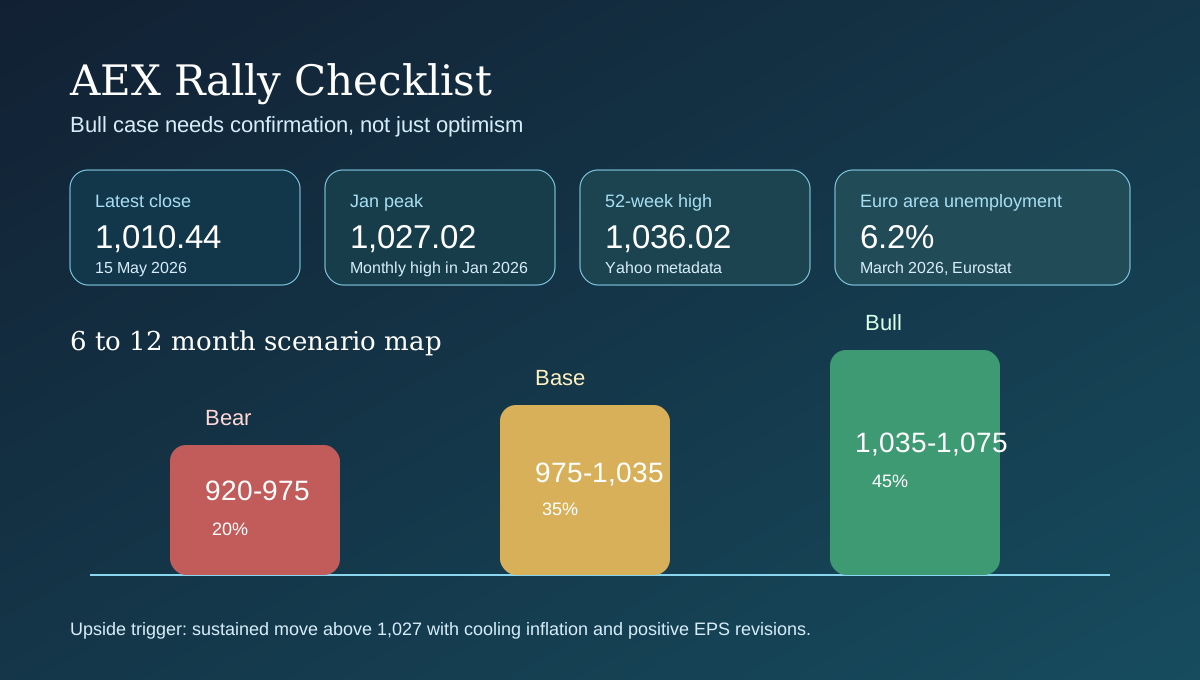
The current setup is constructive but not forgiving. Yahoo Finance metadata showed a 52-week high of 1,036.02 and a 52-week low of 882.42. The index is therefore much closer to resistance than to washout levels. That means buyers need ongoing evidence that earnings can carry the benchmark higher.
Euronext's 31 March 2026 factsheet also showed top-ten concentration at 75.42% and an index dividend yield of 2.48%. The next rally is most credible if that concentration works as a quality feature rather than as a narrow-dependence risk.
02. Key Forces
Five bullish forces that could extend the move
First, earnings momentum in Europe has improved from a weak base. J.P. Morgan Asset Management wrote in its 2026 outlook for global ex-US equities that, after seven months of negative EPS revisions, Europe's 2026 EPS estimate had begun to be revised up, with bottom-up forecasts pointing to 12% year-on-year growth, although the firm said mid-single-digit growth looked more realistic. For the AEX, even the more cautious interpretation is enough to support further upside if revisions stay positive.
Second, the macro economy is weak but still expanding. Eurostat's flash estimate showed euro area GDP up 0.1% quarter on quarter in Q1 2026 and 0.8% year on year, while the euro area unemployment rate fell to 6.2% in March. That is not boom territory, but it is also not a recession backdrop. Equity rallies can continue in that environment if earnings stay intact and financial conditions do not tighten further.
Third, ECB policy is restrictive, but not tightening further for now. On 30 April 2026 the ECB kept the deposit facility rate unchanged at 2.00%. A stable rate backdrop is not the same as easing, but it is less hostile than a fresh tightening cycle. If inflation cools again, the market can reprice toward a friendlier rate path without needing a dramatic macro surprise.
Fourth, the AEX has genuine AI and capex sensitivity. Euronext's composition shows ASML at 14.69%, RELX at 6.11%, Prosus at 5.42%, ASM International at 3.67%, and BESI at 1.53%. ASML reported Q1 2026 sales of EUR 8.8 billion and said AI-related infrastructure investment was solidifying the industry's growth outlook, while ASM International said AI-led demand accelerated further in the quarter. That gives the AEX a real earnings channel into the AI buildout.
Fifth, institutional Europe strategy is positive but not euphoric. Goldman Sachs Research said on 15 January 2026 that it expected the STOXX 600 to deliver an 8% total return in 2026, supported by good global growth, falling interest rates, and 5% EPS growth in 2026 followed by 7% in 2027. That is useful because it implies the professional bull case for Europe is still based on modest earnings growth and decent macro support, not on a speculative melt-up.
| Factor | Why it matters | Current assessment | Bias |
|---|---|---|---|
| Macro backdrop | Determines whether investors pay up for cyclicals and quality growth | GDP is still positive and unemployment is low, but growth is not strong | Neutral |
| Inflation and rates | Drives multiple support | ECB is on hold at 2.00%; April inflation at 3.0% is an obstacle but not yet a trend | Neutral |
| Earnings revisions | Best signal for whether the rally deserves to continue | Europe revisions have improved from negative territory | Bullish |
| AI-linked leadership | ASML and peers can pull the index higher | Q1 company commentary remains supportive | Bullish |
| Valuation | Controls room for upside if the macro backdrop wobbles | iShares AEX ETF P/E at 18.31 is fair, not cheap | Neutral |
The strongest version of the bull case is therefore not a one-factor story. It is a combination of modest growth, stable rates, positive revisions, and continuing AI-linked capex demand.
03. Countercase
What could interrupt the rally
The main near-term risk is inflation. Euro area inflation rose to 3.0% in April 2026 from 2.6% in March, and Statistics Netherlands put Dutch flash inflation at 2.8% in April. If those prints prove to be more than an energy shock and begin to affect core expectations, the market will struggle to justify a richer multiple.
The second risk is that Europe growth stays too soft for breadth to improve. Euro area GDP rose only 0.1% quarter on quarter in Q1 2026, and Dutch GDP matched that pace. A rally driven only by ASML, Shell and a few defensives can continue for a while, but it is less durable than one supported by broader revisions.
The third risk is concentration. Euronext shows the top ten names at 75.42% of the index. If one of the largest leaders disappoints on guidance, the benchmark can feel weaker than the macro data alone would suggest.
| Risk | Latest data point | Why it matters | Current assessment |
|---|---|---|---|
| Inflation reset | Euro area CPI 3.0% in April 2026 | Can keep real rates high and cap P/E expansion | Bearish |
| Soft GDP | Euro area GDP +0.1% qoq in Q1 2026 | Raises the hurdle for broad earnings acceleration | Neutral to bearish |
| Valuation | AEX proxy P/E 18.31 on 14 May 2026 | Leaves less room for disappointment | Neutral |
| Concentration | Top ten weight 75.42% | Can turn stock-specific weakness into index weakness quickly | Bearish |
The bullish case remains intact only if these risks stay contained rather than cumulative. A rally can live with one of them. It becomes fragile when they start reinforcing each other.
04. Institutional Lens
What professional research implies for a further move up
Goldman Sachs Research's January 2026 Europe equity outlook called for an 8% total return in the STOXX 600 in 2026, supported by 5% EPS growth in 2026 and 7% in 2027. Goldman also noted that European stocks were not cheap in historical terms, sitting in the 71st percentile of P/E over the last 25 years. That combination is important. It says the upside case exists, but it needs earnings support because valuation alone is no longer a tailwind.
J.P. Morgan Asset Management's 2026 global ex-US outlook adds a second useful point: European earnings estimates have finally started being revised up after a long downgrade cycle, but J.P. Morgan still thinks mid-single-digit growth is more realistic than the 12% bottom-up estimate. That is effectively a warning against extrapolating too much from a single improvement in sentiment.
For the AEX, these institutional views line up well with the data. There is room for upside, but the move should be led by earnings and confirmed by breadth rather than by a large jump in valuation multiples.
| Source | What it said | Date | Read-through for AEX |
|---|---|---|---|
| Goldman Sachs Research | STOXX 600 total return of 8% in 2026; EPS growth 5% in 2026 and 7% in 2027 | 15 January 2026 | Supports a modest Europe bull case, not a euphoric one |
| Goldman Sachs Research | European stocks are in the 71st percentile of P/E over the last 25 years | 15 January 2026 | Means AEX upside must be earnings-led |
| J.P. Morgan Asset Management | Europe's 2026 EPS estimate has turned positive after seven months of negative revisions; 12% bottom-up growth but mid-single digits may be more realistic | 2026 outlook page crawled last month | Positive revision trend matters more than heroic growth assumptions |
The common institutional message is that Europe can still rally, but the quality of the rally matters. Narrow gains and expensive multiples are less trustworthy than broader revisions and steadier inflation data.
05. Scenarios
Actionable 6 to 12 month scenarios
The scenario ranges below are author estimates based on the current AEX level, the January 2026 peak, the 52-week range, Europe macro data, and the institutional research cited above. They are not third-party price targets.
| Scenario | Probability | Range | Trigger conditions | When to review |
|---|---|---|---|---|
| Bull | 45% | 1,035-1,075 | AEX regains and holds above 1,027, euro area inflation cools back toward 2.5-2.6%, and Europe EPS revisions remain positive through Q2 reporting | Review after the next ECB meeting and after the main Q2 reporting window |
| Base | 35% | 975-1,035 | Growth stays positive but slow, inflation remains sticky, and leadership remains concentrated | Review monthly with inflation and unemployment releases |
| Bear | 20% | 920-975 | AEX loses 980, inflation stays close to 3.0%, and company commentary points to weaker demand or slower orders | Review immediately if the index breaks below 980 on volume or if revisions turn negative again |
The tactical conclusion is straightforward. Buyers should want confirmation above the January high or a clean inflation improvement before assuming the next leg higher is durable. Holders can stay constructive, but the position is stronger if it is defended by revisions rather than by multiple hope alone.
If the data cooperate, the AEX can still push into new highs. If they do not, the more likely outcome is not an instant collapse but a rangebound market that forces earnings to do the heavy lifting.
References
Sources
- Yahoo Finance chart API for AEX 10-year monthly history
- Yahoo Finance chart API for AEX latest daily price metadata
- Euronext AEX Index factsheet, 31 March 2026
- Euronext AEX Index composition, 31 March 2026
- BlackRock iShares AEX UCITS ETF overview and key facts
- ASML Q1 2026 financial results
- ASM International Q1 2026 results
- Eurostat flash estimate: euro area GDP in Q1 2026
- Eurostat unemployment release for March 2026
- Eurostat flash estimate: euro area inflation in April 2026
- Statistics Netherlands flash inflation estimate for April 2026
- ECB monetary policy decision, 30 April 2026
- Goldman Sachs Research: European stocks outlook, 15 January 2026
- J.P. Morgan Asset Management: global ex-US equities outlook