01. Historical Context
The downside case starts with an expensive, concentrated index facing a worse inflation mix
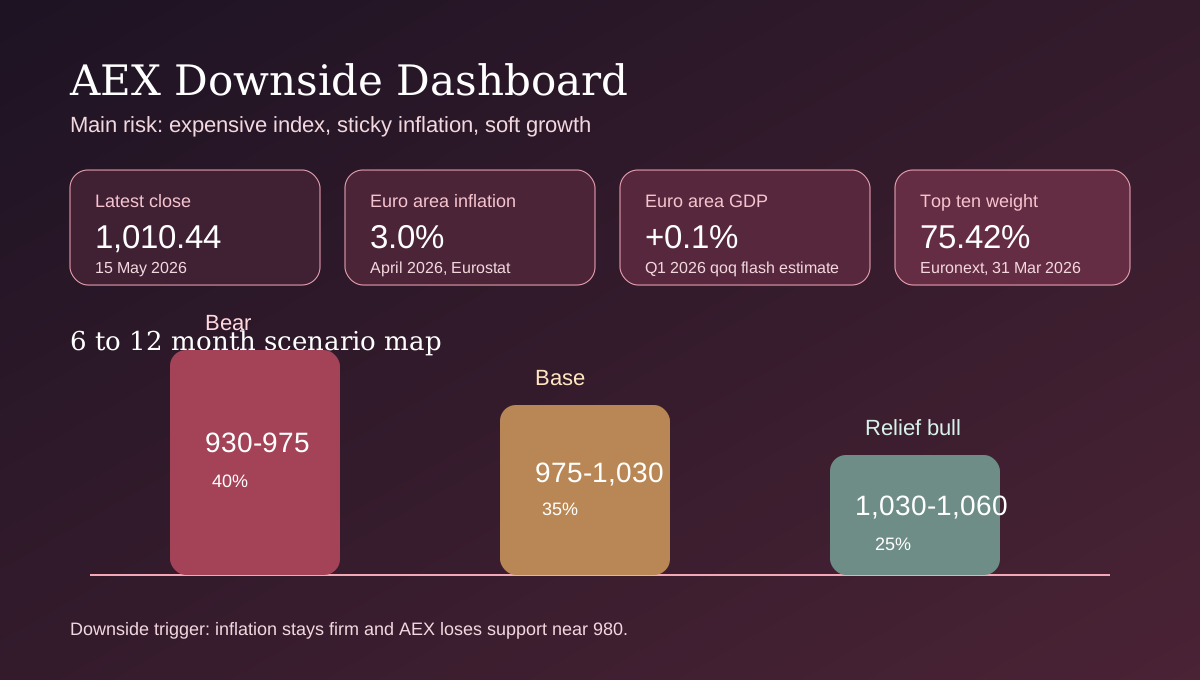
The AEX is not entering this period from washed-out levels. The index closed at 1,010.44 on 15 May 2026, and Yahoo Finance metadata showed a 52-week high of 1,036.02. The January 2026 monthly high was 1,027.02, so the market remains close to record territory. That makes it vulnerable to a de-rating if the macro mix deteriorates even modestly.
| Horizon | What matters most | What would strengthen the downside thesis | What would weaken the downside thesis |
|---|---|---|---|
| 1-3 months | Inflation prints, ECB messaging, and support levels | Inflation remains near 3.0% and the index breaks below 980 | Inflation cools quickly and buyers defend 1,000 |
| 6-12 months | Earnings revisions and breadth | Europe EPS revisions roll over again and concentration increases | Revisions broaden positively and cyclicals hold up |
| To 2027 | Whether soft growth turns into a more persistent slowdown | Energy shock and weak GDP combine with higher-for-longer rates | Growth re-accelerates while rates stop being a headwind |
The composition of the index increases that fragility. Euronext's 31 March 2026 factsheet showed the top ten components at 75.42% of the AEX. That concentration helps in a bull market because quality leaders dominate the benchmark. It hurts when one or two large stocks stop carrying the tape.
Valuation also matters. BlackRock's iShares AEX UCITS ETF page showed a P/E ratio of 18.31 and EPS of 5.55 as of 14 May 2026. That is not extreme by global standards, but it is high enough that the market still needs confidence in growth, disinflation, and earnings revisions to avoid a pullback.
02. Key Forces
Five bearish forces that could push the AEX lower
First, inflation has moved the wrong way. Eurostat's flash estimate showed euro area annual inflation at 3.0% in April 2026, up from 2.6% in March. That matters because an index close to highs can absorb soft growth more easily than it can absorb a renewed valuation shock from higher real rates.
Second, the ECB is not easing into a clean disinflation cycle. On 30 April 2026 the ECB kept the deposit facility rate at 2.00% and said upside risks to inflation and downside risks to growth had intensified because of the war in the Middle East and higher energy prices. That is close to the textbook definition of an uncomfortable backdrop for expensive equities.
Third, growth is positive but weak. Eurostat's flash estimate put euro area GDP growth at just 0.1% quarter on quarter in Q1 2026. Statistics Netherlands reported the Dutch economy also grew 0.1% quarter on quarter in Q1. Slow growth is not itself bearish, but it becomes bearish when it arrives with firmer inflation and little room for aggressive rate cuts.
Fourth, concentration risk is high. The same Euronext data show Shell at 16.02%, ASML at 14.69%, and Unilever at 12.41%. If one of those heavyweight groups misses expectations or faces a sector-specific re-rating, the index-level damage can be larger than broad macro data alone would imply.
Fifth, Europe strategy desks are constructive but cautious, which is not the same thing as saying downside is off the table. Goldman Sachs Research said in January 2026 that European stocks were in the 71st percentile of P/E over the last 25 years and still forecast only a modest 8% total return for the STOXX 600 in 2026. J.P. Morgan Asset Management said returns should be driven increasingly by earnings rather than multiple expansion because equity valuations were elevated in many regions. That is effectively a warning that the AEX loses altitude quickly if the earnings leg wobbles.
| Factor | Why it matters | Current assessment | Bias |
|---|---|---|---|
| Inflation | Higher inflation reduces room for multiple expansion | Euro area inflation re-accelerated to 3.0% in April | Bearish |
| ECB stance | Rates staying restrictive raises the hurdle for equities | Deposit facility rate unchanged at 2.00% | Bearish |
| Growth | Soft GDP leaves less margin for earnings misses | Euro area and Dutch GDP both grew only 0.1% qoq in Q1 | Neutral to bearish |
| Concentration | Few names can drive index-level drawdowns | Top ten weight at 75.42% | Bearish |
| Valuation | Higher starting multiples increase sensitivity to disappointment | AEX proxy P/E at 18.31 | Neutral to bearish |
The bearish setup becomes strongest when these factors align: sticky inflation, weak growth, restrained ECB flexibility, and any sign that earnings revisions are fading again.
03. Countercase
What could stop the decline from becoming larger
The first stabilizer is that growth has slowed, not collapsed. Euro area unemployment fell to 6.2% in March 2026, which is still historically low enough to support domestic demand. If labour markets hold up, many bearish scenarios remain valuation corrections rather than true earnings recessions.
The second stabilizer is that AI-linked demand inside the AEX remains real. ASML said in Q1 2026 that AI-related infrastructure investment was helping solidify the semiconductor industry's growth outlook, and ASM International said AI-led demand accelerated further in the quarter. That does not immunize the index, but it does provide a fundamental offset to the macro drag.
The third stabilizer is that Europe EPS revisions have improved from their earlier trough. J.P. Morgan Asset Management noted that Europe's 2026 EPS estimate had turned higher after seven months of negative revisions. If that trend continues, buyers can return even in a less friendly macro backdrop.
| Supportive factor | Latest data point | Why it matters | Current assessment |
|---|---|---|---|
| Labour market | Euro area unemployment 6.2% in March 2026 | Helps prevent a full earnings collapse | Neutral to bullish |
| AI-linked capex demand | ASML and ASM commentary remained supportive in Q1 2026 | Provides an internal growth engine for large AEX weights | Bullish |
| Revisions | Europe 2026 EPS estimate has started revising up again | Suggests the market is not yet facing a clear earnings recession | Neutral to bullish |
The bearish case therefore needs confirmation from both price and data. Without that confirmation, the more likely outcome is a correction or range trade, not a structural bear market.
04. Institutional Lens
How serious institutions frame the downside risk
Goldman Sachs Research's January 2026 Europe outlook is useful because it was constructive without being complacent. Goldman forecast only a modest 8% total return for the STOXX 600 in 2026 and explicitly noted that European stocks were already in the 71st percentile of P/E over the last 25 years. That tells investors there is not much room for a valuation accident if inflation stays sticky.
J.P. Morgan Asset Management's 2026 global ex-US equities outlook makes a related point. It says returns are likely to be driven increasingly by earnings rather than multiple expansion because valuations are elevated in many regions. For the AEX, that means a slide becomes more plausible if revisions stop improving or if a few heavyweight constituents fail to deliver.
The ECB adds the macro risk. In its 30 April 2026 decision, it said upside inflation risks and downside growth risks had both intensified. That is not a market call, but it is precisely the macro setup in which expensive indices become more fragile.
| Source | What it said | Date | Read-through for AEX |
|---|---|---|---|
| Goldman Sachs Research | STOXX 600 total return forecast of 8% for 2026 | 15 January 2026 | Implies a constructive but not forgiving Europe setup |
| Goldman Sachs Research | Europe is in the 71st percentile of P/E over the last 25 years | 15 January 2026 | Limited room for a valuation shock |
| J.P. Morgan Asset Management | Returns should be driven increasingly by earnings rather than multiple expansion | 2026 outlook page crawled last month | Weak earnings breadth would raise downside risk materially |
| ECB | Upside inflation risks and downside growth risks intensified | 30 April 2026 | Macro balance is worse for equities than a simple GDP print suggests |
The institutional takeaway is that the bearish case does not require a dramatic recession. A softer version is enough: elevated valuations, sticky inflation, and only modest growth can still produce a meaningful index drawdown.
05. Scenarios
Actionable downside scenarios
The ranges below are author estimates built from the current AEX level, the 52-week range, the January 2026 peak, and the latest official macro data. They are scenario tools, not broker targets.
| Scenario | Probability | Range | Trigger conditions | When to review |
|---|---|---|---|---|
| Bear | 40% | 930-975 | AEX breaks below 980, euro area inflation stays close to or above 3.0%, and revisions turn weaker during the next reporting cycle | Review after each inflation release and immediately after the next ECB meeting |
| Base | 35% | 975-1,030 | Growth remains soft but positive, AI-linked leaders hold up, and the market churns sideways while waiting for cleaner macro signals | Review monthly with GDP, inflation and unemployment data |
| Relief bull | 25% | 1,030-1,060 | Inflation cools, the ECB tone improves, and AEX reclaims 1,027 with better revisions | Review after the next earnings season and the next ECB projection round |
The key tactical threshold is 980. If that area fails while inflation remains firm, the market will probably test lower support before it finds a durable bid. If it holds, the downside case becomes more of a choppy digestion than a deeper reset.
For investors, the discipline is to separate a valuation correction from a broken long-term thesis. The AEX still has structural quality, but in the current macro mix, quality does not remove the need for price discipline.
References
Sources
- Yahoo Finance chart API for AEX 10-year monthly history
- Yahoo Finance chart API for AEX latest daily price metadata
- Euronext AEX Index factsheet, 31 March 2026
- Euronext AEX Index composition, 31 March 2026
- BlackRock iShares AEX UCITS ETF overview and key facts
- Eurostat flash estimate: euro area inflation in April 2026
- Eurostat flash estimate: euro area GDP in Q1 2026
- Eurostat unemployment release for March 2026
- Statistics Netherlands GDP estimate for Q1 2026
- Statistics Netherlands flash inflation estimate for April 2026
- ECB monetary policy decision, 30 April 2026
- Goldman Sachs Research: European stocks outlook, 15 January 2026
- J.P. Morgan Asset Management: global ex-US equities outlook
- ASML Q1 2026 financial results
- ASM International Q1 2026 results