01. Historical Context
The bearish setup is really an execution setup
Airbus shares entered mid-May 2026 at EUR 167.68, down sharply from the 52-week high of EUR 221.30. The retreat reflects a market that still believes in the franchise but is less willing to pay peak multiples before seeing hard proof on aircraft handovers and cash conversion. That distinction matters: the downside case here is not about a broken order book, but about a backlog that takes longer to convert into earnings than the market expected.
| Horizon | What matters most | Current assessment | What would strengthen the bearish thesis | What would weaken the bearish thesis |
|---|---|---|---|---|
| 1-3 months | Delivery pace and tone around 2026 guidance | 181 deliveries through April still leave an aggressive catch-up requirement for the rest of the year | Another soft monthly delivery print or any wording that guidance depends on a very back-end loaded second half | Deliveries recover fast enough to make the 2026 target look realistic again |
| 6-18 months | Margin credibility and cash conversion | Q1 2026 started weak, and the rest of the year now carries most of the burden | Commercial margins remain thin and free cash flow recovery is repeatedly deferred | H2 profitability begins to resemble the FY 2025 run rate again |
| To 2030 | Whether Airbus stays a premium multiple industrial | The company still has the backlog to earn that status, but the stock loses support if delays become repetitive | Investors decide the scarcity premium belongs to demand, not to Airbus' execution | Management proves that current bottlenecks are cyclical rather than structural |
The historical trap in names like Airbus is to mistake backlog size for earnings timing. Airbus had a year-end 2025 backlog of 8,754 commercial aircraft and then lifted that to 9,037 by the end of March 2026. Demand is not the issue. Timing is the issue. Stocks usually struggle when investors believe the timing assumptions embedded in valuation are too generous.
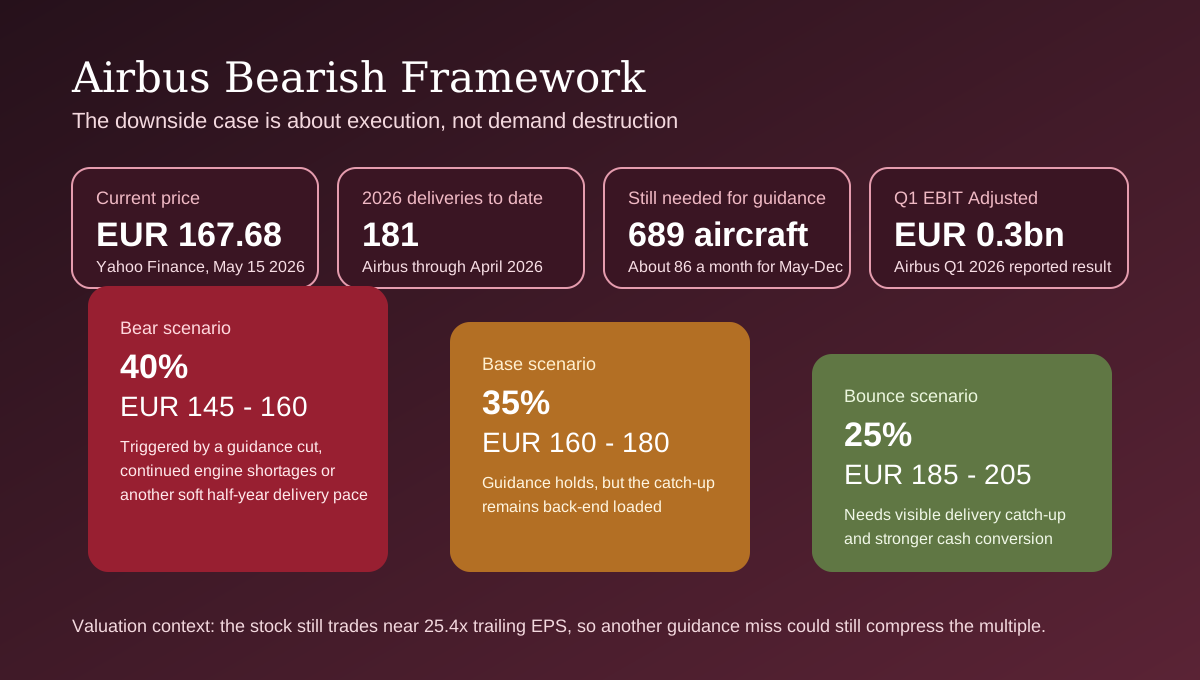
That is why the current price still deserves respect from bears. Using Airbus' FY 2025 reported EPS of EUR 6.61, the stock trades at about 25.4x trailing earnings. That is below early-2026 optimism, but it is still not a distressed industrial multiple. If guidance slips, there is room for the multiple to compress further.
02. Key Forces
Five bearish forces that could push the stock lower
The first bearish force is the sheer delivery math. Airbus' official orders-and-deliveries page shows 181 aircraft delivered through April 2026. Against guidance for around 870 deliveries this year, Airbus still needs 689 aircraft over May through December, or roughly 86 per month. That is meaningfully above April's 67 and far above the Q1 average.
Second, the supply problem has not gone away. Airbus said in February that Pratt & Whitney's failure to commit to the number of engines ordered by Airbus was negatively affecting the 2026 guidance and the ramp-up trajectory. The company also cut its A320-family timing ambition to a rate of 70 to 75 a month by the end of 2027, stabilizing at 75 only thereafter. When a stock is priced on future industrial leverage, even modest ramp delays matter.
Third, the latest quarter was weak enough to keep doubts alive. Airbus reported Q1 2026 revenue of EUR 12.7 billion, down 7% year over year, and EBIT Adjusted of EUR 0.3 billion. mwb Research went further in its April 29 note, arguing that Airbus Commercial generated only EUR 1 million of EBIT on EUR 8.3 billion of revenue and that the reported EPS beat was entirely driven by a EUR 375 million Dassault stake revaluation. Even if investors do not fully agree with that framing, it highlights how little operating room Airbus had in the quarter.
Fourth, macro is no longer offering a clean tailwind. The IMF cut its 2026 global growth forecast to 3.1% in April and its euro-area forecast to 1.1%. Eurostat's April flash estimate showed euro-area inflation back up to 3.0%, with energy inflation at 10.9%. Premium industrial multiples tend to de-rate when inflation re-accelerates at the same time growth expectations soften.
Fifth, the valuation floor is not yet deep. Airbus is below the average target price, but that alone does not make it cheap if consensus numbers still need to fall. MarketScreener's May 14 consensus showed a EUR 209.31 average target, yet mwb Research's April 29 model had a EUR 170 target and 2026E EPS of EUR 6.19, implying 26.8x forward earnings on its own numbers. That is not the kind of multiple that automatically protects capital if execution disappoints again.
| Factor | Latest evidence | Current assessment | Bias |
|---|---|---|---|
| Delivery pace | 181 delivered through April; roughly 86 per month still needed to hit guidance | The industrial bridge to the full-year target is demanding and leaves little room for more slippage | Bearish |
| Supply chain | Pratt & Whitney shortages remain an explicit management issue | The biggest operational risk is external, persistent and hard to solve on a single-quarter timeline | Bearish |
| Earnings quality | Q1 EBIT Adjusted EUR 0.3 billion; one-house analysis highlighted near-zero commercial EBIT | The latest quarter did not give investors enough proof that the ramp is back on track | Bearish |
| Macro backdrop | IMF global growth 3.1%; euro area 1.1%; Eurostat inflation 3.0% | Macro is not recessionary, but it is too mixed to justify blind multiple expansion | Neutral to Bearish |
| Valuation support | Trailing P/E about 25.4x; mwb 2026E P/E 26.8x; Street low target EUR 170 | The stock is off the highs, but not obviously washed out if earnings risk worsens | Neutral |
The bearish thesis gets stronger if these forces reinforce each other. Weak deliveries on their own can be forgiven. Weak deliveries plus higher inflation, cautious sell-side revisions and another quarter of fragile cash conversion are far harder for the stock to absorb.
03. Countercase
What could stop the decline from becoming more serious
The strongest counterargument is still demand. Airbus recorded 398 net orders in Q1 2026 and ended March with 9,037 aircraft in backlog. IATA still expects 5.2 billion passengers in 2026 and says supply-chain bottlenecks are keeping load factors high and fleets older for longer. That is exactly the type of end-market backdrop that can turn even a messy operational year into a better earnings year later.
The second offset is that analyst consensus has not collapsed. MarketScreener still showed an Outperform mean rating from 23 analysts on May 14, with an average target of EUR 209.31 and even the low target at EUR 170. The Street is clearly less optimistic than it was at the highs, but it is not positioning for a structural impairment story.
Third, Airbus has more supporting businesses than commercial narrow-body deliveries alone. FY 2025 Airbus Helicopters revenue rose 13% to EUR 9.0 billion and Airbus Defence and Space revenue rose 11% to EUR 13.4 billion. Those segments do not remove the commercial-aircraft bottleneck, but they do make the group more resilient than a single-engine-rate narrative suggests.
| Offset | Latest data | Why it matters | Current bias |
|---|---|---|---|
| Order book depth | 9,037 commercial aircraft backlog at end-March 2026 | Backlog limits long-term fundamental damage from one weak quarter | Bullish |
| Airline demand | IATA sees 5.2 billion passengers in 2026 and 83.8% load factors | Customers still need fuel-efficient aircraft, which supports Airbus' medium-term slot value | Bullish |
| Sell-side range | Consensus target EUR 209.31, low target EUR 170, high target EUR 255 | The market has become more cautious, but not deeply bearish | Neutral to Bullish |
| Portfolio diversity | Helicopters and Defence & Space both improved in FY 2025 | Group earnings are not solely dependent on a perfect A320 ramp every quarter | Neutral |
That is why the cleanest bearish call is tactical rather than existential. Airbus can absolutely trade lower from here if guidance risk grows, but the data still argue against treating it like a broken franchise.
04. Institutional Lens
How the most relevant external signals frame the downside
Professional investors are looking at Airbus through three lenses at once: whether deliveries are catching up, whether macro conditions are becoming less forgiving, and whether estimates still need to come down. At the moment, the first lens is the most important because it has the power to change the other two.
| Source | What it said | Updated | What it implies |
|---|---|---|---|
| Airbus Q1 2026 results | 114 deliveries, 398 net orders, 9,037 backlog, revenue EUR 12.7 billion, guidance unchanged | 28 Apr 2026 | Demand is intact, but the year started too slowly to remove execution anxiety |
| Airbus monthly deliveries | 67 deliveries in April and 181 year to date | 7 May 2026 | Guidance still requires a steep second-half slope |
| Airbus FY 2025 results | 2026 guide still calls for around 870 deliveries and EUR 7.5 billion of EBIT Adjusted | 19 Feb 2026 | The stock can fall if the market concludes that those numbers are too high |
| mwb Research | Hold rating, EUR 170 target, 2026E EPS EUR 6.19, 2027E EPS EUR 7.75; noted Airbus would need an unusually sharp post-Q1 ramp | 29 Apr 2026 | Provides a conservative sell-side view and a lower-enthusiasm valuation anchor |
| MarketScreener consensus | 23 analysts, Outperform mean rating, average target EUR 209.31, high EUR 255, low EUR 170 | 14 May 2026 | Consensus is constructive, but not enough to prevent de-rating if estimates slip |
| IATA global outlook | 2026 passengers seen at 5.2 billion, with supply-chain issues still constraining the fleet | 9 Dec 2025 | The end market is strong, which caps how far a fundamental bear case should run |
| IMF and Eurostat | Global growth 3.1%, euro-area growth 1.1%, euro-area inflation 3.0% | 14-30 Apr 2026 | Mixed macro conditions raise the cost of any operational disappointment |
The main institutional point is that the bearish case does not require analysts to become negative on Airbus' competitive position. It only requires the Street to mark down the timing and quality of 2026 earnings.
05. Scenarios
Actionable downside scenarios from here
Airbus is best viewed as a conditional setup. The downside becomes investable only when delivery slippage, estimate pressure and macro caution start lining up together. Without that combination, the stock can stay trapped in a frustrating but non-destructive range.
| Scenario | Probability | Trigger | 12-month range | When to re-check |
|---|---|---|---|---|
| Bear | 40% | Half-year and 9M delivery pace still points to a year-end miss, or management trims delivery, EBIT or free-cash-flow guidance | EUR 145-160 | Half-year 2026 results, then 9M 2026 results |
| Base | 35% | Guidance is maintained but the catch-up remains back-end loaded and revisions stay cautious | EUR 160-180 | At each monthly delivery update and the next two earnings releases |
| Bounce | 25% | Deliveries accelerate decisively above April's 67 pace, engine pressure eases and cash conversion normalizes | EUR 185-205 | Immediately if Q2-Q3 operational data materially improve |
The cleanest bearish target is not a dramatic collapse. It is a slide back toward a lower multiple range while the market waits for management to prove it can still land the 2026 plan. That is why the deepest downside range here stops well above the 10-year lows and instead focuses on where the premium-quality narrative starts to wobble.
Investors should therefore treat Airbus as a stock that can re-rate in either direction quickly. If the company makes visible progress on deliveries, the downside thesis weakens fast. If not, the market will keep asking why it should pay a premium industrial multiple before the aircraft actually show up.
References
Sources
- Yahoo Finance chart API for Airbus (AIR.PA), used for price and long-term history
- Airbus Q1 2026 results, published April 28, 2026
- Airbus commercial aircraft orders and deliveries, April 2026 update
- Airbus FY 2025 results and 2026 guidance, published February 19, 2026
- mwb Research update on Airbus after Q1 2026, published April 29, 2026
- MarketScreener analyst consensus for Airbus, accessed May 14, 2026
- IATA global airline outlook for 2026, published December 9, 2025
- IMF World Economic Outlook, April 2026
- IMF Regional Economic Outlook for Europe, April 2026
- Eurostat flash estimate for euro-area inflation, April 30, 2026