01. Historical Context
The bull case survives, but the burden of proof moved to deliveries
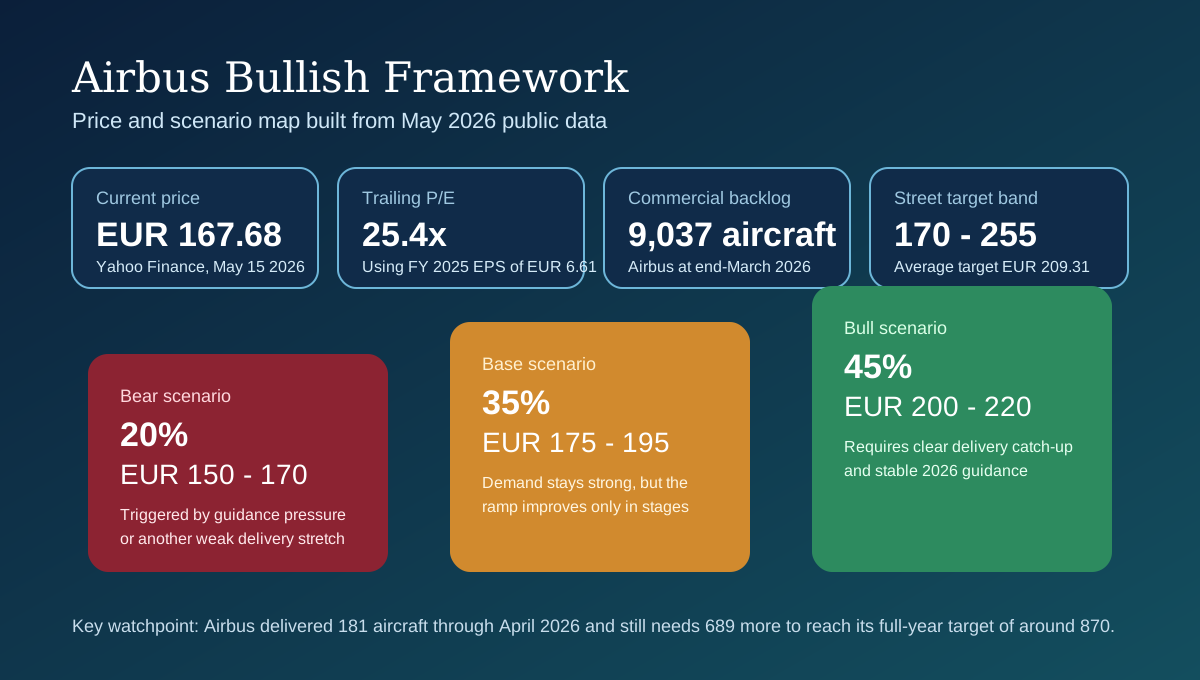
Airbus shares were at EUR 167.68 on May 15, 2026, according to Yahoo Finance chart data. That is well below the 52-week high of EUR 221.30, but still far above the EUR 51.73 monthly close seen at the start of the 10-year lookback, implying a roughly 12.5% annualized share-price compound growth rate over the past decade. The stock has already rewarded investors for scarcity, backlog depth and wide-body recovery; the next leg higher now needs harder operating evidence.
| Horizon | What matters now | Current assessment | What would strengthen the thesis | What would weaken the thesis |
|---|---|---|---|---|
| 1-3 months | Delivery pace versus guidance | 181 aircraft delivered through April, leaving 689 still needed for 2026 guidance | Monthly deliveries move consistently above the Q1 run rate and guidance is reaffirmed without qualification | Another soft monthly delivery print or a weaker half-year tone on cash flow and engines |
| 6-18 months | Ramp execution and margin conversion | FY 2025 EBIT Adjusted reached EUR 7.128 billion; 2026 guidance targets about EUR 7.5 billion | A320, A220 and A350 ramp milestones are met while free cash flow stays around target | Persistent engine shortages, mix pressure or repeated cash conversion slippage |
| To 2030 | Backlog monetization and services mix | Commercial backlog stood at 9,037 aircraft at end-March 2026 | Digital services, defence and installed-base revenue deepen the profit pool | Execution misses force the market to value Airbus as a slower-growth industrial instead of a scarcity asset |
Valuation is no longer depressed, but it is also no longer near the early-2026 peak. Using Airbus' reported FY 2025 EPS of EUR 6.61 and the May 15 share price of EUR 167.68, the trailing P/E is about 25.4x. That is a premium multiple for an industrial name, yet not an extreme one if the company can convert its record backlog into another year of EBIT and cash-flow growth.
The key historical point is that Airbus has already proved demand. FY 2025 commercial aircraft deliveries rose to 793, and the order backlog reached a year-end record of 8,754 aircraft before rising further to 9,037 at the end of March 2026. The debate has shifted from "is demand real?" to "can Airbus industrialize that demand quickly enough for the income statement to catch up?"
02. Key Forces
Five bullish forces that could extend the move
The first bullish force is backlog visibility. Airbus reported 398 net commercial aircraft orders in Q1 2026 and a 9,037-aircraft backlog at quarter-end. IATA's December 9, 2025 industry outlook still projected 5.2 billion passengers in 2026, a 4.4% increase from 2025, while industry-wide RPK growth was expected at 4.9%. Strong end-demand matters because it keeps cancellation risk low even when deliveries slip.
Second, Airbus entered 2026 from a much stronger earnings base than it had a year earlier. FY 2025 revenue rose 6% to EUR 73.4 billion, EBIT Adjusted climbed to EUR 7.128 billion from EUR 5.354 billion, reported EPS rose to EUR 6.61 from EUR 5.36, and free cash flow before customer financing reached EUR 4.574 billion. A company that has already rebuilt earnings power can absorb some quarterly noise better than one still trying to reach escape velocity.
Third, the ramp story still has real operating leverage if it works. Airbus' FY 2025 guidance for 2026 still targets about 870 commercial aircraft deliveries, EUR 7.5 billion of EBIT Adjusted and EUR 4.5 billion of free cash flow before customer financing. It also still targets an A320-family production rate of 70 to 75 aircraft a month by the end of 2027, rate 12 for the A350 in 2028 and rate 13 for the A220 in 2028. A stock does not need all of that upside delivered immediately; it needs investors to believe the path remains intact.
Fourth, services and digital mix give Airbus another earnings lever. Airbus said in April 2026 that its new Skywise subsidiary will employ around 750 people worldwide, serve both Airbus and non-Airbus fleets, and build on a platform with more than 12,000 connected aircraft. Airbus also described digital services as the fastest-growing segment across the services market. That matters because a stronger services mix can cushion the cycle and make the multiple more resilient.
Fifth, the public analyst range still tilts constructive. MarketScreener showed an Outperform consensus on May 14, 2026 from 23 analysts, with an average target price of EUR 209.31, a high target of EUR 255 and a low target of EUR 170.00. At the same time, mwb Research's April 29, 2026 model used 2026E EPS of EUR 6.19 and 2027E EPS of EUR 7.75, which implies earnings growth of about 25% between those two forecast years. The market is not treating Airbus as a deep value trade; it is treating it as an execution-sensitive growth industrial.
| Factor | Latest evidence | Current assessment | Bias |
|---|---|---|---|
| Demand and backlog | 9,037 commercial aircraft backlog at end-March 2026; 398 net Q1 orders | Demand visibility remains exceptionally strong and supports multi-year revenue confidence | Bullish |
| Production ramp | 181 deliveries through April versus around 870 targeted for 2026 | The thesis still works, but execution risk is high because Airbus now needs roughly 86 deliveries a month for May-December | Neutral |
| Profitability | FY 2025 EBIT Adjusted EUR 7.128 billion; FY 2026 target about EUR 7.5 billion | The earnings base is healthier than in 2024, but the market needs Q2-Q4 conversion | Cautiously Bullish |
| Valuation | Price EUR 167.68; trailing P/E about 25.4x; mwb 2026E P/E 26.8x | Not cheap, but far less euphoric than the EUR 221.30 high | Neutral |
| Services and AI mix | Skywise platform above 12,000 connected aircraft; digital services called fastest-growing segment | Incremental support to quality and margin mix, though still secondary to aircraft deliveries | Cautiously Bullish |
The interaction between these forces matters more than any one metric. Airbus does not need a perfect macro backdrop to rally if deliveries accelerate and cash conversion improves. But if delivery pressure persists, the stock will struggle to hold a premium multiple even with a strong backlog and credible long-term services story.
03. Countercase
What could interrupt the rally
The main counterargument is simple: the delivery math is demanding. Airbus had delivered 181 aircraft by the end of April 2026, according to its monthly orders-and-deliveries page. Against guidance for around 870 deliveries this year, that leaves 689 aircraft still to deliver over the final eight months, or roughly 86 a month. April improved to 67 deliveries, but that is still well below the pace needed.
Macro is the second risk. Eurostat's April 30, 2026 flash estimate showed euro-area inflation re-accelerating to 3.0% from 2.6% in March, with energy inflation at 10.9%. The IMF's April 2026 World Economic Outlook cut global growth to 3.1% for 2026, while the IMF's Europe outlook put euro-area growth at just 1.1%. Airbus is not a direct euro-area GDP proxy, but industrial names with premium valuations rarely enjoy higher inflation, slower growth and tighter financial conditions all at once.
Third, valuation still assumes the business remains best-in-class. On the current share price, the stock trades around 25.4x trailing EPS using Airbus' FY 2025 result, while mwb Research's April 29 model implies 26.8x on 2026E earnings. That multiple can hold if the second-half ramp appears. It can compress quickly if the market starts to think 2026 guidance is still too generous.
| Risk | Latest data | Why it matters | Current bias |
|---|---|---|---|
| Delivery shortfall | 181 delivered through April; roughly 86 per month still needed | The stock needs evidence that backlog can become revenue on schedule | Neutral to Bearish |
| Engine bottlenecks | Airbus said Pratt & Whitney shortages are still affecting the 2026 path | Supplier delays can derail both revenue timing and fixed-cost absorption | Bearish |
| Macro re-tightening | Euro-area inflation 3.0% in April; IMF global growth 3.1% | Higher inflation and slower growth pressure premium industrial multiples | Bearish |
| Valuation reset | Trailing P/E about 25.4x; one-house 2026E P/E 26.8x | There is room for the stock to de-rate if guidance slips again | Neutral |
None of those risks invalidates Airbus as a business. They matter because the stock market discounts timing. A high-quality franchise can still underperform for quarters if the backlog remains trapped in work-in-progress instead of turning into aircraft handovers, EBIT and cash flow.
04. Institutional Lens
What the major external signals are saying now
The constructive institutional case rests on demand staying tight while execution stabilizes. The cautious case rests on the same demand strength failing to reach the income statement fast enough. Right now, both claims have hard data behind them, which is why Airbus trades as an execution stock rather than a pure macro trade.
| Source | What it said | Updated | Why it matters here |
|---|---|---|---|
| Airbus FY 2025 results | Revenue EUR 73.4 billion, EBIT Adjusted EUR 7.128 billion, EPS EUR 6.61, FCF before customer financing EUR 4.574 billion; 2026 guide around 870 deliveries and EUR 7.5 billion EBIT Adjusted | 19 Feb 2026 | Shows Airbus entered 2026 with a materially stronger earnings base |
| Airbus Q1 2026 results | 114 deliveries, 398 net orders, 9,037 backlog, revenue EUR 12.7 billion, guidance unchanged | 28 Apr 2026 | Confirms demand remains strong, but execution started the year softly |
| IATA global outlook | 2026 passengers seen at 5.2 billion, industry RPK growth at 4.9%, load factors at 83.8%, with supply-chain bottlenecks still constraining deliveries | 9 Dec 2025 | Supports the idea that airline customers still need aircraft and efficiency |
| IMF World Economic Outlook | Global growth forecast cut to 3.1% for 2026; downside risks include renewed trade tensions and disappointment around AI-driven productivity | 14 Apr 2026 | Sets a softer macro ceiling for industrial multiple expansion |
| IMF Europe outlook | Euro-area growth projected at 1.1% in 2026 | 17 Apr 2026 | Explains why the macro backdrop is not giving Airbus a free pass |
| Eurostat flash inflation | Euro-area inflation rose to 3.0% in April 2026 from 2.6% in March; energy inflation reached 10.9% | 30 Apr 2026 | Reinforces the risk that rates stay restrictive for longer |
| MarketScreener analyst consensus | 23 analysts, Outperform mean rating, average target EUR 209.31, high EUR 255, low EUR 170 | 14 May 2026 | Shows the Street still leans constructive, even after the Q1 miss |
| mwb Research | Hold rating, EUR 170 target, 2026E EPS EUR 6.19, 2027E EPS EUR 7.75; argued Airbus still needs an unusually steep second-half ramp | 29 Apr 2026 | Provides a conservative house view and a useful valuation cross-check |
The high-level takeaway is that no serious dataset is challenging Airbus' demand franchise. The live debate is narrower and more important: whether management can convert a record order book into enough 2026 deliveries to justify a premium multiple again.
05. Scenarios
Actionable scenarios from here
The right way to frame Airbus now is with conditional ranges, not a heroic single-point target. The stock does not need macro perfection. It needs enough delivery acceleration to restore trust in the 2026 bridge from backlog to EBIT and cash flow.
| Scenario | Probability | Trigger | 12-month range | When to re-check |
|---|---|---|---|---|
| Bull | 45% | Monthly deliveries trend materially above April's 67, management keeps 2026 guidance intact, and Q2-Q3 results show improving cash conversion | EUR 200-220 | Half-year 2026 results, then 9M 2026 results |
| Base | 35% | Demand stays firm and guidance survives, but the ramp remains uneven and upside stays capped near the analyst mean target | EUR 175-195 | Half-year 2026 results, then 9M 2026 results |
| Bear | 20% | Delivery pace remains too slow, engine shortages persist, or management trims the 870-aircraft target and cash-flow goals | EUR 150-170 | Immediately on any guidance revision; otherwise at the next two earnings releases |
The base case remains constructive because Airbus still has the ingredients institutions usually want: strong demand, a large backlog, healthy FY 2025 cash flow and a Street target band above the current price. But the stock earns a higher range only if the market sees real aircraft leaving the factory, not just optimistic end-state production targets.
For investors, that means the thesis is strongest when the data tighten in Airbus' favor at the same time: deliveries improve, cash flow recovers and the analyst target range stops drifting lower. If only the narrative improves, the move becomes harder to defend.
References
Sources
- Yahoo Finance chart API for Airbus (AIR.PA), used for price, 52-week range and 10-year history
- Airbus FY 2025 results, published February 19, 2026
- Airbus Q1 2026 results, published April 28, 2026
- Airbus commercial aircraft orders and deliveries, April 2026 update
- IATA global airline outlook for 2026, published December 9, 2025
- IMF World Economic Outlook, April 2026
- IMF Regional Economic Outlook for Europe, April 2026
- Eurostat flash estimate for euro-area inflation, April 30, 2026
- MarketScreener analyst consensus for Airbus, accessed May 14, 2026
- mwb Research update on Airbus after Q1 2026, published April 29, 2026
- Airbus launch of Skywise subsidiary, published April 1, 2026