01. Current Data
Why the bearish argument is now data-driven, not theoretical
| Metric | Latest figure | Why it matters |
|---|---|---|
| Share price | $267 | Sets the starting point for every scenario in this article |
| Valuation | 32.31x trailing P/E and 32.29x forward P/E | Shows the market still prices Amazon as a premium compounder |
| Street earnings view | FY2026 EPS estimate $8.75, up 22.1%; FY2027 EPS estimate $10.15, up 15.9% | Forward earnings are what the current multiple is really discounting |
| Latest quarter | Q1 2026 revenue $181.5 billion, up 17%; operating income $23.9 billion | Confirms the core engine is still expanding faster than most megacaps |
| AWS and AI | AWS revenue $37.6 billion, up 28%; custom AI chips reached a $20 billion annual revenue run rate | Amazon's valuation premium still depends on AWS and AI monetization remaining strong |
Base case: Amazon still looks fundamentally constructive, but the stock now needs continued earnings support rather than a looser multiple. As of May 14, 2026, StockAnalysis showed the shares at $267.22 with a 12-month average target of $306, a low target of $175, and a high target of $370. That leaves upside, but it also means the market already assumes FY2026 and FY2027 EPS estimates of $8.75 and $10.15 are realistic.
The most important operating update remains the April 29, 2026 earnings release. Amazon reported Q1 revenue of $181.5 billion, up 17% year over year, and operating income of $23.9 billion. AWS revenue rose 28% to $37.6 billion, beating the $36.6 billion LSEG consensus cited by Reuters, while trailing twelve-month operating cash flow increased 30% to $148.5 billion. The weak spot was free cash flow, which slipped to $1.2 billion as AI capex accelerated.
Macro is not a side issue at this valuation. The Bureau of Labor Statistics reported April 2026 CPI at 3.8% year over year and core CPI at 2.8%. The Bureau of Economic Analysis reported March 2026 headline PCE inflation at 3.5% and core PCE at 3.2%. The IMF's April 1, 2026 U.S. Article IV update projected 2026 real GDP growth of 2.4% on a Q4-over-Q4 basis and expected core PCE to return to 2% only in the first half of 2027. That keeps the rate backdrop survivable, but not benign for a premium-multiple stock.
02. Key Factors
Five forces that could pull the stock lower
Amazon's next move is still mainly a question of whether earnings growth can stay ahead of capital intensity. StockAnalysis still shows the forward multiple near the trailing multiple because the Street expects EPS to expand materially over the next two fiscal years. That makes estimate stability more important than sentiment alone.
AI is now central to that equation. Amazon told investors on April 29 that custom AI chips had reached a more than $20 billion annual revenue run rate. Reuters also reported on April 20 that Anthropic had committed to spend more than $100 billion over 10 years on Amazon cloud technology. That is real demand evidence, not just thematic language, but it has to translate into sustained free-cash-flow recovery to keep the equity premium intact.
| Factor | Why it matters | Current Assessment | Bias | Current evidence |
|---|---|---|---|---|
| Valuation | Controls how much optimism is already priced in | Demanding | Bearish | 32.31x trailing P/E and 32.29x forward P/E leave less room for execution misses |
| Earnings revision support | Premium multiples hold only if EPS estimates stay firm | Positive | Bullish | FY2026 EPS estimate is $8.75 and FY2027 EPS estimate is $10.15, both above the prior year base |
| AWS and AI monetization | AWS still carries the margin profile of the group | Constructive | Bullish | AWS revenue rose 28% to $37.6 billion and Amazon said custom AI chips are already at a $20 billion run rate |
| Cash conversion | AI capex only deserves a premium if it converts into cash later | Tight | Neutral | Operating cash flow reached $148.5 billion but free cash flow was only $1.2 billion |
| Macro and rates | Sticky inflation can compress even elite growth stocks | Mixed | Neutral | April CPI 3.8%, core CPI 2.8%, and March core PCE 3.2% keep real-rate risk alive |
03. Countercase
What would stop a deeper de-rating
The cleanest bear case is not that Amazon suddenly becomes a weak business. It is that the stock stops being willing to ignore how expensive AI expansion has become. Management guided Q2 2026 net sales to $194 billion to $199 billion and operating income to $20 billion to $24 billion. If the next few quarters land near the low end of that range while capex stays high, the market can de-rate the name even if absolute growth remains good.
Investors also need to remember how much of the Q1 optics were helped by non-operating items. Amazon disclosed that Q1 net income included a $16.8 billion pre-tax gain related to its investment in Anthropic. The core AWS and retail picture was still good, but that one-off gain means trailing earnings quality matters more than the headline EPS print alone.
| Risk | Latest data point | Why it matters now | What would confirm it |
|---|---|---|---|
| Multiple compression | 12-month average target $306 versus a $267.22 share price | Upside still exists, but not enough to absorb major estimate cuts easily | Forward P/E stays above 30x while FY2027 EPS falls below $9.50 |
| AWS normalization | AWS beat LSEG by $1.0 billion in Q1 2026 | The market is paying for continued outperformance, not just solid results | AWS growth drops below the mid-20% range for two quarters |
| AI payback slippage | Free cash flow only $1.2 billion despite $148.5 billion in trailing operating cash flow | Capex is rising faster than current free-cash conversion | Another two quarters of near-zero free cash flow without a better margin offset |
| Inflation and rate risk | March core PCE 3.2% and April core CPI 2.8% | Sticky inflation can stop multiple expansion even when revenue is still growing | Core PCE fails to keep trending toward the IMF's 2% first-half 2027 path |
04. Institutional Lens
What the current institutional data says about downside risk
The institutional read is strongest when it stays factual. FactSet's May 1, 2026 Earnings Insight noted that Amazon posted EPS of $2.78 against a pre-report expectation of $1.63 and that the company helped lift expected first-quarter earnings growth for the Consumer Discretionary sector to 39.0% from 1.7% at the start of the quarter. That matters because it shows Amazon was not just good in isolation; it materially changed sector earnings breadth.
Reuters added a second important data point on April 29, 2026: AWS revenue of $37.6 billion exceeded the $36.6 billion LSEG estimate. On April 20, Reuters also reported that Anthropic had committed to spend more than $100 billion over 10 years on Amazon cloud technology. Together, those data points say the AI demand picture is real. The unresolved question is valuation discipline, not whether demand exists.
| Source type | Concrete datapoint | Why it matters for the stock |
|---|---|---|
| FactSet, updated May 1, 2026 | Amazon EPS was $2.78 versus a pre-report expectation of $1.63; sector earnings growth estimate rose to 39.0% | Shows Amazon still has the power to move earnings breadth, not just its own narrative |
| Reuters and LSEG, April 29, 2026 | AWS revenue was $37.6 billion versus a $36.6 billion estimate | Confirms AI and cloud demand are still monetizing above consensus |
| IMF, April 1, 2026 | 2026 U.S. GDP growth projected at 2.4% and core PCE seen back at 2% only in the first half of 2027 | Explains why valuation support is solid but not risk-free |
| StockAnalysis, accessed May 14, 2026 | Average analyst target $306, range $175 to $370; FY2026 EPS estimate $8.75 | Defines where the sell-side consensus is currently anchored |
05. Scenarios
Bearish scenarios with explicit triggers
The bear case becomes actionable only when valuation, cash conversion, and estimates all weaken together. A good company can still be a weak stock if too much optimism was prepaid into the multiple.
| Scenario | Probability | Range / implication | Trigger | When to review |
|---|---|---|---|---|
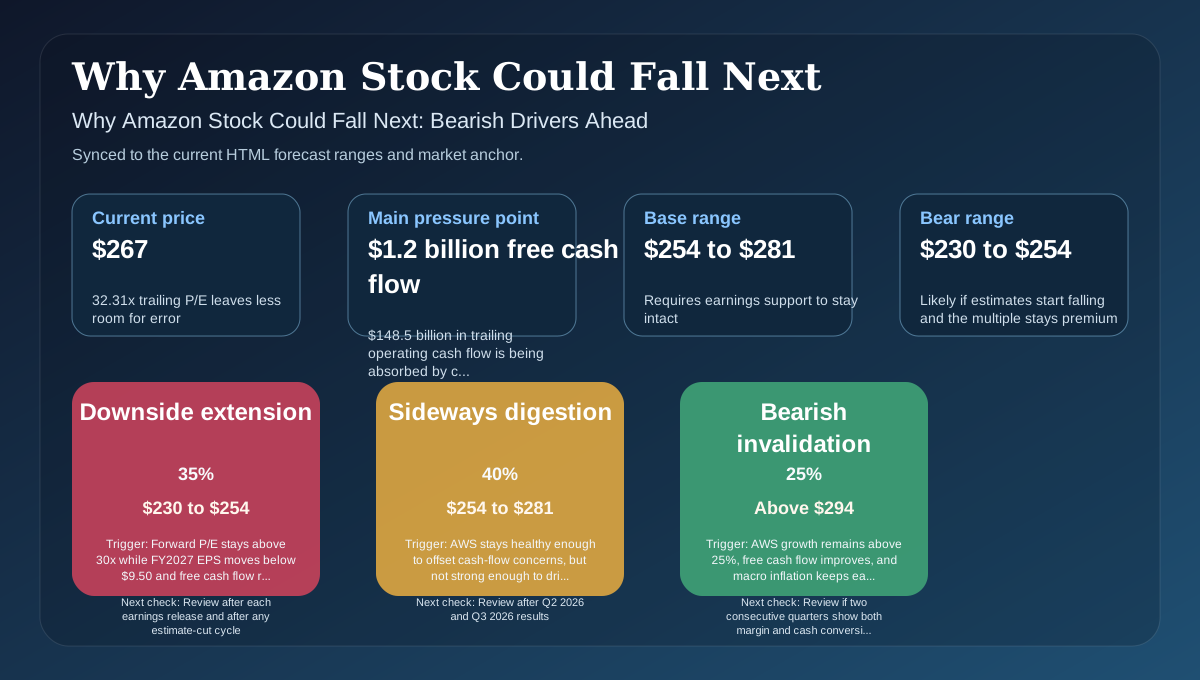
| Downside extension | 35% | $230 to $254 | Forward P/E stays above 30x while FY2027 EPS moves below $9.50 and free cash flow remains weak | Review after each earnings release and after any estimate-cut cycle |
| Sideways digestion | 40% | $254 to $281 | AWS stays healthy enough to offset cash-flow concerns, but not strong enough to drive re-rating | Review after Q2 2026 and Q3 2026 results |
| Bearish invalidation | 25% | Above $294 | AWS growth remains above 25%, free cash flow improves, and macro inflation keeps easing | Review if two consecutive quarters show both margin and cash conversion improvement |
References
Sources
- StockAnalysis Amazon overview, price, valuation, and analyst target data accessed May 14, 2026
- StockAnalysis Amazon revenue and EPS forecast data accessed May 14, 2026
- Amazon Q1 2026 earnings release, April 29, 2026
- FactSet Earnings Insight, May 1, 2026
- Reuters on Amazon Q1 2026 AWS beat versus LSEG estimates, April 29, 2026
- Reuters on Anthropic committing more than $100 billion to Amazon cloud infrastructure, April 20, 2026
- U.S. CPI for April 2026, Bureau of Labor Statistics
- U.S. Personal Income and Outlays for March 2026, Bureau of Economic Analysis
- IMF 2026 Article IV consultation for the United States, April 1, 2026