01. Historical Context
The stock is vulnerable because expectations are already extremely high
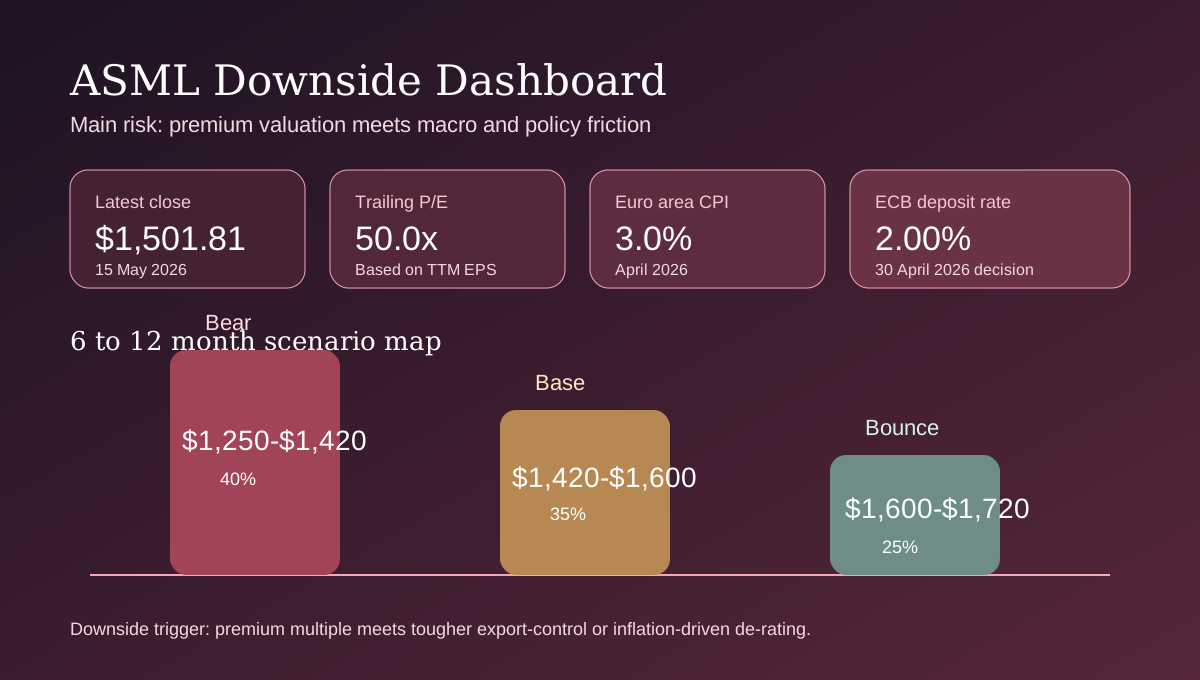
ASML closed at $1,501.81 on 15 May 2026, only about 6.3% below Yahoo Finance's 52-week high of $1,603.49 and after compounding more than 1,400% over the last decade. That kind of price history matters because high-quality growth stocks tend to correct when expectations merely stop improving, not only when the underlying business breaks.
| Horizon | What matters most | What would strengthen the thesis | What would weaken the thesis |
|---|---|---|---|
| 1-3 months | Whether Q2 delivery and guidance remain clean | Gross margin lands inside the 51-52% guide and management repeats strong demand language | Any softer wording on AI demand, shipments or export controls |
| 6-18 months | Valuation support versus earnings growth | Revenue keeps tracking toward EUR 36-40bn in 2026 and service revenue holds up | Earnings stay good but the market refuses to pay 50x trailing earnings |
| To 2030 | Whether AI demand stays broad enough to justify a premium multiple | ASML tracks toward the upper half of its EUR 44-60bn revenue opportunity | Growth lands near the low end while the multiple compresses |
MacroTrends lists ASML's P/E ratio at 50.55 on 7 May 2026. Using the latest $1,501.81 price and MacroTrends' $30.01 TTM EPS gives a similar trailing multiple of about 50.0x. That is the core setup behind the bearish case: the stock does not need a bad quarter to fall. It may only need investors to decide that the current multiple already captures the medium-term AI upside.
The macro backdrop does not help premium equities. Eurostat's flash estimate showed euro area inflation at 3.0% in April 2026, up from 2.6% in March, and the ECB kept the deposit facility rate unchanged at 2.00% on 30 April 2026. When inflation re-accelerates, long-duration growth stocks usually become more sensitive to even small changes in sentiment.
02. Key Forces
Five bearish forces that could push the trend lower
The first risk is simple valuation compression. MacroTrends shows ASML's TTM EPS at $30.01 and its P/E near 50x. Even if earnings continue to rise, that starting valuation can compress quickly if rates stay higher for longer or if investors shift capital toward cheaper cyclicals.
Second, export controls remain an explicit management risk. In Q1 2026 ASML said the bandwidth in its full-year guidance accommodated potential outcomes of ongoing discussions around export controls. When a company has to caveat its sales outlook that way, investors should treat policy risk as active, not theoretical.
Third, cash-flow optics can turn against the stock in volatile periods. CFO Roger Dassen said Q1 2026 free cash flow was negative EUR 2.6 billion largely because of the timing of down payments. That is not an earnings-quality red flag by itself, but it is a reminder that the path from orders to shipments to cash can stay lumpy even in a strong demand cycle.
Fourth, demand may remain strong while upside gets pulled forward. ASML's stock already reflects a lot of the AI infrastructure cycle. If investors begin to think 2026 or 2027 is the local peak for customer capacity expansion, the share price can weaken before reported sales do.
Fifth, the macro discount-rate backdrop is still awkward. The ECB said on 30 April 2026 that upside risks to inflation and downside risks to growth had intensified. That is a difficult mix for expensive growth stocks because it combines slower growth with less room for valuation support from lower rates.
| Factor | Why it matters | Current assessment | Bias |
|---|---|---|---|
| Valuation | Controls how much execution is already priced | About 50x trailing earnings is demanding | Bearish |
| Policy risk | Can affect shipments and customer mix | Export controls remain a live variable in guidance | Bearish |
| Demand backdrop | Protects the thesis if orders stay strong | Still strong, which limits the pure fundamental downside | Neutral |
| Cash conversion | Matters when the market starts stressing quality | Q1 free cash flow was negative because of timing effects | Neutral to bearish |
| Macro rates | Premium stocks are sensitive to inflation and rates | Euro area CPI re-accelerated to 3.0% and ECB stayed on hold | Bearish |
The bearish setup becomes stronger if these factors align at the same time: sticky inflation, tougher export rules, and investor fatigue with paying a premium for still-good but no-longer-improving expectations.
03. Countercase
What could stop the decline from becoming a larger problem
The strongest counterargument is the business itself. In Q1 2026 ASML reported EUR 8.8 billion of sales, 53.0% gross margin and EUR 2.8 billion of net income, then raised its 2026 sales outlook to EUR 36-40 billion. A stock can fall on valuation even with that profile, but the underlying results make it harder to argue for a deep fundamental bear case.
A second stabilizer is backlog and customer urgency. ASML reported a 2025 backlog of EUR 38.8 billion and said customers had increased their expected short- and medium-term demand for its products. That backlog will not remove volatility, but it provides more support than a typical cyclical equipment stock has when sentiment turns.
Third, the company's roadmap still matters. Management said High-NA had processed more than half a million wafers with over 80% availability and that Low-NA EUV capacity should rise to at least 80 systems next year. If those milestones keep being met, long-term investors may use drawdowns as valuation resets rather than as reasons to abandon the thesis.
| Supportive factor | Latest data point | Why it matters | Current assessment |
|---|---|---|---|
| 2026 guide | EUR 36-40bn sales and 51-53% gross margin | Shows the company is still growing into the AI cycle | Bullish |
| Backlog | EUR 38.8bn at end-2025 | Provides revenue visibility through volatility | Bullish |
| Roadmap execution | High-NA over 500,000 wafers and above 80% availability | Supports the strategic moat | Neutral to bullish |
The practical implication is that a bearish stance on the stock should be based on price and multiple risk first, not on the assumption that ASML's strategic position is deteriorating right now.
04. Institutional Lens
How professional investors should frame the downside
The most reliable institutional lens here is the combination of ASML's own reporting and official macro data rather than generic bank commentary. ASML raised its 2026 sales guide in April, but it also kept reminding investors that export controls remain an active uncertainty. The ECB, meanwhile, said on 30 April 2026 that upside inflation risks and downside growth risks had intensified. That is exactly the kind of setup in which premium semiconductor names can de-rate even if end demand is still healthy.
MacroTrends adds the valuation context. A stock trading near 50 times trailing earnings is not impossible to own, but it reduces room for error. In that framework, the downside case is less about a dramatic collapse in AI demand and more about the market resetting how much it is willing to pay for future growth.
That is also why the bearish thesis should be monitored through observable variables: valuation, inflation, export-control language and guide consistency. Those will likely move before a long-term strategic shift becomes visible.
| Source family | What it tends to emphasize | Current assessment | Why it matters here |
|---|---|---|---|
| ASML reporting | Guide, backlog, roadmap and export-control sensitivity | Fundamentals remain strong but policy risk is explicit | Most direct way to judge whether the stock's premium still makes sense |
| Official macro data | Inflation, policy rates and growth | April CPI rose to 3.0%; ECB held the deposit rate at 2.00% | Sets the discount-rate backdrop for a premium multiple |
| Market valuation data | Trailing earnings versus price | Near 50x trailing earnings | Shows how much optimism is already embedded |
The bearish takeaway is disciplined rather than dramatic: ASML can remain a great business while still becoming a weaker stock if the market stops paying more for future demand than the current earnings base can comfortably support.
05. Scenarios
Who should wait, who should reduce, and what would confirm the downside
The ranges below are author scenarios based on the latest share price, the 52-week range, current trailing EPS and the macro backdrop. They are not third-party targets.
| Scenario | Probability | Range | Trigger conditions | When to review |
|---|---|---|---|---|
| Bear | 40% | $1,250-$1,420 | ASML loses support around $1,450, inflation stays elevated, and management becomes more cautious on export controls or customer timing | Reassess after Q2 results and each major export-control update |
| Base | 35% | $1,420-$1,600 | Business stays strong but the stock churns as earnings catch up with valuation | Review monthly with macro data and after each quarter |
| Bounce | 25% | $1,600-$1,720 | Q2 results stay clean, inflation pressure eases and the market accepts the raised guide as sustainable | Review if the stock reclaims the 52-week high area decisively |
For existing holders, the key issue is not whether ASML is a quality asset. It is whether the position size still matches a stock that can remain fundamentally strong and yet correct 10-20% on a valuation reset. For new buyers, the cleanest entries usually appear either after a confirmed reacceleration in earnings expectations or after the market gives back enough premium to restore asymmetry.
The downside case becomes materially stronger only if price weakness is joined by softer guidance or a harder policy shock. Without that combination, the stock may simply be entering a lower-quality but not structurally broken phase.
References
Sources
- Yahoo Finance chart API for recent ASML prices and 52-week range
- ASML Q1 2026 financial results
- ASML Q1 2026 investor call transcript
- ASML Q4 2025 and full-year 2025 financial results
- MacroTrends ASML P/E ratio history
- MacroTrends ASML diluted EPS history
- Eurostat flash estimate for euro area inflation in April 2026
- ECB monetary policy decision, 30 April 2026