01. Historical Context
The bearish case starts with a high bar, not a broken business
Broadcom's stock has earned investor trust over a long period. Yahoo Finance chart data show the adjusted close rose from $11.89 in June 2016 to $425.19 on May 15, 2026. That record is exactly why the bearish setup matters now: when a stock compounds this strongly, the market eventually stops paying for the past and starts paying for what can still surprise to the upside from here.
| Horizon | What matters most | Current assessment | Bias |
|---|---|---|---|
| Next 3 months | Q2 FY2026 revenue, AI revenue, and the June 3 earnings reaction | The setup is crowded enough that a miss could be punished quickly | Bearish |
| 6-12 months | Whether FY2026 EPS consensus can hold near $11.55 while inflation stays sticky | Business quality is supportive, but the multiple can compress without a collapse in earnings | Neutral to Bearish |
| To 2030 | Whether AI infrastructure spending remains durable after the first build-out wave | The thesis survives only if Broadcom keeps winning share and keeping margins high | Neutral |
The core bearish argument is therefore simple. Broadcom does not need to report bad numbers to fall. It only needs to stop delivering numbers that are strong enough for a 31.49x forward earnings multiple. That is a much tougher requirement than many investors appreciate when they look only at revenue growth.
The official company guide gives the market a clear measuring stick. Broadcom reported on March 4, 2026 that Q1 FY2026 AI semiconductor revenue was $8.4 billion and that Q2 AI semiconductor revenue should reach $10.7 billion. If those targets slip, the market will not treat it as a small operational wobble. It will treat it as evidence that the AI premium had run too far, too fast.
02. Key Forces
Five bearish forces that could pull the stock lower
The first risk is valuation compression. StockAnalysis showed Broadcom at 82.87x trailing earnings and 31.49x forward earnings on May 15, 2026. Even if those forward numbers reflect consensus confidence rather than excess, they still leave little protection against a lower multiple if risk-free rates stay elevated.
The second risk is that inflation is not yet behaving like a clean soft-landing story. The Bureau of Labor Statistics reported April 2026 CPI at 3.8% year over year, and the Bureau of Economic Analysis reported March 2026 core PCE at 3.2% year over year. The BEA also reported first-quarter 2026 GDP growth of 2.0% annualized with a 4.5% increase in the quarterly PCE price index. That mix can keep long-duration growth multiples under pressure.
The third risk is dependence on hyperscaler spending. Goldman Sachs said on December 18, 2025 that 2026 hyperscaler capex estimates had risen to $527 billion. That is bullish for Broadcom's demand outlook, but it also means the stock is tied to one of the most crowded institutional themes in the market. If those budgets flatten or shift toward internal optimization, Broadcom loses a major source of marginal upside.
The fourth risk is expectation density. StockAnalysis showed a $457.79 average target, a $480 median target, and a $582 high target from 29 analysts. That tells you the Street still sees upside, but it also means the consensus posture is already constructive. When optimism is broad, downgrades and earnings estimate cuts matter more than they usually do.
The fifth risk is that AI infrastructure stocks have already outrun near-term earnings revisions. Goldman Sachs noted on December 18, 2025 that its AI infrastructure basket had gained 44% year to date while the consensus two-year forward EPS estimate for the group had risen only 9%. Broadcom has much better reported fundamentals than most names in that basket, but the market mechanism is the same: when price outruns estimate revisions for long enough, disappointment gets amplified.
| Factor | Latest evidence | Current assessment | Bias |
|---|---|---|---|
| Valuation | 31.49x forward P/E and 82.87x trailing P/E | Premium multiple is the biggest source of downside torque | Bearish |
| Macro | April CPI 3.8%; March core PCE 3.2%; Q1 GDP growth 2.0% | Not weak enough for a recession trade, not cool enough for an easy multiple expansion trade | Bearish |
| AI execution bar | Q2 AI guide is $10.7B after Q1 actual of $8.4B | The target is clear, and the market will react hard if it is missed | Bearish |
| Consensus positioning | Average target $457.79; median $480; 29 analysts | Broad bullish consensus reduces the shock absorber | Moderately Bearish |
| Business quality | Q1 FY2026 non-GAAP EPS $2.05 and adjusted EBITDA margin 68% | The business is still strong enough to limit a full thesis break | Neutral |
That last point is important. The downside case is not a call for structural collapse. It is a call for respecting how expensive quality can become when both AI enthusiasm and institutional positioning lean in the same direction.
03. Countercase
What could stop the decline from becoming much larger
The first counterargument is Broadcom's own reported cash generation. On March 4, 2026 the company reported Q1 FY2026 free cash flow of $8.01 billion and announced a new $10 billion share repurchase authorization. That is not what a weakening franchise looks like, and it gives management room to support the stock if volatility creates an opportunity.
The second counterargument is product momentum. Broadcom's March 2026 announcements around Tomahawk 6 and 400G/lane optical DSPs show the company is still shipping at the leading edge of the network layer that AI clusters need. A business that is visibly winning the infrastructure bottleneck usually deserves a better multiple than a generic semiconductor supplier.
The third counterargument is macro resilience. The IMF said on April 2, 2026 that U.S. growth should run at 2.4% in 2026, unemployment should stay around 4%, and core PCE inflation should return to 2% in the first half of 2027. If that path holds, Broadcom can absorb a valuation pause without turning the stock into a true long-term bear case.
| Checkpoint | Latest data | What would invalidate the bear case | Current assessment |
|---|---|---|---|
| AI revenue | Q1 FY2026 actual $8.4B; Q2 guide $10.7B | A clean beat and raise on June 3, 2026 | Still open |
| Cash flow | Q1 free cash flow $8.01B and new $10B buyback authorization | Another quarter of strong cash conversion despite heavy AI demand | Supportive |
| Macro | IMF projects 2.4% U.S. growth in 2026 | Lower inflation prints that reduce pressure on rates | Mixed |
| Product leadership | Tomahawk 6 and 400G optical DSP launched in March 2026 | Proof of share gains in networking and optics | Supportive |
The practical point is that Broadcom can still correct hard without invalidating the multi-year business story. The stock is vulnerable because the market has already priced Broadcom as one of the highest-quality beneficiaries of AI. That is a compliment to the company and a risk to the shares.
04. Institutional Lens
How professional investors would frame the downside from here
FactSet's May 8, 2026 update said the S&P 500 traded at 21.0x forward earnings, above its five-year and ten-year averages. That matters because Broadcom is not trading in a cheap market. It is trading in a market that is still rewarding growth, but only as long as growth arrives cleanly enough to justify a premium on top of an already above-average index multiple.
Goldman Sachs provided the second key lens. On December 18, 2025 it highlighted both surging hyperscaler capex expectations and a widening gap between AI infrastructure stock performance and the group's two-year EPS revisions. For a bearish Broadcom setup, that is the right institutional framework: look for any sign that price is running materially ahead of earnings upgrades.
Broadcom's own Q1 FY2026 results then define the live trigger. The market has a precise benchmark in front of it. If June 3 brings AI revenue below $10.7 billion, weaker-than-expected total revenue versus the $22.0 billion guide, or a less confident second-half demand outlook, the stock does not need a macro shock to fall. The earnings print itself would be enough.
| Source | Latest update | What it said | Why bears care |
|---|---|---|---|
| FactSet | May 8, 2026 | S&P 500 forward P/E was 21.0, with 84% of companies beating EPS | The market backdrop is supportive, but also expensive |
| Goldman Sachs Research | December 18, 2025 | AI infrastructure stocks were up 44% year to date while two-year forward EPS rose only 9% | Highlights the risk that valuation has run ahead of revisions |
| Broadcom | March 4, 2026 | Q2 revenue guide about $22.0B and AI semiconductor revenue guide $10.7B | Creates a hard binary checkpoint for the next leg of the trade |
| BLS and BEA | April 30 to May 12, 2026 | CPI 3.8%, core PCE 3.2%, Q1 PCE price index 4.5% | Sticky inflation can pressure high-multiple semis even without a recession |
The institutional read is therefore disciplined rather than dramatic. Broadcom can still be a great company and a weak stock if the next several data points reduce confidence in the durability of the AI upgrade cycle or the affordability of the current multiple.
05. Scenarios
Actionable downside scenarios from here
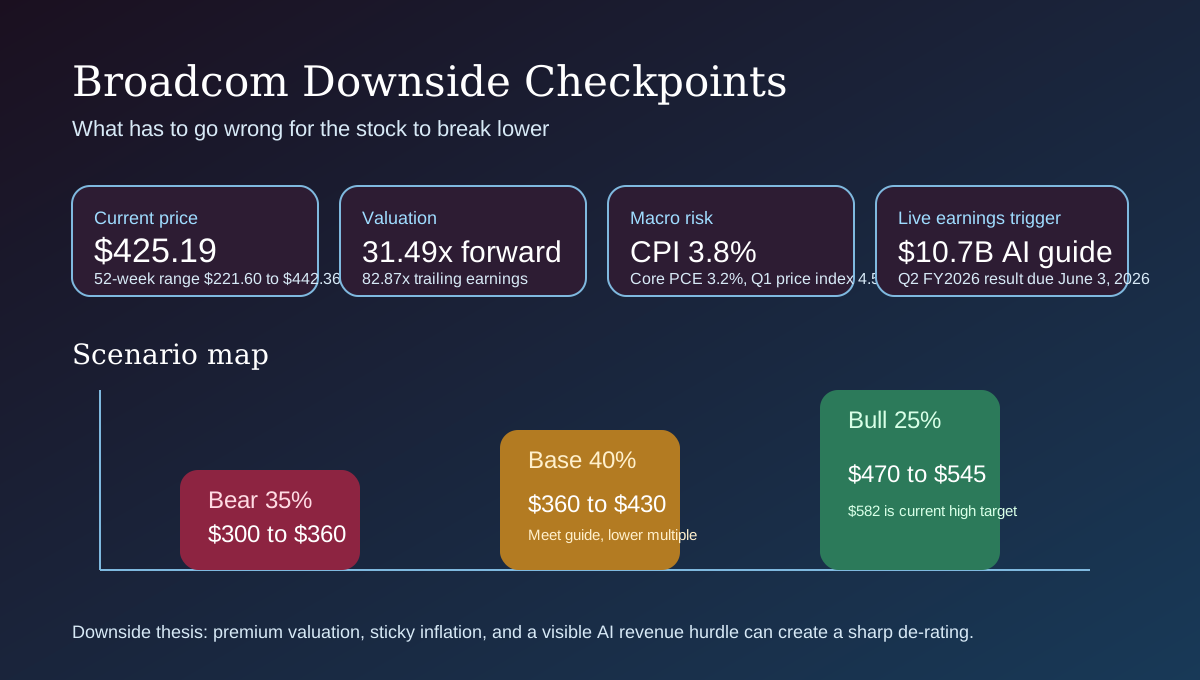
The ranges below are house scenarios anchored to current valuation, Street consensus, Broadcom's guidance, and the existing analyst target band. They are not external price targets. The point is to tie the downside thesis to conditions that can actually be monitored instead of to a generic fear of “too much AI hype.”
| Scenario | Probability | Measurable trigger | Indicative price range | Review point |
|---|---|---|---|---|
| Bear | 35% | Q2 FY2026 misses the $22.0B revenue guide or the $10.7B AI revenue guide, while FY2026 EPS consensus falls below $11.00 and inflation remains sticky | $300 to $360 over the next 6 to 12 months | Review on June 3, 2026 and after the July 2026 CPI and PCE releases |
| Base | 40% | Broadcom meets near-term guidance, but the multiple compresses toward the high 20s as estimate upgrades slow | $360 to $430 over the next 6 to 12 months | Review after Q3 FY2026 guidance and the next analyst target resets |
| Bull squeeze | 25% | Broadcom beats and raises, AI revenue exceeds $10.7B, and Street targets migrate toward the current high-end band | $470 to $545, with $582 as the current published high target | Review immediately after June 3, 2026 results |
The practical stance for investors is to treat Broadcom as a premium stock that can still suffer a non-trivial de-rating. A bearish trade only gains conviction if data worsen. Until then, the higher-probability path is not a collapse, but a vulnerable premium multiple that can compress faster than the underlying business deteriorates.
References
Sources
- Broadcom Inc. Announces First Quarter Fiscal Year 2026 Financial Results and Quarterly Dividend, March 4, 2026
- Broadcom Now Shipping World's First 102.4 Tbps Switch in Production Volume, March 12, 2026
- Broadcom Delivers Industry's First 400G/lane Optical DSP for Next-Generation AI Networks, March 11, 2026
- Goldman Sachs, Why AI Companies May Invest More than $500 Billion in 2026, December 18, 2025
- FactSet, S&P 500 Earnings Season Update: May 8, 2026
- U.S. Bureau of Labor Statistics, Consumer Price Index News Release for April 2026, May 12, 2026
- U.S. Bureau of Economic Analysis, Personal Income and Outlays, March 2026, April 30, 2026
- U.S. Bureau of Economic Analysis, GDP (Advance Estimate), 1st Quarter 2026, April 30, 2026
- IMF Executive Board Concludes 2026 Article IV Consultation with the United States, April 2, 2026
- StockAnalysis, Broadcom Statistics & Valuation, accessed May 16, 2026
- StockAnalysis, Broadcom Stock Forecast & Analyst Price Targets, accessed May 16, 2026
- Yahoo Finance chart API for AVGO 10-year monthly price history, accessed May 16, 2026