01. Historical Context
Broadcom still has a credible path to more upside
Broadcom's stock is not rising on narrative alone. Yahoo Finance chart data show the adjusted close moved from $11.89 in June 2016 to $425.19 on May 15, 2026, while official company results show revenue grew from $13.24 billion in fiscal 2016 to $63.89 billion in fiscal 2025. That is the foundation of the bullish case: the market has repeatedly rewarded Broadcom because the company has actually scaled cash flow and earnings through new cycles, not because it merely attached itself to a fashionable theme.
| Horizon | What matters most | Current assessment | Bias |
|---|---|---|---|
| Next 3 months | Whether June 3 results confirm or exceed the $10.7B AI revenue guide | Near-term catalyst is clear and still favorable if Broadcom beats | Moderately Bullish |
| 6-12 months | Whether FY2026 revenue can track the $107.0B consensus and Street targets continue to move higher | Execution trend remains strong enough to support further upside | Bullish |
| To 2030 | Whether Broadcom extends leadership in networking, custom silicon, and private AI infrastructure | The runway still looks large if AI spending stays strategic rather than cyclical | Bullish |
Broadcom's March 4, 2026 earnings release is the most important current proof point. The company reported Q1 FY2026 AI semiconductor revenue of $8.4 billion, up 106% year over year, and guided to $10.7 billion in Q2. That level of reported AI revenue changes the debate. Investors no longer need to speculate about whether Broadcom has meaningful AI exposure. They only need to decide how long that growth rate can stay strong enough to justify the premium multiple.
The answer will partly depend on whether Broadcom remains a central supplier to the network-heavy side of AI clusters rather than only to the compute side. That is why the stock can still rise from here even after a large move: if the market keeps discovering that AI build-outs require more switching, connectivity, optical components, and custom silicon than previously assumed, Broadcom's earnings base can expand again.
02. Key Forces
Five bullish forces that could extend the rally
The first bullish force is simple reported scale. Broadcom's Q1 FY2026 AI semiconductor revenue of $8.4 billion and Q2 guide of $10.7 billion put the company in a different category from businesses that only describe AI opportunity in qualitative terms. Investors usually pay up for reported scale when it comes with high margins and strong customer concentration in the right buyers.
The second bullish force is hyperscaler spending. Goldman Sachs said on December 18, 2025 that consensus 2026 hyperscaler capex estimates had reached $527 billion and could still have up to $200 billion of upside based on past forecasting gaps. That is one of the strongest external demand supports for Broadcom because custom silicon and high-bandwidth networking budgets tend to move with that capex cycle.
The third bullish force is product leadership. Broadcom said on March 12, 2026 that Tomahawk 6, the world's first 102.4 Tbps switch, had entered production volume, and on March 11, 2026 it introduced the industry's first 400G/lane optical DSP for next-generation AI networks. Those launches matter because the companies that capture the networking bottleneck usually keep pricing power longer than the market expects.
The fourth bullish force is software leverage from VMware. Broadcom's VMware Cloud Foundation 9.1 launch on May 5, 2026 focused on secure and cost-effective infrastructure for production AI, and the company said 56% of surveyed organizations were running or planning production inferencing in private cloud environments. That creates a second route for Broadcom to monetize AI beyond chip content alone.
The fifth bullish force is capital return. Broadcom generated $8.01 billion of free cash flow in Q1 FY2026 and authorized a new $10 billion stock buyback. That gives the company room to defend the stock during volatility and reinforces the argument that Broadcom is not just a high-growth AI trade, but also a very large cash compounder.
| Factor | Latest evidence | Current assessment | Bias |
|---|---|---|---|
| AI revenue growth | Q1 FY2026 AI semiconductor revenue $8.4B, up 106% year over year | Broadcom is already monetizing AI at scale | Bullish |
| Demand backdrop | Goldman sees $527B of 2026 hyperscaler capex, with potential upside | External demand still points higher for networking and custom silicon | Bullish |
| Product cycle | Tomahawk 6 and 400G optical DSP launched in March 2026 | Broadcom is shipping into key AI infrastructure bottlenecks | Bullish |
| Software optionality | VCF 9.1 targets private AI infrastructure; 56% of surveyed firms are running or planning private-cloud inferencing | VMware can widen the AI monetization stack | Moderately Bullish |
| Valuation | Forward P/E 31.49 and average target $457.79 | There is upside left, but only if execution remains very clean | Neutral |
The reason the bull case still works despite the premium multiple is that Broadcom's upside is no longer hypothetical. The company has turned AI into reported revenue, reported cash flow, and visible product traction. Stocks usually keep working when the narrative and the income statement are improving together.
03. Countercase
What could interrupt the rally
The biggest risk is valuation. StockAnalysis showed Broadcom at 82.87x trailing earnings and 31.49x forward earnings on May 15, 2026. That means investors are not just paying for growth. They are paying for a specific type of growth: sustained AI leadership with very little slippage in margins, customer spending, or delivery cadence.
The second risk is macro. The Bureau of Labor Statistics reported April CPI at 3.8% year over year, and the Bureau of Economic Analysis reported March core PCE at 3.2% year over year plus a 4.5% increase in the first-quarter PCE price index. If that inflation path keeps real yields elevated, richly valued semiconductors can stall even while business demand remains healthy.
The third risk is that AI capex eventually broadens into a return-on-investment debate. Goldman Sachs itself highlighted on December 18, 2025 that AI infrastructure stocks had already gained much more than their two-year EPS revisions. Broadcom is not the weakest link in that trade, but it still sits inside the same ecosystem. Once investors begin demanding evidence that customer returns are improving, the whole group becomes less forgiving.
| Risk | Latest data | Why it matters now | Current assessment |
|---|---|---|---|
| Valuation | 31.49x forward P/E; 82.87x trailing P/E | The stock still needs further estimate support to keep re-rating | Moderate risk |
| Inflation | April CPI 3.8%; March core PCE 3.2% | Higher-for-longer rates remain a live headwind to premium semis | Moderate risk |
| Consensus crowding | Average target $457.79; median $480; high $582 | A crowded bull setup raises volatility around earnings | Moderate risk |
| Execution bar | Q2 AI guide is $10.7B after Q1 actual of $8.4B | The next beat must still be large enough to impress | High risk |
The bullish thesis therefore remains valid, but it is not automatic. Broadcom can keep rising only if the next evidence set stays good enough to justify a stock that is already being treated as a premier AI compounder.
04. Institutional Lens
What serious public research says about the upside
Broadcom's own reporting remains the strongest institutional input. On March 4, 2026 the company reported Q1 FY2026 revenue of $19.311 billion, non-GAAP EPS of $2.05, and adjusted EBITDA of 68% of revenue, then guided to about $22.0 billion of Q2 revenue. That combination of growth and cash conversion is why the market still gives Broadcom a premium multiple instead of treating it as a generic cyclical semiconductor stock.
Goldman Sachs Research supports the demand side of the story. On May 12, 2026 Goldman wrote that optical networking could see a 9x total addressable market unlock to $154 billion as AI infrastructure evolves. On December 18, 2025 Goldman also said 2026 hyperscaler capex expectations had climbed to $527 billion and could still rise further. Those are exactly the kind of external demand signals that justify staying constructive on Broadcom's switching and connectivity franchises.
FactSet's May 8, 2026 earnings update adds an important market overlay. FactSet said 84% of S&P 500 companies reporting Q1 results had beaten EPS estimates and that the S&P 500 forward P/E stood at 21.0. In practice, that means the market is still rewarding earnings momentum. Broadcom can keep participating in that regime if its own estimate revisions remain positive.
| Source | Latest update | What it said | Why bulls care |
|---|---|---|---|
| Broadcom | March 4, 2026 | Q1 FY2026 AI semiconductor revenue was $8.4B and Q2 guide is $10.7B | Confirms that AI demand is already visible in reported results |
| Goldman Sachs Research | May 12, 2026 | Optical networking could unlock a $154B market | Supports a long runway for Broadcom's network layer exposure |
| Goldman Sachs Research | December 18, 2025 | Consensus 2026 hyperscaler capex rose to $527B, with upside beyond that | Reinforces the spending backdrop for Broadcom's largest AI customers |
| FactSet | May 8, 2026 | S&P 500 forward P/E was 21.0 and 84% of reporters beat EPS estimates | The market still favors companies with strong earnings momentum |
| StockAnalysis consensus | Accessed May 16, 2026 | Average target $457.79, median $480, high $582, FY2026 revenue estimate $107.0B | Street still sees room for additional upside if execution stays clean |
The institutional conclusion is constructive but disciplined. Broadcom remains one of the better public-market ways to own AI infrastructure because it sells scarce components into a rising spend category and converts that demand into free cash flow. The stock keeps working if those three facts remain true together.
05. Scenarios
Actionable upside scenarios from here
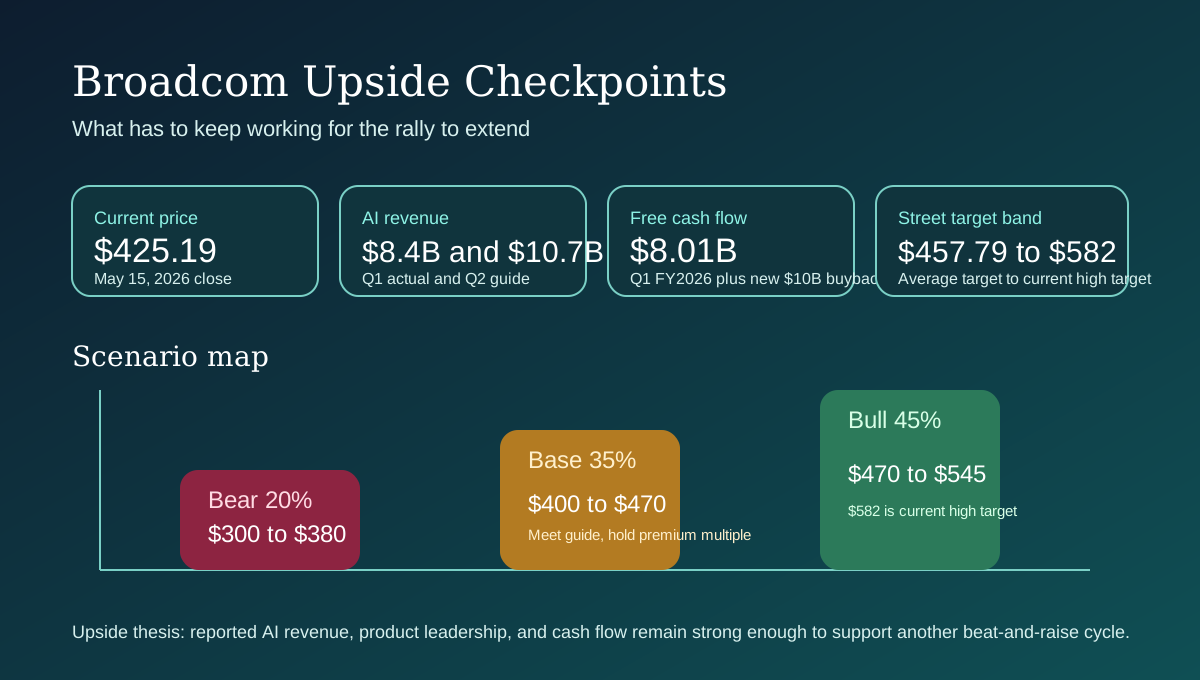
The ranges below are house scenarios based on Broadcom's latest guidance, current Street targets, and the stock's existing premium multiple. They are not third-party target prices. They are intended to show what investors should watch if they want a bullish thesis that can be updated with real evidence rather than with mood alone.
| Scenario | Probability | Measurable trigger | Indicative price range | Review point |
|---|---|---|---|---|
| Bull | 45% | Q2 FY2026 AI revenue meets or exceeds $10.7B, total revenue beats the $22.0B guide, and FY2026 consensus stays near or above $107.0B revenue and $11.55 EPS | $470 to $545 over the next 6 to 12 months, with $582 as the current high-end published target | Review on June 3, 2026 and again after the next round of analyst revisions |
| Base | 35% | Broadcom meets guidance, but upside is limited as the multiple holds near current levels instead of expanding | $400 to $470 over the next 6 to 12 months | Review after Q3 FY2026 guidance and after each major hyperscaler earnings season |
| Bear | 20% | AI revenue or margins disappoint, inflation remains sticky, and the multiple compresses into the high 20s or lower | $300 to $380 over the next 6 to 12 months | Review immediately if FY2026 EPS consensus drops below $11.00 |
The most practical bullish stance is selective rather than euphoric. Broadcom still has a credible path higher because reported AI revenue, product cadence, and cash flow all support the story. The trade works best when investors keep demanding clean evidence, especially around June earnings, instead of assuming the stock can rise indefinitely on narrative strength alone.
References
Sources
- Broadcom Inc. Announces First Quarter Fiscal Year 2026 Financial Results and Quarterly Dividend, March 4, 2026
- Broadcom Now Shipping World's First 102.4 Tbps Switch in Production Volume, March 12, 2026
- Broadcom Delivers Industry's First 400G/lane Optical DSP for Next-Generation AI Networks, March 11, 2026
- Broadcom Announces VMware Cloud Foundation 9.1, Enabling Secure and Cost-Effective Infrastructure for Production AI, May 5, 2026
- Goldman Sachs Research, Optical Networking: The Next Mega Trend in AI Infrastructure, May 12, 2026
- Goldman Sachs, Why AI Companies May Invest More than $500 Billion in 2026, December 18, 2025
- FactSet, S&P 500 Earnings Season Update: May 8, 2026
- U.S. Bureau of Labor Statistics, Consumer Price Index News Release for April 2026, May 12, 2026
- U.S. Bureau of Economic Analysis, Personal Income and Outlays, March 2026, April 30, 2026
- StockAnalysis, Broadcom Statistics & Valuation, accessed May 16, 2026
- StockAnalysis, Broadcom Stock Forecast & Analyst Price Targets, accessed May 16, 2026
- Yahoo Finance chart API for AVGO 10-year monthly price history, accessed May 16, 2026