01. Historical Context
The CAC 40 has upside, but it is not starting from a cheap or washed-out level
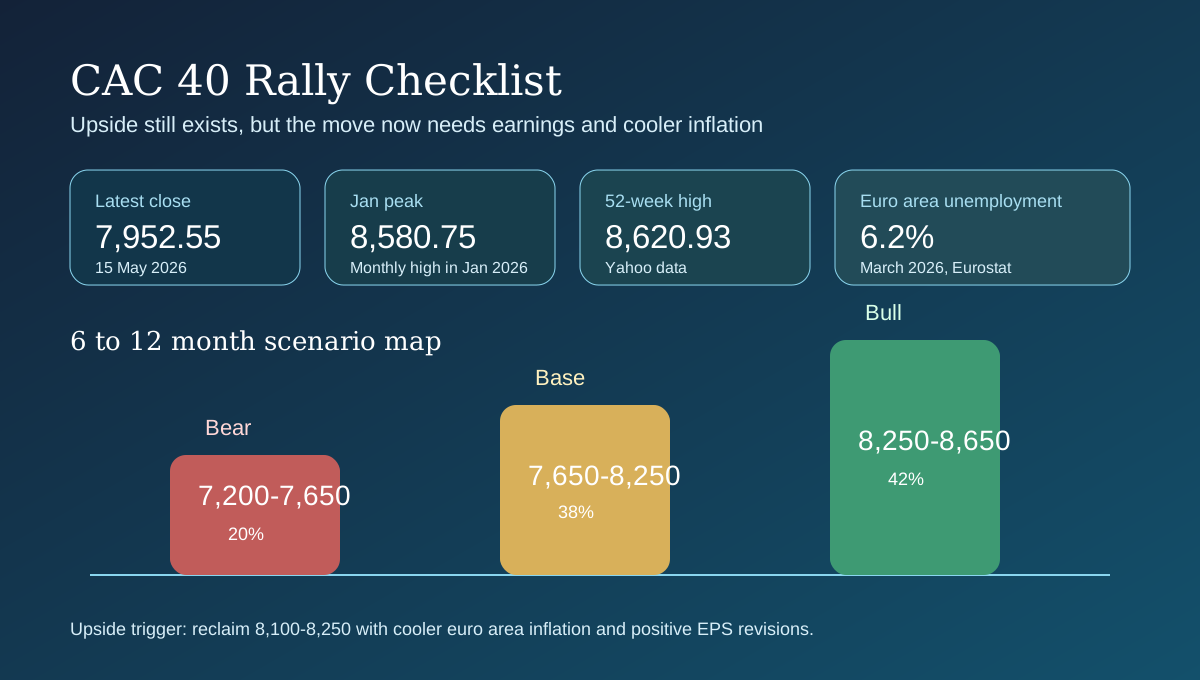
The CAC 40 has already delivered a strong long-run move. Yahoo Finance chart data show the index rising from 4,237.48 on 31 May 2016 to 7,952.55 on 15 May 2026, a total gain of 87.67% over ten years. That matters because the next rally is not a deep-value rebound story. It is a continuation story that depends on whether earnings can justify keeping the benchmark close to the upper end of its recent range.
| Horizon | What matters most | What would strengthen the thesis | What would weaken the thesis |
|---|---|---|---|
| 1-3 months | Inflation path, ECB tone, and Q2 earnings commentary | CAC 40 reclaims 8,100 while euro area inflation cools back toward 2.6% | Inflation stays near 3.0% and the index fails repeatedly below resistance |
| 6-12 months | Earnings revisions and participation across sectors | Positive Europe EPS revisions spread beyond industrial and AI-infrastructure names | Returns rely mostly on multiple expansion while revisions flatten |
| To 2027 | Whether soft macro data still convert into cash-flow growth | France and euro area growth re-accelerate modestly while rates stop tightening financial conditions | France stays flat, energy remains a tax on demand, and exporters face a stronger euro |
Euronext's CAC 40 factsheet dated 31 March 2026 showed free-float market capitalization of EUR 1,745.47 billion, top-ten concentration of 59.64%, price-to-book of 3.24, price-to-sales of 2.55, price-to-cash-flow of 14.58, and a dividend yield of 2.96%. The public factsheet does not publish a CAC 40 price-to-earnings ratio, which is why the valuation discussion below uses those published fundamentals and Europe-wide P/E benchmarks from Goldman Sachs and J.P. Morgan rather than inventing a CAC-specific P/E.
The index composition also explains why the upside case is plausible. As of 31 March 2026, the largest weights were TotalEnergies at 9.52%, Schneider Electric at 7.57%, LVMH at 6.63%, Air Liquide at 5.90%, Sanofi at 5.53%, Airbus at 5.47%, and Safran at 5.09%. That mix gives the benchmark exposure to energy cash generation, electrification, industrial automation, aerospace, and luxury demand. The rally thesis works best if more than one of those pillars participates.
02. Key Forces
Five bullish forces that could extend the move
First, Europe-wide earnings revisions have stopped deteriorating. J.P. Morgan Asset Management wrote in its 2026 global ex-US equities outlook that, after seven months of negative EPS revisions, Europe's 2026 EPS estimate is now being revised up and bottom-up forecasts point to 12% year-on-year growth, even though the firm thinks mid-single-digit growth is the more realistic outcome. For the CAC 40, even that more cautious view is enough to support upside if revisions remain positive through the next reporting cycle.
Second, professional strategy desks are constructive on Europe, but not euphoric. Goldman Sachs Research said on 15 January 2026 that it expected the STOXX 600 to generate an 8% total return in 2026, supported by 5% EPS growth in 2026 and 7% in 2027. That matters because it frames the bull case as earnings-led and modest, not as a speculative melt-up. If the CAC 40 rises, the cleaner path is through profit delivery rather than a much higher multiple.
Third, the labor backdrop is still supportive enough to keep recession fears contained. Eurostat reported that euro area unemployment fell to 6.2% in March 2026 from 6.3% in February, while euro area GDP still grew 0.1% quarter on quarter in the first quarter. That is weak growth, but it is not a contractionary backdrop. Equity benchmarks can still grind higher in that kind of environment if earnings and cash flow remain intact.
Fourth, several large CAC 40 components are still seeing real demand from electrification, semiconductors, and AI infrastructure. Schneider Electric reported Q1 2026 group revenues of EUR 9.8 billion, up 11.2% organically, with energy management up 12.8% and growth led by data center demand. Air Liquide said Q1 sales were nearly EUR 6.8 billion, investment decisions reached EUR 1.5 billion, and backlog hit a record EUR 5.5 billion, including projects tied to next-generation AI chips. STMicroelectronics said its data-center revenue should be nicely above USD 500 million in 2026 and well above USD 1 billion in 2027. Capgemini reported Q1 bookings of EUR 6.054 billion, with generative and agentic AI accounting for more than 11% of group bookings.
Fifth, the luxury complex is not booming, but it is proving more resilient than a collapse narrative would imply. LVMH reported Q1 2026 revenue of EUR 19.1 billion, down 6% reported but up 1% organically, despite saying the Middle East conflict reduced quarterly organic growth by around 1%. That does not make luxury a pure bullish driver, but it does reduce the probability that a sharp consumer-led earnings hole appears all at once in one of the CAC 40's largest sectors.
| Factor | Why it matters | Current assessment | Bias |
|---|---|---|---|
| Macro backdrop | Sets the ceiling for cyclicals and market multiples | Euro area GDP still rose 0.1% qoq in Q1 2026 and unemployment is 6.2%, but growth is soft | Neutral |
| Inflation and rates | Determines whether valuation can expand | Euro area CPI jumped to 3.0% in April while the ECB kept the deposit rate at 2.00% | Neutral to bearish |
| Earnings revisions | Best evidence that the rally deserves to continue | J.P. Morgan says Europe 2026 EPS revisions have turned positive after seven negative months | Bullish |
| AI and electrification leaders | Schneider, Air Liquide, ST, and Capgemini can pull the index higher | Company commentary remains supportive, especially in data center and semiconductor infrastructure | Bullish |
| Valuation support | Controls how much room remains if data stay only average | Euronext publishes P/B 3.24 and P/CF 14.58; Goldman and J.P. Morgan place Europe near 15-16x forward earnings | Neutral |
The strongest version of the bull case is therefore a combined story: positive revisions, stable labor data, visible industrial demand, and inflation that cools enough to prevent the ECB from re-hardening its stance.
03. Countercase
What could interrupt the rally
The main risk is that inflation has re-accelerated at exactly the wrong time. Eurostat's flash estimate put euro area inflation at 3.0% in April 2026, up from 2.6% in March, with energy inflation at 10.9%. France's final April CPI print from Insee was 2.2% year on year, but French energy prices were up 14.3% from a year earlier. If those energy effects begin to feed into expectations or margins, the market will struggle to justify a richer multiple.
The second risk is that France's domestic macro data remain too soft for broad earnings momentum. Insee said French GDP was flat in the first quarter of 2026 after 0.2% growth in the fourth quarter of 2025, and unemployment rose to 8.1% in the first quarter. That combination does not automatically break the bullish case, but it does raise the hurdle for domestically exposed names and for sectors that need cleaner consumer demand.
The third risk is concentration. Euronext's factsheet shows the top ten names at 59.64% of the index. If a few large constituents disappoint at the same time - for example energy, luxury, or industrial leaders - the headline benchmark can look much weaker than the broader European earnings backdrop alone would suggest.
| Risk | Latest data point | Why it matters | Current assessment |
|---|---|---|---|
| Inflation reset | Euro area CPI 3.0% in April 2026; energy inflation 10.9% | Can keep real rates high and block multiple expansion | Bearish |
| Soft France macro | France GDP 0.0% qoq in Q1 2026; unemployment 8.1% | Raises the hurdle for domestically sensitive sectors | Neutral to bearish |
| Valuation | Europe at 15x 2026 P/E per Goldman; 16x forward earnings per J.P. Morgan Europe ex-UK | Leaves less room for disappointment than a cheap market would | Neutral |
| Concentration | Top ten weights total 59.64% | Turns stock-specific misses into index-level weakness quickly | Bearish |
| Luxury demand mix | LVMH Q1 total revenue +1% organic, but Fashion and Leather Goods -2% organic | Shows that one of the index's biggest sectors is stable, not booming | Neutral to bearish |
The bullish setup remains credible only if these headwinds stay separate. The problem starts when sticky inflation, flat French activity, and narrow leadership begin to reinforce one another.
04. Institutional Lens
What professional research implies for further upside
Goldman Sachs and J.P. Morgan are broadly constructive on European equities, but both are effectively saying the same thing: Europe can rise, yet it should rise on earnings rather than on exuberant valuation expansion. That is a useful framework for the CAC 40 because the benchmark already trades as a quality market, not as a distressed one.
Goldman Sachs Research's January 2026 outlook called for an 8% total return in the STOXX 600 in 2026, with 5% EPS growth in 2026 and 7% in 2027. Goldman also said European stocks were not cheap against their own history, standing at 15 times 2026 earnings and around the 70th-71st percentile of P/E over the last 25 years. J.P. Morgan Asset Management added that Europe's 2026 EPS estimate had turned positive after seven months of downgrades, but it still viewed mid-single-digit growth as more realistic than the 12% bottom-up consensus.
The IMF's April 2026 World Economic Outlook is the macro anchor beneath those calls. The IMF projected euro area growth of 1.1% in 2026 and France at 0.9%. That is enough to keep a bull case alive, but not enough to support an indiscriminate rally if company guidance softens.
| Source | What it said | Date | Read-through for CAC 40 |
|---|---|---|---|
| Goldman Sachs Research | STOXX 600 total return of 8% in 2026, with EPS growth of 5% in 2026 and 7% in 2027 | 15 January 2026 | Supports a measured Europe bull case rather than a melt-up |
| Goldman Sachs Research | Europe trades at 15x 2026 P/E and in the 70th-71st percentile of its own history | 15 January 2026 | Means CAC upside should be earnings-led, not multiple-led |
| J.P. Morgan Asset Management | Europe's 2026 EPS estimate is being revised up after seven negative months; 12% bottom-up growth but mid-single digits more realistic | 2026 outlook page available in May 2026 | Revision direction matters more than heroic consensus numbers |
| IMF World Economic Outlook | Euro area GDP forecast 1.1% in 2026; France 0.9% in 2026 | April 2026 | Macro growth is positive, but too modest to forgive repeated earnings misses |
The common message is constructive but disciplined. The CAC 40 can push higher, but the quality of the advance matters more than the headline move itself.
05. Scenarios
Actionable 6 to 12 month scenarios
The ranges below are author estimates built from the current CAC 40 level, the January 2026 peak, the 52-week range, Europe macro data, and the institutional research cited above. They are not third-party index targets.
| Scenario | Probability | Range | Trigger conditions | When to review |
|---|---|---|---|---|
| Bull | 42% | 8,250-8,650 | CAC 40 reclaims 8,100 and then 8,250, euro area CPI cools back below 2.6%, and Europe EPS revisions stay positive through Q2 reporting | Review after the next ECB meeting and after the main Q2 reporting window |
| Base | 38% | 7,650-8,250 | Growth stays positive but soft, the ECB stays on hold, and leadership remains mixed across energy, luxury, and industrials | Review monthly with Eurostat inflation and labor releases |
| Bear | 20% | 7,200-7,650 | The index loses 7,500 decisively, inflation remains near 3.0%, and earnings commentary weakens in large constituents | Review immediately on a weekly close below 7,500 or on a turn back to negative EPS revisions |
The tactical conclusion is straightforward. Buyers should want confirmation above 8,100 and cleaner inflation before assuming the next leg higher is durable. Existing holders can stay constructive, but the position is stronger if it is defended by revisions and operating delivery rather than by hope for a fast valuation re-rating.
If the data cooperate, the CAC 40 can retest the 2026 highs. If they do not, the more likely outcome is a broad range rather than an immediate breakout.
References
Sources
- Yahoo Finance chart API for CAC 40 10-year monthly history
- Yahoo Finance chart API for CAC 40 latest daily price metadata
- Euronext CAC 40 factsheet, 31 March 2026
- Euronext CAC 40 composition, 31 March 2026
- Goldman Sachs Research: European stocks outlook, 15 January 2026
- J.P. Morgan Asset Management: global ex-US equities outlook
- IMF World Economic Outlook, April 2026
- Eurostat flash estimate: euro area inflation in April 2026
- Eurostat unemployment release for March 2026
- ECB monetary policy decision, 30 April 2026
- Insee final consumer price index release for April 2026
- Insee GDP flash estimate for Q1 2026
- Insee unemployment release for Q1 2026
- Schneider Electric Q1 2026 revenues
- Air Liquide Q1 2026 activity update
- STMicroelectronics Q1 2026 financial results
- Capgemini Q1 2026 revenues
- LVMH Q1 2026 revenue release