01. Historical Context
The bearish setup matters because valuation and concentration still leave room for disappointment
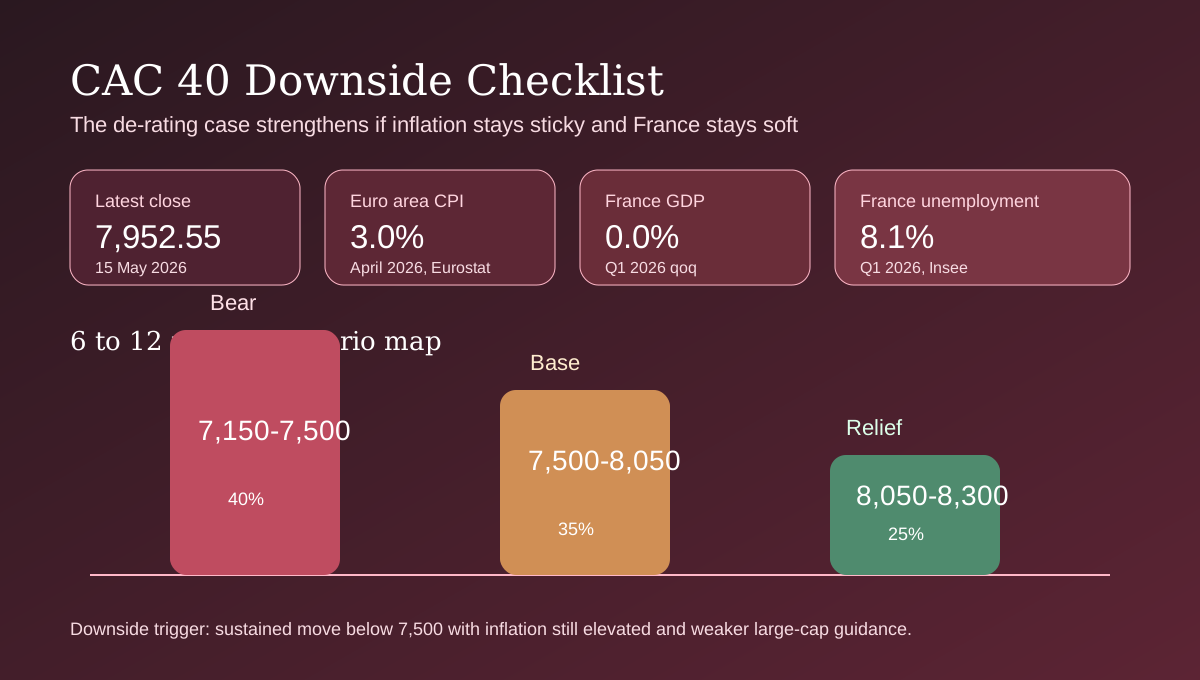
Downside analysis is strongest when the market is not already screaming distress. Yahoo Finance data show the CAC 40 at 7,952.55 on 15 May 2026 versus a 52-week high of 8,620.93 and a January monthly high of 8,580.75. That means the benchmark has already corrected from the highs, but not enough to guarantee that bad news is fully priced.
| Horizon | What matters most | What would strengthen the thesis | What would weaken the thesis |
|---|---|---|---|
| 1-3 months | Inflation, ECB language, and market reaction to earnings | Euro area inflation stays near 3.0% and the index fails below 8,050 | Inflation cools quickly and CAC 40 reclaims 8,050 |
| 6-12 months | Whether soft growth turns into weaker profit delivery | France activity stays flat and revisions roll over again | Europe-wide revisions continue to improve and breadth widens |
| To 2027 | Whether current leadership can still carry the benchmark | Concentration amplifies misses in energy, luxury, or industrials | Large-cap leaders convert capex and pricing power into cash-flow durability |
Euronext's 31 March 2026 factsheet showed price-to-book of 3.24, price-to-sales of 2.55, price-to-cash-flow of 14.58, dividend yield of 2.96%, and top-ten concentration of 59.64%. None of those figures describe a crash-priced market. They describe a benchmark that still assumes reasonable quality in the earnings base.
Composition risk is central here. The top positions include TotalEnergies at 9.52%, Schneider Electric at 7.57%, LVMH at 6.63%, Air Liquide at 5.90%, Sanofi at 5.53%, Airbus at 5.47%, and Safran at 5.09%. If several of those pillars soften together, the index can fall even if the broader European narrative remains only mildly negative.
02. Key Forces
Five bearish forces that could push the trend lower
The first bearish force is inflation. Eurostat's flash estimate showed euro area CPI at 3.0% in April 2026, up from 2.6% in March, with energy inflation accelerating to 10.9%. The ECB responded on 30 April by leaving the deposit facility rate at 2.00%. That combination matters because a market that is not cheap rarely responds well when disinflation stalls and policy cannot turn more supportive.
The second force is French macro softness. Insee reported that French GDP was flat in the first quarter of 2026 after 0.2% growth in the prior quarter, while unemployment rose to 8.1%, the highest since the first quarter of 2021. A flat domestic economy does not automatically break the CAC 40, but it reduces tolerance for earnings misses in domestically exposed or consumer-sensitive segments.
The third force is valuation compression risk. Goldman Sachs said in January 2026 that Europe traded at 15 times 2026 earnings and in roughly the 70th-71st percentile of its own history. J.P. Morgan Asset Management said Europe ex-UK was trading around 16 times forward earnings. That does not imply an imminent collapse, but it does mean the market can still fall without needing a recession if investors simply decide those multiples are too generous for a slower-growth regime.
The fourth force is mixed consumer and luxury delivery. LVMH reported Q1 2026 total revenue of EUR 19.1 billion and organic growth of 1%, but its Fashion and Leather Goods division was down 2% organically. Kering reported first-quarter revenue of EUR 3.568 billion, down 6% as reported and stable on a comparable basis, with Gucci down 8% comparable. Those figures do not imply crisis, but they do show that one of the benchmark's major profit pools is not carrying broad upside momentum.
The fifth force is concentration. Euronext's factsheet shows the top ten names at 59.64% of the index, and the public composition snapshot shows that several sectors with very different drivers dominate the benchmark. When leadership is narrow, one earnings miss can quickly become an index event rather than a stock event.
| Factor | Why it matters | Current assessment | Bias |
|---|---|---|---|
| Inflation and rates | Drives the market's willingness to pay current multiples | Euro area CPI is back at 3.0% and the ECB is on hold at 2.00% | Bearish |
| France macro data | Shapes demand confidence in domestic and cyclical sectors | GDP was flat in Q1 2026 and unemployment rose to 8.1% | Bearish |
| Valuation | Determines how much disappointment can be absorbed | Europe is around 15-16x forward earnings, not distressed | Neutral to bearish |
| Earnings breadth | Separates a pause from a durable de-rating | Revisions improved at the Europe level, but luxury and domestic demand remain mixed | Neutral |
| Concentration | Turns single-stock weakness into benchmark weakness | Top ten names represent 59.64% of the index | Bearish |
The downside case therefore does not need a dramatic macro accident. It only needs inflation to stay sticky, the French backdrop to remain soft, and the market to lose patience with a still-expensive earnings stream.
03. Countercase
What could stop the decline from becoming a larger de-rating
The most important counterargument is that European earnings revisions have improved rather than worsened. J.P. Morgan Asset Management said Europe's 2026 EPS estimate is now being revised up after seven months of downgrades. That matters because a bearish view is much weaker if forward profits continue stabilizing even while macro headlines look mediocre.
The second counterpoint is that some of the CAC 40's industrial and technology-adjacent leaders are still seeing robust order flow. Schneider Electric posted 11.2% organic revenue growth in Q1 2026, led by data centers. Air Liquide lifted investment decisions to EUR 1.5 billion and said backlog rose to a record EUR 5.5 billion. STMicroelectronics confirmed a 2026 data-center revenue expectation nicely above USD 500 million. Those are not recessionary company datapoints.
The third counterpoint is that labor data at the euro area level remain relatively firm. Eurostat's 6.2% unemployment rate for March 2026 is low enough to limit the probability of an immediate demand collapse. That makes the bearish case more about valuation and earnings quality than about a straight recession call.
| Offset | Latest data point | Why it matters | Current assessment |
|---|---|---|---|
| Europe EPS revisions | J.P. Morgan says 2026 Europe EPS revisions have turned positive | Reduces the odds of a deep earnings-led selloff | Bullish offset |
| Industrial demand | Schneider Q1 revenue +11.2% organic; data center demand strong | Shows one major CAC weight still has real structural demand | Bullish offset |
| Gas and semiconductor infrastructure | Air Liquide backlog EUR 5.5 billion; ST data-center revenue above USD 500 million expected in 2026 | Supports the index's industrial and semiconductor-adjacent earnings base | Bullish offset |
| Euro area labor market | Unemployment 6.2% in March 2026 | Suggests the region is weak, not broken | Neutral to bullish offset |
| Institutional market view | Goldman still expects 8% STOXX 600 total return in 2026 | Professional strategy remains constructive unless earnings roll over | Neutral to bullish offset |
The bearish case becomes much stronger only if these offsets fade at the same time. Without that confirmation, the more likely downside path is a grind lower or a volatile range rather than a straight collapse.
04. Institutional Lens
How professional investors frame the downside risk
Professional research does not argue that Europe is fragile by default. It argues that Europe is moderately constructive but no longer cheap. That distinction matters. Goldman Sachs Research said Europe traded at 15 times 2026 earnings in January and around the 70th-71st percentile of its own valuation history, yet still expected an 8% total return in the STOXX 600 because it also forecast 5% EPS growth in 2026 and 7% in 2027.
J.P. Morgan Asset Management delivered the same message with different wording: Europe ex-UK is around 16 times forward earnings, revisions have turned up, but mid-single-digit profit growth is more realistic than 12% bottom-up expectations. In other words, the downside case is not about a broken base case. It is about what happens if the market stops receiving enough evidence to justify those multiples.
The IMF's April 2026 WEO projected euro area growth of 1.1% and France at 0.9% for 2026. That is slow enough to make the benchmark vulnerable to disappointments, but not weak enough to guarantee a long bear market on macro alone.
| Source | What it said | Date | Read-through for CAC 40 |
|---|---|---|---|
| Goldman Sachs Research | STOXX 600 total return of 8% in 2026, but Europe trades at 15x 2026 P/E and is not cheap historically | 15 January 2026 | If profits miss, the valuation cushion is limited |
| J.P. Morgan Asset Management | Europe's 2026 EPS revisions have improved, but mid-single-digit growth is more realistic than 12% consensus | 2026 outlook page available in May 2026 | Downside extends if reality undershoots even the more conservative earnings path |
| IMF World Economic Outlook | Euro area GDP forecast 1.1% in 2026; France 0.9% in 2026 | April 2026 | Growth is positive, but too soft to absorb repeated earnings disappointments easily |
| ECB | Deposit facility rate kept at 2.00% on 30 April 2026 | 30 April 2026 | Policy is stable, but not loose enough to bail out weak earnings automatically |
The institutional message is therefore simple: the CAC 40 can fall further, but the fall should be read through the lens of earnings and valuation compression, not assumed to be a pure recession trade from day one.
05. Scenarios
Actionable downside scenarios over the next 6 to 12 months
The ranges below are author estimates built from the current CAC 40 level, the 1-year range, current inflation data, French macro releases, and the institutional research cited above. They are not third-party price targets.
| Scenario | Probability | Range | Trigger conditions | When to review |
|---|---|---|---|---|
| Bear | 40% | 7,150-7,500 | The CAC 40 closes below 7,500 on a sustained basis, euro area inflation remains near or above 2.8%, and large-cap earnings commentary weakens further | Review after the next Eurostat inflation release, the next ECB meeting, and the main Q2 reporting window |
| Base | 35% | 7,500-8,050 | Growth stays soft but positive, revisions do not fully roll over, and industrial leaders offset part of the pressure from luxury and domestic weakness | Review monthly with inflation, labor, and revisions data |
| Relief rally | 25% | 8,050-8,300 | Inflation cools faster than feared, revisions stay positive, and the market rewards industrial and AI-infrastructure exposure again | Review if the index reclaims 8,050 and holds above it through earnings season |
The tactical conclusion is that sellers still have a macro argument, but they need confirmation from price and earnings. A weekly close below 7,500 would materially strengthen the bearish case. Without that break, the higher-probability outcome is an uneven range with selective weakness rather than a one-way collapse.
For holders, risk control matters more than predicting the exact bottom. The market can still deteriorate, but the downside is strongest only if inflation, French macro data, and benchmark concentration start compounding instead of merely coexisting.
References
Sources
- Yahoo Finance chart API for CAC 40 10-year monthly history
- Yahoo Finance chart API for CAC 40 latest daily price metadata
- Euronext CAC 40 factsheet, 31 March 2026
- Euronext CAC 40 composition, 31 March 2026
- Goldman Sachs Research: European stocks outlook, 15 January 2026
- J.P. Morgan Asset Management: global ex-US equities outlook
- IMF World Economic Outlook, April 2026
- Eurostat flash estimate: euro area inflation in April 2026
- Eurostat unemployment release for March 2026
- ECB monetary policy decision, 30 April 2026
- Insee final consumer price index release for April 2026
- Insee GDP flash estimate for Q1 2026
- Insee unemployment release for Q1 2026
- LVMH Q1 2026 revenue release
- Kering Q1 2026 revenue release
- Schneider Electric Q1 2026 revenues
- Air Liquide Q1 2026 activity update
- STMicroelectronics Q1 2026 financial results