01. Historical Context
The DAX still has upside, but it needs a better quality rally than the last one
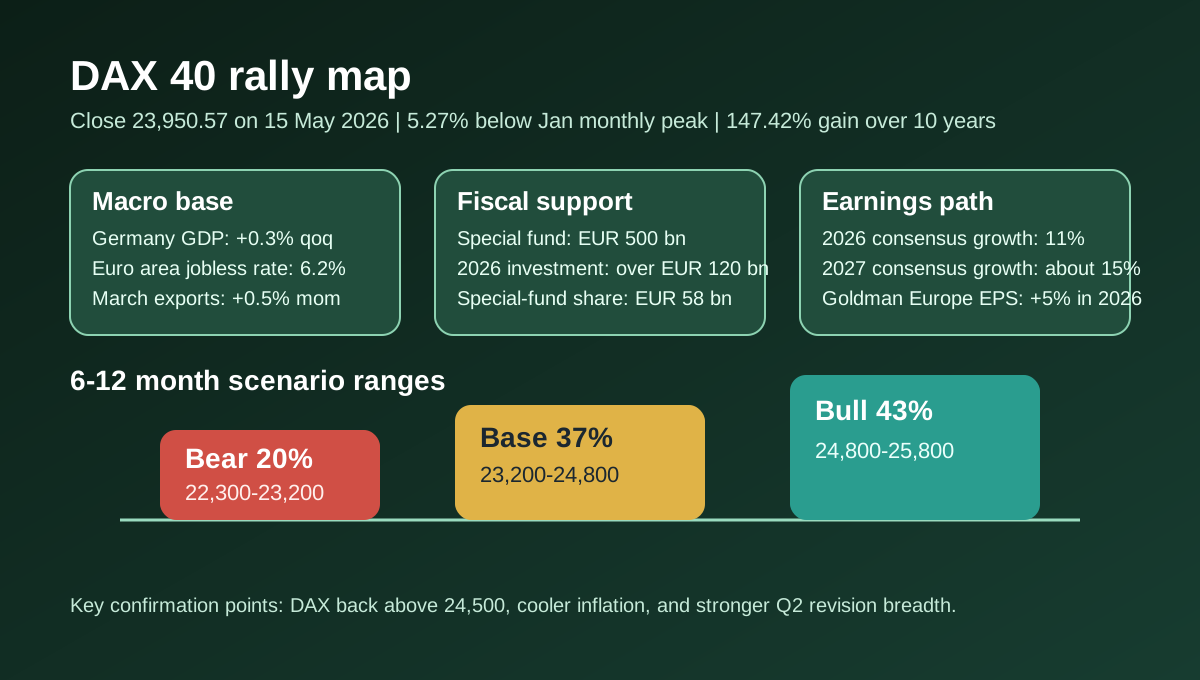
The DAX has already delivered a long-run gain that investors cannot ignore. Yahoo Finance chart data show the index climbing from 9,680.09 on 31 May 2016 to 23,950.57 on 15 May 2026, a 147.42% increase over ten years and a 9.53% annualized return. That means the next upside leg is not a recovery-from-crisis story. It is a continuation story that depends on whether profits, fiscal support and industrial demand can justify keeping the benchmark close to its recent highs.
| Horizon | What matters most | What would strengthen the thesis | What would weaken the thesis |
|---|---|---|---|
| 1-3 months | Inflation path, ECB tone, and Q2 guidance | DAX reclaims 24,500 while Germany CPI cools and guidance stabilizes | Inflation stays hot and the index fails repeatedly below resistance |
| 6-12 months | Earnings revisions and participation across sectors | Positive revisions broaden beyond a handful of industrial and AI-linked names | Consensus numbers stay high while delivered growth stays mediocre |
| To 2027 | Whether fiscal support turns into real cash-flow growth | Germany's investment push lifts domestic demand without reigniting a policy scare | Higher public spending is offset by energy costs, weaker exports, or persistent inflation |
The STOXX DAX page describes the index as a performance benchmark that includes dividends and caps any one name at 15%. It also lists Siemens, Allianz, SAP, Siemens Energy, Airbus, Deutsche Telekom, Munich Re, Infineon, Rheinmetall, and Deutsche Bank among the top ten constituents. That mix matters because it gives the benchmark exposure to industrial automation, enterprise software, power infrastructure, semiconductors, financials and defense. The rally case gets stronger if more than one of those pillars participates at the same time.
Valuation is not distressed, but it is still workable if growth improves. Goldman Sachs Research wrote on 15 January 2026 that Europe traded at 15x 2026 earnings, around the 70th to 71st percentile of its own 25-year history. Simply Wall St's German market page, updated 16 May 2026 using S&P Global Market Intelligence data, showed an aggregate German market P/E of 17.2x and earnings forecast to grow 17% annually. That combination means upside remains plausible, but it needs an earnings story rather than a purely sentiment-driven rerating.
02. Key Forces
Five bullish forces that could extend the move
First, Germany's economy has finally moved back into growth. Destatis said first-quarter 2026 GDP rose 0.3% quarter on quarter and 0.5% year on year on a price-adjusted basis. Private consumption, government consumption and exports all increased compared with the prior quarter. That is not an outright boom, but it is enough to keep the DAX from depending solely on foreign demand and policy hope.
Second, some of the most cyclically important hard data have improved. Destatis reported new manufacturing orders up 5.0% month on month in March and exports up 0.5% month on month to EUR 135.8 billion. Industrial production still fell 0.7% in March, so the picture is mixed, but the rally case only needs incremental improvement rather than perfection. For an export-heavy benchmark, stronger orders and exports are the kind of early-cycle data that can matter more than one weak production print.
Third, Germany's fiscal stance has turned more supportive for equities. The Federal Government says the infrastructure and climate-neutrality special fund totals EUR 500 billion and that federal investment is planned to exceed EUR 120 billion in 2026, including EUR 58 billion from the special fund. That is a meaningful tailwind for industrials, grid suppliers, construction-linked names and domestic demand more broadly.
Fourth, the earnings setup is mixed, but still constructive if it improves from here. Deutsche Borse wrote on 11 May 2026 that the DAX reporting season had been slightly disappointing, with an aggregate earnings surprise of minus 4.5% and realized earnings growth of 0.7%. But the same note said the consensus still expects 11% earnings growth for the current year and around 15% for 2027. That gap between weak delivery and optimistic forward expectations is a risk if it widens, but it is a catalyst if the next reporting cycle closes it in the right direction.
Fifth, regional institutional research is still constructive on Europe. Goldman Sachs Research expects the STOXX 600 to deliver an 8% total return in 2026, supported by 5% EPS growth in 2026 and 7% in 2027. J.P. Morgan Asset Management says Europe's 2026 EPS estimate is finally being revised up after seven months of downgrades, while also arguing that mid-single-digit growth is a more realistic base than the 12% bottom-up consensus. For the DAX, that mix points to a measured, earnings-led rally rather than a speculative melt-up.
| Factor | Why it matters | Current assessment | Bias |
|---|---|---|---|
| Macro backdrop | Determines whether cyclicals can keep rerating | Germany GDP returned to growth and euro area unemployment is 6.2%, but activity is still soft | Neutral to bullish |
| Inflation and rates | Controls how much multiple expansion is possible | Germany CPI is 2.9% and euro area inflation is 3.0%, while the ECB deposit rate remains 2.00% | Neutral |
| Earnings revisions | Best proof that the rally deserves to continue | Europe's 2026 EPS estimates are now being revised up, but DAX surprise breadth was weak in Q1 | Neutral to bullish |
| Fiscal and capex cycle | Supports industrial and infrastructure-heavy parts of the index | Germany now has a EUR 500 billion special fund and plans over EUR 120 billion in 2026 investment | Bullish |
| Valuation support | Sets the room for error if data improve only modestly | Europe trades near 15x forward earnings and the German aggregate market P/E is 17.2x | Neutral |
The strongest version of the bullish case is therefore a broadening case: better domestic activity, positive revisions, visible fiscal follow-through and inflation that cools enough to stop acting like a tax on multiples.
03. Countercase
What could interrupt the rally
The largest risk is that inflation stays too high for too long. Destatis said Germany's CPI rose 2.9% in April and core inflation was 2.3%, while Eurostat's flash estimate put euro area inflation at 3.0% with energy inflation at 10.9%. If that energy shock persists, the market will struggle to justify a higher multiple on soft rather than strong growth.
A second risk is that Germany's industrial recovery still lacks consistency. March factory orders were strong, but industrial production fell 0.7% and manufacturing output excluding energy and construction fell 0.9%. ZEW's May survey showed expectations at minus 10.2 and the current-conditions gauge at minus 77.8. That combination is good enough to keep hope alive, but not good enough to guarantee that a rally will broaden smoothly.
Third, the DAX reporting season needs to improve quickly. Aggregate earnings surprise was minus 4.5% and realized growth was just 0.7% in the Deutsche Borse tally. If the next reporting cycle fails to validate the consensus expectation of 11% earnings growth this year and around 15% in 2027, upside targets will start to look stretched.
| Risk | Latest data point | Why it matters | Current assessment |
|---|---|---|---|
| Inflation reset | Germany CPI 2.9% in April 2026; euro area CPI 3.0%; euro area energy inflation 10.9% | Can block multiple expansion and keep the ECB cautious | Bearish |
| Mixed hard data | March production -0.7%, even with factory orders +5.0% and exports +0.5% | Shows the industrial rebound is still uneven | Neutral to bearish |
| Soft sentiment | ZEW expectations at minus 10.2 and current conditions at minus 77.8 | Weak confidence can spill into revisions if it persists | Bearish |
| Earnings hurdle | DAX aggregate earnings surprise minus 4.5%; earnings growth 0.7% | Leaves less room for optimism than headline index levels suggest | Bearish |
| Valuation | Goldman puts Europe at 15x 2026 earnings, near the 70th-71st percentile of history | Means upside should come from earnings, not a richer multiple | Neutral |
The bullish setup remains credible only if these headwinds ease one by one. If sticky inflation, weak production and poor surprise breadth start reinforcing one another, the likely outcome becomes another consolidation instead of a breakout.
04. Institutional Lens
What professional research implies for further upside
The institutional read on Europe is constructive but disciplined. Research desks are not calling for a euphoric melt-up. They are saying that Europe can rise if earnings improve and fiscal support offsets the region's structural headwinds. That is exactly the right framework for the DAX.
| Source | What it said | Date | Read-through for DAX 40 |
|---|---|---|---|
| Goldman Sachs Research | STOXX 600 total return of 8% in 2026, with 5% EPS growth in 2026 and 7% in 2027 | 15 January 2026 | Supports a measured Europe bull case built on profits rather than exuberance |
| Goldman Sachs Research | Europe trades at 15x 2026 P/E and around the 70th-71st percentile of its own history | 15 January 2026 | Means a DAX rally should be earnings-led, not multiple-led |
| J.P. Morgan Asset Management | Europe's 2026 EPS estimate is being revised up after seven negative months, though mid-single-digit growth looks more realistic than the 12% bottom-up consensus | 2026 outlook page available in May 2026 | Improving revisions help, but expectations still need to be earned |
| ECB staff projections | Euro area GDP growth forecast 0.9% in 2026 and 1.3% in 2027; 2026 HICP inflation forecast 2.6% | March 2026 | Macro growth is positive, but not strong enough to forgive repeated misses |
| Deutsche Borse weekly outlook | DAX aggregate earnings surprise minus 4.5%, realized earnings growth 0.7%, consensus still at 11% for the current year and around 15% for 2027 | 11 May 2026 | The upside case depends on the next reporting cycle being meaningfully better than the last one |
The common message is that the DAX can still push higher, but the quality of the advance matters. A rally backed by revisions, capex and broader sector participation deserves more trust than a rally driven only by declining fear.
05. Scenarios
Actionable 6 to 12 month scenarios
The ranges below are author estimates built from the current DAX level, the 52-week range, Germany macro data, and the institutional research cited above. They are not third-party index targets.
| Scenario | Probability | Range | Trigger conditions | When to review |
|---|---|---|---|---|
| Bull | 43% | 24,800-25,800 | DAX reclaims 24,500 and then 25,000, Germany inflation cools toward 2.5%, and Europe EPS revisions remain positive through Q2 reporting | Review after the next ECB meeting and the main Q2 reporting window |
| Base | 37% | 23,200-24,800 | Germany growth stays positive but soft, fiscal support helps selectively, and earnings revisions stabilize without a major upside surprise | Review monthly with Destatis activity releases and Eurostat inflation data |
| Bear | 20% | 22,300-23,200 | Inflation stays close to 3.0%, the DAX loses 23,500 decisively, and forward guidance weakens again | Review immediately on a weekly close below 23,500 or on renewed negative revisions |
The tactical conclusion is simple. Buyers should want evidence above 24,500 and a cleaner inflation trend before assuming the next leg up is durable. Existing holders can stay constructive, but the position is stronger if it is defended by revisions and operating delivery rather than by a hope-driven rerating.
If the data cooperate, the DAX can work back toward the early-2026 highs. If they do not, the more likely outcome is another broad range rather than an immediate breakout.
References
Sources
- Yahoo Finance chart API for DAX 40 10-year monthly history
- Yahoo Finance chart API for DAX 40 latest daily prices
- STOXX DAX index page for methodology, top components, and 52-week range
- Simply Wall St German market valuation page using S&P Global Market Intelligence data, updated 16 May 2026
- Destatis GDP flash estimate for Q1 2026
- Destatis manufacturing orders release for March 2026
- Destatis exports release for March 2026
- Destatis industrial production release for March 2026
- Destatis CPI release for April 2026
- ZEW Financial Market Survey for May 2026
- Eurostat flash estimate for euro area inflation in April 2026
- Eurostat unemployment release for March 2026
- ECB monetary policy decisions, 30 April 2026
- ECB staff macroeconomic projections for the euro area, March 2026
- Deutsche Borse weekly outlook on the DAX, published 11 May 2026
- Goldman Sachs Research: European stocks outlook, 15 January 2026
- J.P. Morgan Asset Management: global ex-US equities outlook
- German Federal Government note on the infrastructure and climate-neutrality special fund, 25 March 2026