01. Historical Context
The DAX is correcting from a high level, not rebounding from distress
Yahoo Finance chart data show the DAX rising from 9,680.09 on 31 May 2016 to 23,950.57 on 15 May 2026, a 147.42% gain over ten years, equivalent to a 9.53% annualized climb. That long-run move matters because the current setup is not a deep-value reset. It is a late-cycle test of whether earnings, inflation and policy can still justify keeping the index close to record territory.
| Horizon | What matters most | What would strengthen the downside thesis | What would weaken the downside thesis |
|---|---|---|---|
| 1-3 months | Inflation, ECB tone, and Q2 guidance | DAX loses 23,500 while Germany CPI stays above 2.7% and euro area inflation stays near 3.0% | Inflation cools quickly and the index reclaims 24,500 on improving revisions |
| 6-12 months | Earnings delivery and industrial momentum | Q2 and Q3 reporting fail to validate the 2026 earnings growth consensus | Orders, exports, and profit revisions improve together |
| To 2027 | Whether fiscal support offsets external and energy shocks | Energy costs, weak production, and narrow leadership keep multiples under pressure | Germany's fiscal impulse broadens demand and lowers sensitivity to temporary shocks |
The STOXX DAX page says the index tracks the 40 largest qualifying companies on the Frankfurt regulated market, uses free-float market capitalization, and caps any single constituent at 15%. The same page lists Siemens, Allianz, SAP, Siemens Energy, Airbus, Deutsche Telekom, Munich Re, Infineon, Rheinmetall, and Deutsche Bank among the top ten components. That concentration matters on the way down: if industrials, financials and AI-linked hardware names soften at the same time, the benchmark can lose altitude faster than the broad economy does.
Valuation also leaves less margin for disappointment than a cheap market would. Goldman Sachs Research wrote on 15 January 2026 that Europe traded at 15 times 2026 earnings, around the 70th to 71st percentile of its own 25-year history. Simply Wall St's German market page, updated 16 May 2026 using S&P Global Market Intelligence data, showed an aggregate market P/E of 17.2x and described the market as trading close to its three-year average P/E of 20.2x. That is not a bubble signal by itself, but it is also not the kind of starting point that makes downside data easy to ignore.
02. Key Forces
Five bearish forces that could push the trend lower
First, inflation has turned into a live problem again. Destatis said Germany's CPI rose 2.9% year on year in April 2026, up from 2.7% in March, while core inflation was 2.3%. Energy prices were up 10.1% from a year earlier, including a 26.2% jump in motor fuels. Eurostat's flash estimate put euro area inflation at 3.0% in April, with energy inflation at 10.9%. That kind of price mix is difficult for a market that wants easier financial conditions and higher multiples at the same time.
Second, the ECB is not in a position to bail out risk assets with a suddenly easier message. On 30 April 2026 the Governing Council kept the deposit facility rate at 2.00%, the main refinancing rate at 2.15%, and the marginal lending rate at 2.40%. In its March 2026 staff projections, the ECB still expected euro area real GDP growth of only 0.9% in 2026 while projecting HICP inflation of 2.6% for the year. That combination leaves little room for complacency: growth is soft, but inflation is not yet soft enough to remove valuation pressure.
Third, Germany's confidence and production data remain fragile. The ZEW survey for May 2026 showed economic expectations at minus 10.2 and the current-conditions gauge at minus 77.8. ZEW also reported the auto sector at minus 57.2 and mechanical engineering at minus 32.1. Hard data are not clean either. Destatis said industrial production fell 0.7% month on month in March and manufacturing production excluding energy and construction fell 0.9%.
Fourth, the latest earnings season has not been strong enough to overpower those macro concerns. Deutsche Borse wrote on 11 May 2026 that the DAX reporting season had been slightly disappointing, with an aggregate earnings surprise of minus 4.5% and realized earnings growth of just 0.7%, below what had been expected at the start of the season. When a market is near its highs, modest profit growth and negative surprise breadth can matter more than the headline level of the index.
Fifth, the consensus still assumes a much better future than the recent evidence fully supports. The same Deutsche Borse weekly outlook said the consensus still expects 11% earnings growth for the current year and around 15% for 2027. If that path slips, the DAX does not need an outright recession to fall; it only needs the market to pay a lower multiple for a slower earnings path.
| Factor | Why it matters | Current assessment | Bias |
|---|---|---|---|
| Inflation and rates | Controls how much multiple support equities can still claim | Germany CPI is 2.9% and euro area inflation is 3.0%; the ECB deposit rate is 2.00% | Bearish |
| Industrial momentum | DAX earnings are still tied to Germany's cyclicals and exporters | March industrial production fell 0.7%, even though orders rebounded | Bearish |
| Sentiment | Weak confidence often shows up before earnings revisions do | ZEW expectations are at minus 10.2 and the current-conditions gauge is minus 77.8 | Bearish |
| Earnings quality | Negative surprise breadth makes the market less forgiving | DAX aggregate earnings surprise was minus 4.5% and growth was only 0.7% | Bearish |
| Valuation support | Determines whether bad news is already priced in | Goldman says Europe trades at 15x 2026 earnings; German market P/E is 17.2x on the Simply Wall St aggregate page | Neutral to bearish |
The downside thesis is strongest when these factors reinforce one another. Sticky inflation alone can be absorbed. Weak production alone can be dismissed. But sticky inflation, weak production and negative earnings surprise breadth together usually force the market to lower its confidence interval.
03. Countercase
What could stop the decline from becoming a larger problem
The strongest counterargument is that Germany's economy has at least started to grow again. Destatis said first-quarter 2026 GDP rose 0.3% quarter on quarter and 0.5% from a year earlier on a price-adjusted basis, with private consumption, government consumption and exports all higher than in the prior quarter. That does not erase the inflation problem, but it does reduce the odds that the DAX is already staring at a deep domestic recession.
A second stabilizer is that not all hard data are weak. Destatis reported new manufacturing orders up 5.0% month on month in March and exports up 0.5% month on month to EUR 135.8 billion. Those numbers matter because the DAX is still an export-heavy benchmark. If orders and exports hold while inflation cools, the downside thesis weakens quickly.
Third, Germany now has a much larger fiscal cushion than it did in prior slowdowns. The Federal Government says the infrastructure and climate-neutrality special fund totals EUR 500 billion and that federal investment is planned to exceed EUR 120 billion in 2026, including EUR 58 billion from the special fund. That is material support for industrial, infrastructure, grid and construction-sensitive businesses across the index.
| Stabilizer | Latest data point | Why it matters | Current assessment |
|---|---|---|---|
| GDP growth | Germany Q1 2026 GDP +0.3% qoq and +0.5% yoy | Shows the economy is soft, not collapsing | Neutral to bullish |
| Orders and exports | March factory orders +5.0% mom; exports +0.5% mom | Gives exporters and capital-goods names some support | Neutral |
| Fiscal impulse | EUR 500 billion special fund; over EUR 120 billion federal investment planned for 2026 | Can cushion domestic cyclicals and infrastructure names | Bullish |
| Forward earnings hopes | Consensus still looks for 11% earnings growth this year and around 15% in 2027 | If delivered, those numbers would limit the depth of any derating | Neutral |
| Distance from the lows | DAX is 7.40% above its 52-week low, not already breaking it | Shows the market has corrected, but not yet capitulated | Neutral |
The clean read-through is that the bear case is real, but it still needs confirmation from the next inflation prints, the next ECB messaging cycle, and the next round of guidance from large constituents.
04. Institutional Lens
What professional research says the market is missing
Professional research is not uniformly bearish on Europe, but it is clear that the region is not cheap enough to shrug off missed expectations. That matters for the DAX because a benchmark near records is usually more sensitive to revision risk than to headline optimism.
Goldman Sachs Research said on 15 January 2026 that it expected the STOXX 600 to return 8% in 2026, with 5% EPS growth in 2026 and 7% in 2027, but it also said Europe traded at 15x 2026 earnings and in roughly the 70th to 71st percentile of its own 25-year valuation history. J.P. Morgan Asset Management wrote in its 2026 global ex-US equities outlook that Europe's 2026 EPS estimate was finally being revised up after seven months of negative revisions, yet it still viewed mid-single-digit earnings growth as more realistic than the 12% bottom-up consensus. The bearish read for the DAX is straightforward: if the region's profit growth disappoints even those moderated expectations, valuation support gets thinner quickly.
| Source | What it said | Date | Read-through for DAX 40 |
|---|---|---|---|
| Goldman Sachs Research | STOXX 600 total return of 8% in 2026, with 5% EPS growth in 2026 and 7% in 2027 | 15 January 2026 | Europe can still rise, but the case is earnings-led rather than valuation-led |
| Goldman Sachs Research | Europe trades at 15x 2026 P/E and around the 70th-71st percentile of its own history | 15 January 2026 | The DAX is not cheap enough to absorb repeated earnings misses without damage |
| J.P. Morgan Asset Management | Europe's 2026 EPS estimate is being revised up after seven negative months, but mid-single-digit growth looks more realistic than the 12% bottom-up consensus | 2026 outlook page available in May 2026 | Revision direction has improved, but the hurdle rate for delivery remains high |
| ECB staff projections | Euro area GDP growth forecast 0.9% in 2026 and 1.3% in 2027; 2026 HICP inflation forecast 2.6% | March 2026 | Soft growth and still-elevated inflation are not ideal conditions for rerating cyclicals |
| Deutsche Borse weekly outlook | DAX earnings surprise minus 4.5%, realized earnings growth 0.7%, consensus still at 11% for the current year and around 15% for 2027 | 11 May 2026 | The market is still leaning on forward optimism more than on delivered numbers |
The common institutional message is not that the DAX must break down. It is that the market still needs better evidence than it has today if it wants to resume a durable advance from this valuation and macro backdrop.
05. Scenarios
Actionable downside scenarios for the next 3 to 6 months
The ranges below are author estimates built from the current DAX level, the 52-week range, Germany inflation and activity data, and the institutional research cited above. They are not third-party index targets.
| Scenario | Probability | Range | Trigger conditions | When to review |
|---|---|---|---|---|
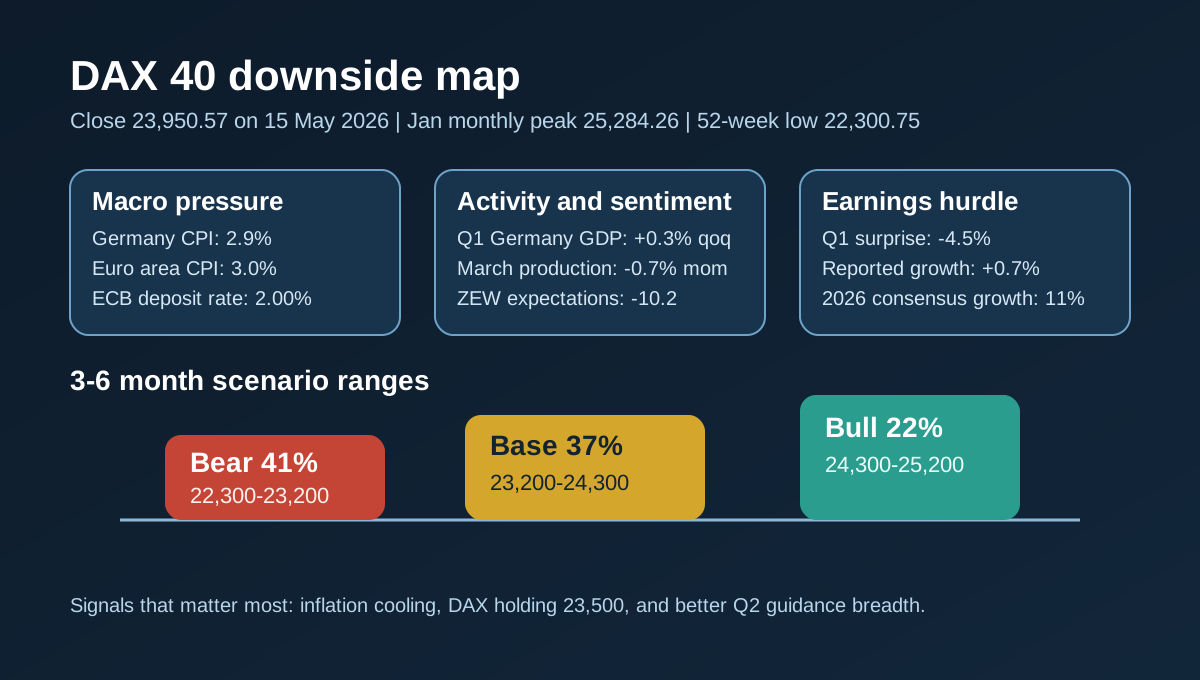
| Bear | 41% | 22,300-23,200 | DAX closes below 23,500 and then 23,000, Germany CPI stays above 2.7% or euro area inflation stays near 3.0%, and Q2 guidance fails to improve earnings breadth | Review after the next German CPI release, the next ECB meeting, and the core Q2 reporting window |
| Base | 37% | 23,200-24,300 | Germany avoids recession, but production and sentiment remain weak while earnings revisions stop improving | Review monthly with Destatis activity releases and Eurostat inflation data |
| Bull | 22% | 24,300-25,200 | Inflation cools materially, the DAX reclaims 24,500, and revision breadth improves after the next reporting cycle | Review immediately on a sustained move back above 24,500 and on improving surprise breadth |
The tactical implication is that investors should treat 23,500 to 24,500 as the key evidence zone. Below it, the market is increasingly vulnerable to a retest of the March lows. Above it, the downside thesis starts losing force and the burden of proof shifts back to the bulls.
The more inflation and earnings disappointments arrive together, the more quickly the downside path becomes the dominant one.
References
Sources
- Yahoo Finance chart API for DAX 40 10-year monthly history
- Yahoo Finance chart API for DAX 40 latest daily prices
- STOXX DAX index page for methodology, top components, and 52-week range
- Simply Wall St German market valuation page using S&P Global Market Intelligence data, updated 16 May 2026
- Destatis CPI release for April 2026
- Destatis GDP flash estimate for Q1 2026
- Destatis manufacturing orders release for March 2026
- Destatis exports release for March 2026
- Destatis industrial production release for March 2026
- ZEW Financial Market Survey for May 2026
- Eurostat flash estimate for euro area inflation in April 2026
- Eurostat unemployment release for March 2026
- ECB monetary policy decisions, 30 April 2026
- ECB staff macroeconomic projections for the euro area, March 2026
- Deutsche Borse weekly outlook on the DAX, published 11 May 2026
- Goldman Sachs Research: European stocks outlook, 15 January 2026
- J.P. Morgan Asset Management: global ex-US equities outlook
- German Federal Government note on the infrastructure and climate-neutrality special fund, 25 March 2026