Who Is Brett Berard? Canadiens Call-Up, Scouting Report and Career | Nov. 19
Meet Brett Berard, the Canadiens winger recalled from Laval in November 2026. Explore his path from Providence and the Rangers, strengths and likely role.
Information checked: November 18, 2026, at 8:39 p.m. UTC.
If your phone sounded during Canada’s November 18 Alert Ready test, it was receiving a scheduled test of the National Public Alerting System (NPAS), not a warning that an emergency was underway. Public Safety Canada said the test was scheduled across all provinces and territories over cellular networks, television and radio. Test timing varies by jurisdiction, so there is no single clock time for every Canadian phone.
The loud tone is intentional: the test uses the alerting system to check delivery and help people recognize the signal before a real threat. A test message identifies itself as a test and requires no action. A real alert, however, can contain immediate instructions about a wildfire, tornado, flood, hazardous spill or another threat. Read the message before dismissing it.
Key points
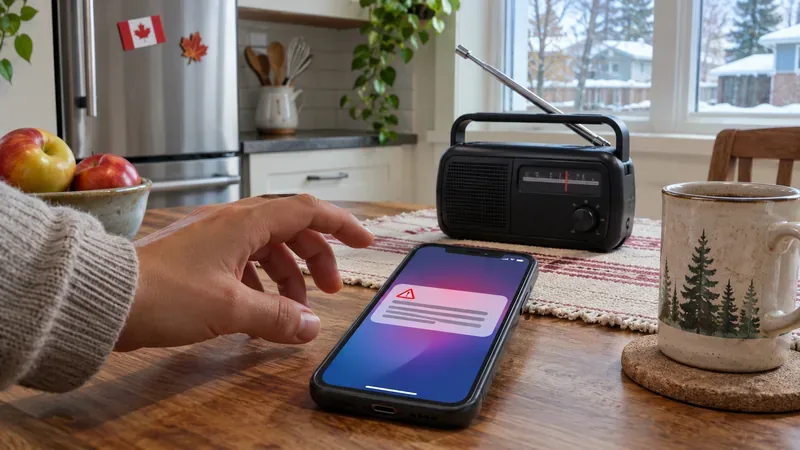
Alert Ready is designed to get attention even when a person is not actively looking at a screen. For a test, compatible wireless devices in the selected alert area receive a test message with the distinctive alert sound and vibration. The CRTC says alerts use the same attention signal as television and radio alerts. Broadcasters can interrupt programming to carry the test, which is why the sound may come from more than one device in the room.
The November 18 test was announced by Public Safety Canada for all provinces and territories. Provincial notices gave local schedules. For example, British Columbia announced its test for 1:55 p.m. Pacific Time; New Brunswick set 10:55 a.m.; and Newfoundland and Labrador scheduled 9:55 a.m. Newfoundland Standard Time, with a separate 9:25 a.m. Atlantic Standard Time slot for most of Labrador. These are examples, not a universal schedule. Check Alert Ready’s testing schedule or your provincial or territorial emergency-management office for the local notice.
A test is not sent as an ordinary SMS text. The CRTC says wireless alerts travel over a dedicated channel to compatible phones that are turned on in the selected area. That channel does not track phone numbers or the physical location of individual phones. The phone’s connection to the cellular network in the broadcast area determines whether it can receive the alert; turning on GPS or location services is not required.
The system is a partnership rather than a single app. An authorized federal, provincial, territorial or municipal emergency-management organization prepares an alert. It enters the message into Pelmorex’s National Alert Aggregation and Dissemination (NAAD) system, which checks and passes it to distributors. Wireless providers, radio and television broadcasters, cable and satellite services then distribute it through their networks. Alert Ready is the name Canadians see; NPAS is the wider system behind it.
Tests exercise this chain and give the public a chance to hear and recognize the signal. The CRTC says wireless providers and broadcasters issue two tests each year: one in May during Emergency Preparedness Week and a second usually in November. The specific date and participation can vary. Testing helps expose delivery problems, but it does not guarantee every device will receive every alert in every circumstance.
The CRTC lists several requirements for wireless reception: a phone must be compatible with wireless public alerting, connected to LTE or a newer network when the alert is sent, and ideally running current operating-system software. A phone on Wi-Fi only will not receive the wireless alert. Poor cellular reception, such as in an underground garage, can also interfere. The device may also be switched off or outside the selected broadcast area. Some jurisdictions may choose not to participate in a particular test.
If you missed a test, do not assume your phone will receive a real alert. Check your model against Alert Ready’s wireless compatibility information, install available system updates, and confirm that the device can connect to a cellular network. Do not rely on changing a sound setting as a substitute for checking compatibility or the network connection. The CRTC says Canadians cannot opt out of required emergency alerts on compatible phones, although some devices may offer options that affect how an alert sounds.
Read the full message and identify whether it says “test” or gives an emergency instruction. For a test, no action is required; there is no need to call 911. For a real alert, follow the instructions and the issuing authority’s updates. An alert may tell people in a specific area to evacuate, shelter indoors, avoid a road or take another immediate safety step. Do not dismiss it as a test just because you heard a similar sound during a drill.
Keep at least one alternate information source available, such as a battery-powered radio, especially if you live in an area with unreliable cellular service. Alert Ready also reaches television and radio, but power and communications disruptions can affect access. Know which local authority issues alerts where you live and how it publishes follow-up information.
Public Safety Canada scheduled a nationwide system test for that date. A test message identifies itself as a test and requires no action. Always read the message because a real alert can be issued separately.
The CRTC says required emergency alerts cannot be opted out of on compatible phones. Some devices may offer sound or vibration controls, but settings vary and should not be treated as a way to disable emergency delivery.
No. The CRTC says location services are not required. The wireless alert is broadcast to compatible phones connected to LTE or newer service within the selected alert area.
Meet Brett Berard, the Canadiens winger recalled from Laval in November 2026. Explore his path from Providence and the Rangers, strengths and likely role.
The Nicolas Cage John Madden biopic is streaming on Prime Video in Canada. Here’s how to find it, what it costs to access, and what early critics and fans are saying.
Brett Berard made his Montreal Canadiens debut against New Jersey on Nov. 18, recording one shot in 5:08 as Montreal rallied for a 3–2 win.
A pregame breakdown of Colorado vs. Utah: records, head-to-head history, scoring rates, power-play edge, injuries and the keys that shaped the Nov. 18 matchup.
Now streaming on Prime Video in Canada, Madden follows John Madden from Raiders coach to broadcaster and video game icon. Here’s the real history behind the film.
Lainey Wilson’s third straight CMA hosting year adds a new chapter to her rise as country music’s awards-night anchor. Here’s how her run compares with CMA history.
Stephen Wilson Jr.’s acclaimed 2025 “Stand By Me” performance is drawing renewed attention after his 2026 CMA New Artist win and duet with Chris Stapleton.
A House of Commons petition seeking U.S. Ambassador Pete Hoekstra’s removal closed with 285,921 validated signatures. Here’s its parliamentary status and next step.
Colorado and Utah meet at Delta Center in their first 2026–27 regular-season matchup. Check the verified game status, key context and what Canadian fans should watch next.
Nicolas Cage’s John Madden biopic began streaming globally on Prime Video Nov. 18. See what Canadian viewers need to know and what the first AP review says.