01. Historical Context
This is a continuation setup, not a deep-value rebound
The EURO STOXX 50 has already delivered a large long-run advance. Yahoo Finance chart data show the index rising from 2,864.74 on 31 May 2016 to 5,827.76 on 15 May 2026, a total gain of 103.43% over ten years. That matters because the next rally is not starting from capitulation. It is starting from a benchmark that is still trading close to its cycle highs and therefore needs earnings and macro confirmation.
| Horizon | What matters most | What would strengthen the thesis | What would weaken the thesis |
|---|---|---|---|
| 1-3 months | Inflation path, ECB tone, and Q2 earnings commentary | Index reclaims 6,000 while euro area inflation cools back toward 2.5% | Inflation stays near 3.0% and the index fails repeatedly below 6,000 |
| 6-12 months | Earnings revisions and breadth across sectors | Positive revisions broaden beyond technology and industrial leaders | Returns rely mostly on multiple expansion while revisions flatten or reverse |
| To 2027 | Whether soft macro data still convert into EPS growth | Euro area growth re-accelerates modestly while rates stop tightening financial conditions | Growth remains weak, inflation sticky, and exporters stay under pressure from currency effects |
The latest public STOXX factsheet, dated 31 March 2026, showed 17.2x trailing P/E, 14.7x projected P/E, 2.0 price-to-book, 2.6% dividend yield, 1.6 price-to-sales, and 21.2 price-to-cash-flow. On the same date STOXX showed country weights of France 33.4%, Germany 29.5%, Netherlands 14.6%, Spain 10.6%, and Italy 8.2%. That makes the index sensitive both to euro area macro data and to a small number of large globally exposed winners.
The short version is that the index has room to rise, but it is not cheap enough to rise on hope alone. Bullish follow-through now needs some mix of positive revisions, resilient labor data, and evidence that the benchmark's biggest AI, industrial, and financial names are still earning the premium the market gives them.
02. Key Forces
Five bullish forces that could extend the move
First, Europe-wide earnings revisions have turned more supportive. J.P. Morgan Asset Management wrote in its 2026 global ex-US equities outlook, published on 19 November 2025, that after seven months of negative EPS revisions Europe's 2026 EPS estimate is now being revised up, with bottom-up forecasts pointing to 12% year-on-year growth, even though the firm thinks mid-single-digit growth is the more realistic outcome. For the EURO STOXX 50, even that more cautious interpretation is enough to support more upside if revision direction stays positive.
Second, Goldman Sachs Research is constructive on Europe, but on a measured basis. Goldman said on 15 January 2026 that it expected the STOXX 600 to generate an 8% total return in 2026, supported by 5% EPS growth in 2026 and 7% in 2027. Goldman also said European stocks were not cheap in historical terms, standing at 15x 2026 earnings and around the 71st percentile of P/E over the last 25 years. That frames the bull case correctly: this is an earnings-led upside case, not a melt-up case.
Third, the macro backdrop is still weak but not recessionary. Eurostat's preliminary flash estimate showed euro area GDP grew 0.1% quarter on quarter in Q1 2026, while Eurostat's labor release showed unemployment at 6.2% in March 2026, down from 6.3% in February. Soft growth with a stable labor market is not ideal, but it is still a setting in which large-cap equities can grind higher if profits hold up.
Fourth, several major constituents are still printing real demand in AI, software, automation, and grid-linked capex. ASML reported Q1 2026 net sales of EUR 8.8 billion and lifted its 2026 sales view to EUR 36-40 billion, citing AI-related infrastructure demand. SAP reported current cloud backlog of EUR 21.9 billion and cloud revenue growth of 27% at constant currencies. Siemens said on 13 May 2026 that its digital business grew 19% in the first half of fiscal 2026 and called AI a clear growth driver for hardware, software, and services. Siemens Energy reported Q2 FY2026 orders of EUR 17.7 billion and strong momentum in Grid Technologies.
Fifth, the rally does not need dramatic policy easing to survive; it mainly needs less inflation fear. The ECB kept its deposit facility rate at 2.00% on 30 April 2026, while Eurostat's flash inflation estimate showed euro area CPI at 3.0% in April, up from 2.6% in March because energy inflation accelerated to 10.9%. If those inflation pressures cool back down over the next few releases, the market can retain a mid-teens forward multiple and push back toward prior highs without assuming an aggressive easing cycle.
| Factor | Why it matters | Current assessment | Bias |
|---|---|---|---|
| Macro backdrop | Sets the ceiling for cyclicals and index multiples | Euro area GDP still rose 0.1% qoq in Q1 2026 and unemployment is 6.2%, but growth is soft | Neutral |
| Inflation and rates | Determines whether valuation can expand | Euro area CPI jumped to 3.0% in April while the ECB kept the deposit rate at 2.00% | Neutral to bearish |
| Earnings revisions | Best evidence that the rally deserves to continue | J.P. Morgan says Europe's 2026 EPS estimate is being revised up after seven negative months | Bullish |
| Leadership quality | Large index weights still need to deliver | ASML, SAP, Siemens, and Siemens Energy are still pointing to tangible demand drivers | Bullish |
| Valuation support | Controls how much room remains if data stay only average | STOXX published 17.2x trailing P/E and 14.7x projected P/E; Goldman put Europe at 15x 2026 earnings | Neutral |
The strongest version of the bull case is therefore a combined story: positive revisions, stable labor data, visible AI and industrial demand, and inflation that cools enough to stop the market from fearing a fresh rates problem.
03. Countercase
What could interrupt the rally
The main risk is that inflation has re-accelerated at exactly the wrong time. Eurostat's flash estimate put euro area inflation at 3.0% in April 2026, up from 2.6% in March, with energy inflation at 10.9%. If those energy effects feed into expectations or margins for longer than expected, the market will struggle to justify a richer multiple.
The second risk is valuation. Goldman said Europe was already trading around 15x 2026 earnings and in the 71st percentile of its own 25-year P/E history. STOXX's own factsheet showed 17.2x trailing P/E and 14.7x projected P/E. That does not block upside, but it does mean the benchmark needs operating delivery. This is not a cheap market where mediocre data can still rescue the bull case.
The third risk is that export-sensitive sectors remain under pressure. J.P. Morgan said the euro's appreciation contributed to a 17% downward revision in 2025 EPS estimates for European exporting sectors, versus a 1% upward revision for domestic sectors. The EURO STOXX 50 is full of global exporters, so a strong-currency or weak-demand squeeze can cap upside faster than the domestic macro data alone would suggest.
| Risk | Latest data point | Why it matters | Current assessment |
|---|---|---|---|
| Inflation reset | Euro area CPI 3.0% in April 2026; energy inflation 10.9% | Can keep real rates high and block multiple expansion | Bearish |
| Valuation | STOXX at 17.2x trailing and 14.7x projected P/E; Goldman says Europe is at 15x 2026 earnings | Leaves less room for disappointment than a cheap market would | Neutral |
| Export sensitivity | J.P. Morgan cites a 17% downward revision in 2025 EPS estimates for European exporting sectors | Shows that currency and trade conditions still matter materially | Neutral to bearish |
| Soft growth | Euro area GDP only 0.1% qoq in Q1 2026 | Weak activity makes earnings follow-through more demanding | Neutral |
| Concentration | France 33.4%, Germany 29.5%; ASML alone carries a 10.99% weight | A few large misses can drag the headline benchmark quickly | Bearish |
The bullish setup stays credible only if these headwinds remain separate. The problem starts when sticky inflation, softer revisions, and narrow leadership begin to reinforce one another.
04. Institutional Lens
What professional research implies for further upside
Goldman Sachs and J.P. Morgan are broadly constructive on European equities, but both are effectively making the same point: Europe can rise, yet it should rise on earnings rather than on exuberant multiple expansion. That is a useful discipline for the EURO STOXX 50 because the benchmark already trades like a quality, globally exposed large-cap index rather than a distressed market.
| Source | What it said | Date | Read-through for EURO STOXX 50 |
|---|---|---|---|
| Goldman Sachs Research | STOXX 600 total return of 8% in 2026, with EPS growth of 5% in 2026 and 7% in 2027 | 15 January 2026 | Supports a measured Europe bull case rather than a melt-up |
| Goldman Sachs Research | Europe trades at 15x 2026 earnings and in the 71st percentile of its own 25-year P/E history | 15 January 2026 | Means upside should be earnings-led, not multiple-led |
| J.P. Morgan Asset Management | Europe's 2026 EPS estimate is being revised up after seven negative months; bottom-up 12% growth but mid-single digits more realistic | 19 November 2025 | Revision direction matters more than aggressive consensus numbers |
| IMF Regional Economic Outlook for Europe | Euro area growth projected at 1.1% in 2026 amid elevated risks | 17 April 2026 | Macro growth is positive, but too modest to forgive repeated earnings misses |
| ECB policy decision | ECB kept key rates unchanged and left the deposit facility at 2.00% | 30 April 2026 | Inflation cooling matters more than a fast easing story for near-term upside |
The common message is constructive but disciplined. The EURO STOXX 50 can push higher, but the quality of the advance matters more than the headline move itself.
05. Scenarios
Actionable 6 to 12 month scenarios
The ranges below are author estimates built from the current index level, the January 2026 peak, the 52-week range, STOXX valuation data, euro area macro releases, and the institutional research cited above. They are not third-party index targets.
| Scenario | Probability | Range | Trigger conditions | When to review |
|---|---|---|---|---|
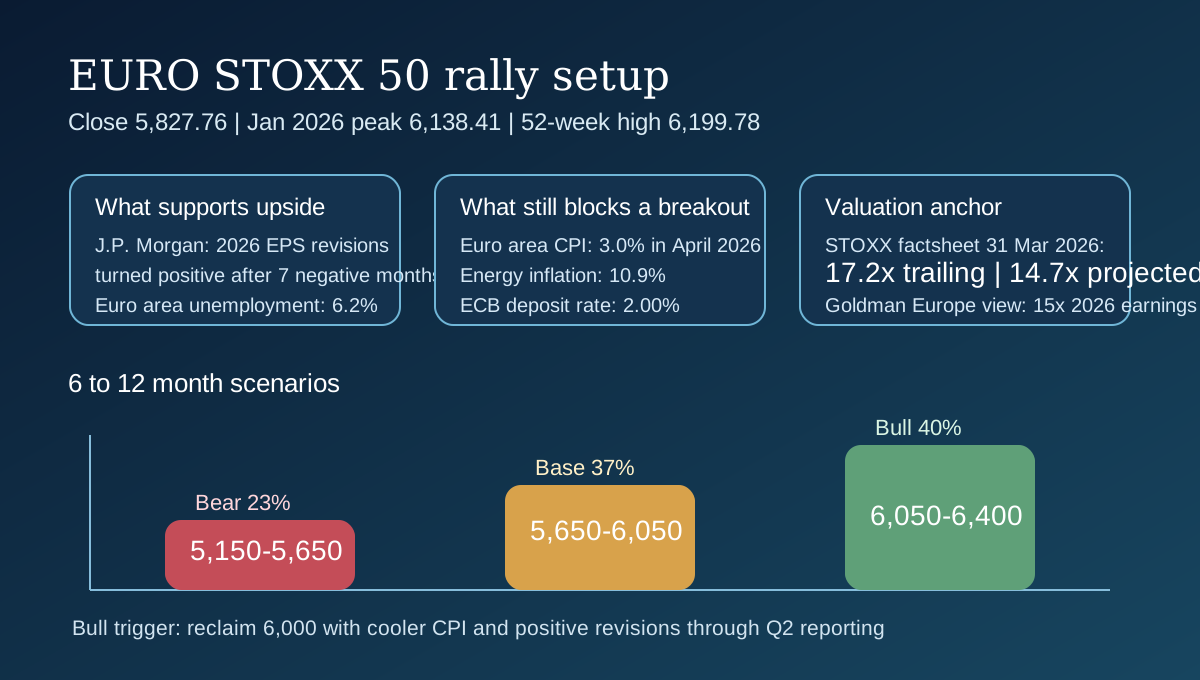
| Bull | 40% | 6,050-6,400 | EURO STOXX 50 reclaims 6,000 on a sustained basis, euro area CPI cools back toward 2.5%, and Europe-wide EPS revisions stay positive through the main Q2 reporting window | Review after the next ECB meeting and after July-August 2026 reporting season |
| Base | 37% | 5,650-6,050 | Growth stays positive but soft, the ECB remains cautious, and leadership remains concentrated in a few technology, industrial, and financial names | Review monthly with Eurostat inflation, GDP, and labor releases |
| Bear | 23% | 5,150-5,650 | The index loses 5,650 decisively, inflation remains near 3.0%, and Q2 commentary weakens for large constituents or European revisions roll over again | Review immediately on a weekly close below 5,650 or on a shift back to negative revision momentum |
The tactical conclusion is straightforward. Buyers should want confirmation above 6,000 and cleaner inflation before assuming the next leg higher is durable. Existing holders can stay constructive, but the position is stronger if it is defended by revisions and operating delivery rather than by hopes of a fast valuation re-rating.
If the data cooperate, the index can retest the January high and challenge the 52-week high. If they do not, the more likely outcome is a broad range rather than an immediate breakout.
References
Sources
- Yahoo Finance chart API for EURO STOXX 50 10-year monthly history
- Yahoo Finance chart API for EURO STOXX 50 latest daily price metadata
- STOXX EURO STOXX 50 factsheet page, current factsheet data dated 31 March 2026
- STOXX EURO STOXX 50 components page
- Goldman Sachs Research: European stocks outlook, 15 January 2026
- J.P. Morgan Asset Management: global ex-US equities outlook
- IMF Regional Economic Outlook for Europe, April 2026
- Eurostat flash estimate: euro area inflation in April 2026
- Eurostat unemployment release for March 2026
- Eurostat GDP release for Q1 2026
- ECB monetary policy decision, 30 April 2026
- ASML Q1 2026 financial results
- SAP Q1 2026 results
- Siemens press release, 13 May 2026
- Siemens Energy Q2 FY2026 earnings release