01. Historical Context
The index is vulnerable because it is still near highs and not trading at crisis valuations
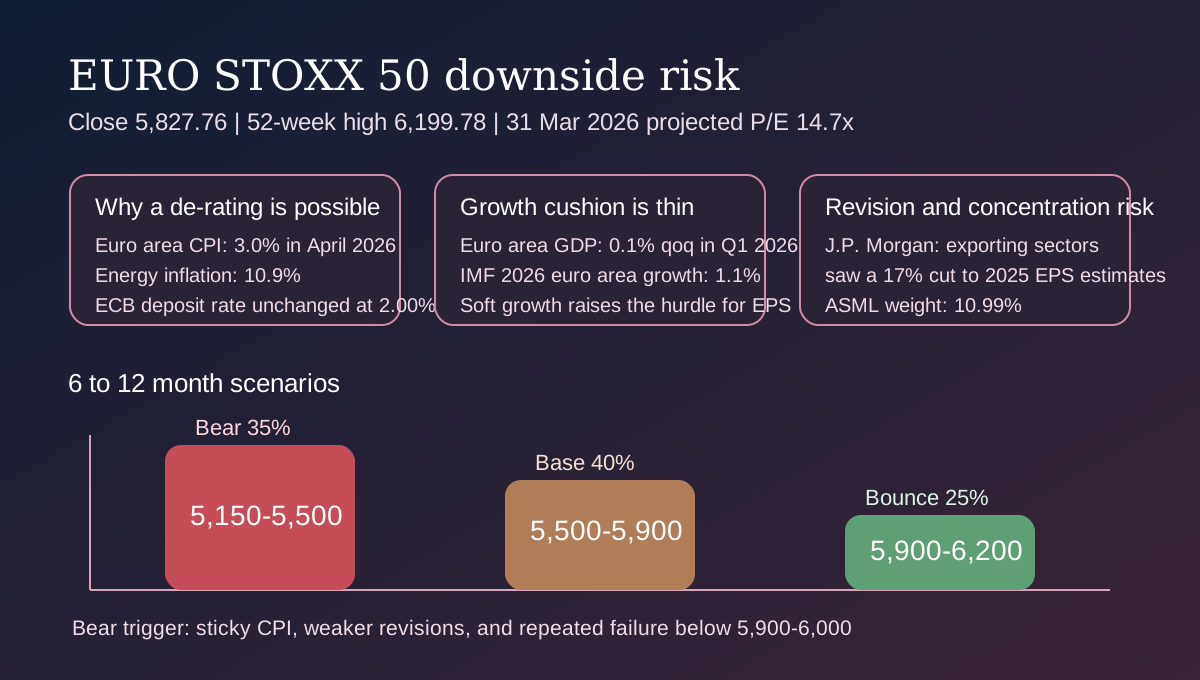
The case for a deeper drawdown starts with the price level. Yahoo Finance data show the EURO STOXX 50 at 5,827.76 on 15 May 2026, only 5.06% below its January 2026 monthly peak of 6,138.41 and 6.00% below its 52-week high of 6,199.78. Over the prior decade the index still more than doubled, rising 103.43% from 2,864.74 on 31 May 2016. That means the bearish argument is not about a broken 10-year trend. It is about whether a still-expensive benchmark now faces enough inflation, rate, and revisions pressure to justify a lower multiple.
| Horizon | What matters most | What would strengthen the thesis | What would weaken the thesis |
|---|---|---|---|
| 1-3 months | Inflation path, ECB tone, and whether the index can hold 5,650 | Inflation stays near 3.0%, the ECB remains cautious, and the index keeps failing below 5,900-6,000 | Inflation cools quickly and the benchmark reclaims 6,000 with better breadth |
| 6-12 months | Revisions, export sensitivity, and multiple discipline | Export-linked earnings estimates keep falling and the market stops paying a mid-teens forward multiple | Europe-wide revisions stay positive and AI or industrial leaders keep the benchmark near peak earnings expectations |
| To 2027 | Whether soft growth turns into a broader profit slowdown | Growth stays weak, energy costs remain a tax on margins, and leadership narrows further | Growth stabilizes, inflation fades, and operating delivery absorbs the valuation pressure |
The latest public STOXX factsheet, dated 31 March 2026, showed 17.2x trailing P/E, 14.7x projected P/E, 2.0 price-to-book, and a 2.6% dividend yield. Those numbers are not extreme, but they are full enough that the market can still de-rate if macro conditions deteriorate. The same factsheet showed France at 33.4% and Germany at 29.5% of the benchmark, which adds concentration in two economies that are especially exposed to industrial, export, and policy-cycle swings.
The bearish path is therefore a quality reset, not a collapse call. It becomes credible if inflation remains sticky, growth stays sluggish, and investors stop treating a handful of large AI and industrial winners as enough to justify the whole benchmark.
02. Key Forces
Five bearish forces that could push the trend lower
First, the valuation cushion is limited. STOXX published 17.2x trailing P/E and 14.7x projected P/E as of 31 March 2026. Goldman Sachs said on 15 January 2026 that Europe was trading around 15x 2026 earnings and at the 71st percentile of its own 25-year P/E history. That does not mean the market is wildly expensive, but it does mean that any downside surprise is more likely to show up through multiple compression.
Second, inflation re-accelerated. Eurostat's flash estimate put euro area CPI at 3.0% in April 2026, up from 2.6% in March, with energy inflation accelerating to 10.9%. On 30 April 2026 the ECB kept key rates unchanged and left the deposit facility at 2.00%. If inflation stays elevated, investors cannot rely on a fast policy-easing cushion, and that raises the risk that a growth scare becomes an equity de-rating.
Third, the macro data are too soft to absorb repeated misses easily. Eurostat's preliminary flash estimate showed euro area GDP growth of only 0.1% quarter on quarter in Q1 2026, while the IMF's Regional Economic Outlook for Europe projected 1.1% growth for the euro area in 2026 amid elevated risks. That is not a recession call, but it is a weak enough backdrop that margins and revisions matter disproportionately.
Fourth, export sensitivity remains a live risk. J.P. Morgan Asset Management said the euro's appreciation contributed to a 17% downward revision in 2025 EPS estimates for European exporting sectors, versus a 1% upward revision for domestic sectors. Many of the EURO STOXX 50's largest constituents are globally exposed exporters, so the benchmark is vulnerable if the currency, trade, or demand backdrop stays unhelpful.
Fifth, concentration can turn ordinary disappointment into index-level weakness. STOXX's current components page shows ASML at 10.99% of the index and a heavy cluster of large weights in banks, industrials, software, and energy. If one or two of those leaders miss guidance while inflation is still sticky, the whole benchmark can lose altitude quickly even if the median constituent is only mildly weaker.
| Factor | Why it matters | Current assessment | Bias |
|---|---|---|---|
| Valuation | Controls how much disappointment the market can absorb | STOXX published 17.2x trailing and 14.7x projected P/E; Goldman says Europe is at 15x 2026 earnings | Bearish |
| Inflation and policy | Determines whether falling prices will attract dip buyers quickly | Euro area CPI is 3.0% and ECB deposit rate remains 2.00% | Bearish |
| Growth backdrop | Weak growth leaves less room for earnings mistakes | Euro area GDP grew only 0.1% qoq in Q1 2026; IMF sees 1.1% growth for 2026 | Neutral to bearish |
| Revisions and exports | Global exporters dominate the index mix | J.P. Morgan cites a 17% cut to 2025 EPS estimates for European exporting sectors | Bearish |
| Concentration | Few names can determine the index path | ASML is 10.99% of the index and France plus Germany account for 62.9% of country weight | Bearish |
The bearish setup becomes most credible when these factors align: sticky inflation, slow growth, a cautious ECB, and weakening leadership. In that environment, the market does not need a crisis to fall. It only needs investors to demand a lower price for the same earnings base.
03. Countercase
What could stop the decline from turning into a larger de-rating
The first counterpoint is that the labor backdrop is not yet cracking. Eurostat reported euro area unemployment at 6.2% in March 2026, down from 6.3% in February. A low unemployment rate does not guarantee stronger equities, but it does reduce the probability that a modest growth slowdown instantly becomes a full earnings recession.
Second, large AI and industrial leaders are still producing real demand signals. ASML lifted its 2026 sales outlook to EUR 36-40 billion, SAP reported EUR 21.9 billion of current cloud backlog, and Siemens Energy raised its outlook after Q2 FY2026 orders reached EUR 17.7 billion. If these heavyweights keep executing, they can absorb some macro weakness and stop the benchmark from sliding into a broader earnings reset.
Third, the main institutional strategy calls are not outright bearish. Goldman still expects an 8% total return for the STOXX 600 in 2026, and J.P. Morgan says Europe's 2026 EPS estimate has turned positive after seven months of downgrades. That does not invalidate the downside case, but it does mean the bar for a larger drawdown is higher than it would be in a market where institutions were already unanimously defensive.
| Offset | Latest data point | Why it matters | Current assessment |
|---|---|---|---|
| Labor market resilience | Euro area unemployment 6.2% in March 2026 | Reduces the odds of an immediate demand collapse | Supportive |
| Positive institutional base case | Goldman still expects 8% STOXX 600 total return in 2026 | Shows that downside still needs a fresh negative catalyst | Supportive |
| Revision direction for 2026 | J.P. Morgan says Europe's 2026 EPS estimate is being revised up | A bearish thesis is stronger only if that improvement reverses | Neutral to supportive |
| Leadership execution | ASML, SAP, Siemens, and Siemens Energy continue to report tangible demand drivers | Large weights can keep the headline index firmer than the average stock | Supportive |
| Dividend support | STOXX published a 2.6% dividend yield on 31 March 2026 | Income support can moderate downside if the market merely ranges | Neutral |
The bearish call therefore needs confirmation. It strengthens if inflation stays sticky while revisions worsen. It weakens if inflation fades, the ECB regains flexibility, and the benchmark's largest constituents keep earning through the soft patch.
04. Institutional Lens
How professional investors usually frame the downside
Major institutions frame downside in Europe around three variables: growth disappointment, valuation compression, and liquidity. That framework fits the EURO STOXX 50 well because the benchmark is large-cap, internationally exposed, and still priced above a classic value-market multiple.
| Source | What it said | Date | Read-through for EURO STOXX 50 |
|---|---|---|---|
| Goldman Sachs Research | Europe trades at 15x 2026 earnings and in the 71st percentile of its own 25-year P/E history | 15 January 2026 | Downside can come from de-rating even without a collapse in EPS |
| Goldman Sachs Research | STOXX 600 total return target for 2026 is 8%, supported by 5% EPS growth in 2026 and 7% in 2027 | 15 January 2026 | Bearish follow-through becomes more credible only if those earnings assumptions start to fail |
| J.P. Morgan Asset Management | Exporting sectors saw a 17% downward revision in 2025 EPS estimates, versus a 1% upward revision for domestic sectors | 19 November 2025 | Shows why currency and trade sensitivity can still drag the benchmark |
| IMF Regional Economic Outlook for Europe | Euro area growth projected at 1.1% in 2026 amid elevated risks | 17 April 2026 | Soft macro leaves less protection against negative earnings surprises |
| ECB policy decision | ECB kept key rates unchanged with the deposit facility at 2.00% | 30 April 2026 | If inflation stays high, the market cannot count on fast policy relief |
The practical lesson is that a deeper slide usually arrives through a chain of smaller misses rather than one single disaster. If inflation stays sticky, growth stays soft, and leadership stops broadening, preserving capital matters more than chasing every rebound.
05. Scenarios
Actionable 6 to 12 month downside scenarios
The ranges below are author estimates, not third-party index targets. They are built from the current index level, the latest public STOXX valuation data, the 52-week range, and the macro and institutional signals cited above.
| Scenario | Probability | Range | Trigger conditions | When to review |
|---|---|---|---|---|
| Bear | 35% | 5,150-5,500 | Euro area CPI stays near or above 3.0%, the index cannot reclaim 5,900-6,000, and revisions weaken again for exporters or large industrial leaders | Review after each CPI release, ECB meeting, and major earnings cycle |
| Base | 40% | 5,500-5,900 | Growth stays soft, inflation gradually improves but not enough for a clean rerating, and the market ranges while leadership remains mixed | Review monthly with Eurostat inflation, GDP, and labor releases |
| Bullish rebound | 25% | 5,900-6,200 | Inflation cools back toward 2.5%, Europe-wide revisions stay positive, and large-cap leaders keep delivering strong guidance | Review after the main Q2 and Q3 reporting windows |
The tactical conclusion is simple. A break below 5,650 would make the bearish case materially stronger because it would suggest the market is no longer willing to overlook sticky inflation and soft growth. A clean move back above 5,900 would weaken the drawdown thesis because it would imply buyers still trust the benchmark's earnings base.
The highest-probability risk is not a crash. It is a lower-quality phase in which the index trades down or sideways because the valuation multiple compresses while macro data stay merely mediocre.
References
Sources
- Yahoo Finance chart API for EURO STOXX 50 10-year monthly history
- Yahoo Finance chart API for EURO STOXX 50 latest daily price metadata
- STOXX EURO STOXX 50 factsheet page, current factsheet data dated 31 March 2026
- STOXX EURO STOXX 50 components page
- Goldman Sachs Research: European stocks outlook, 15 January 2026
- J.P. Morgan Asset Management: global ex-US equities outlook
- IMF Regional Economic Outlook for Europe, April 2026
- Eurostat flash estimate: euro area inflation in April 2026
- Eurostat unemployment release for March 2026
- Eurostat GDP release for Q1 2026
- ECB monetary policy decision, 30 April 2026
- ASML Q1 2026 financial results
- SAP Q1 2026 results
- Siemens press release, 13 May 2026
- Siemens Energy Q2 FY2026 earnings release