01. Historical Context
The FTSE 100 still has upside, but it is not starting from a washed-out level
The FTSE 100 has already had a strong run. Yahoo Finance chart data show the index climbing from 6,504.30 on 31 May 2016 to 10,195.37 on 15 May 2026, a 56.75% price gain over ten years. LSEG's January 2026 note adds an important sentiment marker: the index recorded its first ever five-figure close at 10,004.57 on 5 January 2026. That matters because the next rally is not a deep-value rebound story. It is a continuation story that needs earnings and macro data to stay supportive.
| Horizon | What matters most | What would strengthen the thesis | What would weaken the thesis |
|---|---|---|---|
| 1-3 months | Inflation path, Bank of England tone, and the 10,000 level | FTSE 100 reclaims 10,400 while CPI and services inflation cool | Inflation stays sticky and the index slips back below 10,000 |
| 6-12 months | Earnings durability across banks, energy, health care, and defence | Heavyweights keep guidance intact and buybacks or dividends remain supportive | Rally depends mostly on multiple expansion while earnings drift lower |
| To 2027 | Whether soft UK growth still converts into cash-flow resilience | Lower inflation allows easier policy without a sharp profit squeeze | Labour weakness, sticky prices, and commodity reversal hit profits together |
The valuation starting point is supportive, but not generous enough to ignore disappointment. BlackRock's iShares FTSE 100 tracker showed the benchmark on 16.67x current forecast-year earnings, 2.31x book, and a 2.88% trailing yield as of 14 May 2026. That combination is still cheaper than many US large-cap benchmarks, but it is not a distressed entry point either. The next leg higher should therefore come from earnings confidence and policy relief, not from investors suddenly deciding to pay much more for the same cash flows.
Index concentration also shapes the rally path. The March 2026 iShares factsheet put the top ten holdings at 49.84% of the FTSE 100, led by AstraZeneca, HSBC, Shell, Rolls-Royce, BP, British American Tobacco, Unilever, GSK, Rio Tinto, and BAE Systems. That means a credible rally can still happen even if domestic UK growth is only modest, because the benchmark is heavily exposed to global health care, banking, energy, mining, and defence rather than to purely domestic cyclicals.
02. Key Forces
Five bullish forces that could extend the move
First, the UK economy is still growing. The Office for National Statistics said on 14 May 2026 that monthly real GDP rose 0.3% in March, leaving GDP up 0.6% over the three months to March versus the prior three months and 1.2% higher than a year earlier. That is not a boom, but it is enough to keep the FTSE 100 out of an outright recession setup. An index with this sector mix does not need spectacular domestic growth; it only needs activity resilient enough to keep profit expectations intact.
Second, several of the largest constituents are still delivering hard numbers. HSBC said on 5 May 2026 that first-quarter profit before tax excluding notable items was USD 10.1 billion, revenue excluding notable items was USD 19.1 billion, banking net interest income rose USD 0.7 billion to USD 11.3 billion, and annualized return on average tangible equity was 18.7% excluding notable items. Shell reported on 7 May 2026 adjusted earnings of USD 6.915 billion and announced a new USD 3.0 billion buyback programme after completing the previous USD 3.5 billion programme. BAE Systems said on 7 May 2026 that it had delivered a strong start to the year, kept full-year guidance unchanged, and still expected 2026 sales growth of 7% to 9%, underlying EBIT growth of 9% to 11%, and underlying EPS growth of 9% to 11%.
Third, the FTSE's sector mix can still work in its favour if geopolitical and fiscal trends remain where they are. J.P. Morgan Asset Management noted in its first-quarter 2026 market review that the FTSE All-Share delivered positive returns in the period, supported by its commodity tilt. That matters because the FTSE 100 still has large weights in banks, oil majors, miners, and defence-linked manufacturers. A rally in this benchmark does not require a broad technology melt-up; it can come from old-economy earnings staying firmer than feared.
Fourth, policy has not turned more restrictive. The Bank of England held Bank Rate at 3.75% on 30 April 2026 by an 8-1 vote, even as it acknowledged that CPI inflation had risen to 3.3% and that the labour market continued to loosen. If the next inflation prints cool rather than re-accelerate, that is enough for investors to start pricing lower rates again without needing a dramatic policy pivot.
Fifth, the UK still looks relatively competitive on valuation versus crowded global alternatives. Goldman Sachs Research said on 12 January 2026 that it expected UK GDP to grow 1.4% on a Q4-over-Q4 basis in 2026, while J.P. Morgan Asset Management wrote that UK large caps remained attractively valued heading into 2026. Those are not FTSE 100 price targets, but together they support the idea that the benchmark can rally if earnings keep coming through and inflation gradually comes down.
| Factor | Why it matters | Current assessment | Bias |
|---|---|---|---|
| Growth backdrop | Sets the floor under cyclical earnings | UK GDP rose 0.3% in March and 0.6% over the latest three months | Neutral to bullish |
| Inflation and rates | Determines whether the market can rerate | CPI is 3.3% and services CPI 4.5%, but Bank Rate is still on hold at 3.75% | Neutral |
| Heavyweight earnings | Banks, energy, and defence drive much of the index | HSBC, Shell, and BAE all reported supportive first-quarter or year-to-date updates in May | Bullish |
| Valuation and income | Controls how much upside is already priced | P/E 16.67x, P/B 2.31x, and trailing yield 2.88% still offer some support | Neutral to bullish |
| Concentration | Narrow leadership can make rallies fragile | Top ten holdings are 49.84% of the benchmark | Neutral to bearish |
The strongest version of the bull case is therefore a combined story: resilient earnings from the index heavyweights, inflation that cools enough to stop policy getting tougher, and a benchmark that keeps attracting flows because it still offers real cash generation and dividend support.
03. Countercase
What could interrupt the rally
The main risk is inflation persistence. The ONS said the UK CPI annual rate rose to 3.3% in March 2026 from 3.0% in February, while core CPI was 3.1% and services CPI was 4.5%. The Bank of England's April summary was explicit that there was still a risk of material second-round effects in price and wage setting. If the 20 May 2026 inflation release shows another upside surprise, the market will find it harder to justify a cleaner rate-cut story.
The second risk is that the labour market keeps softening faster than earnings can absorb. ONS employment data released on 21 April 2026 showed a UK unemployment rate of 4.9% for December 2025 to February 2026, an inactivity rate of 21.0%, and a claimant count of 1.694 million in March. Those numbers are not recessionary on their own, but they do tell you that the domestic economy is not strong enough to rescue the index if its big international earners stumble.
The third risk is concentration. With the top ten names at 49.84% of the index, a simultaneous wobble in health care, banks, and energy can hit the headline benchmark quickly. The FTSE 100 is broad enough to be diversified across sectors, but not broad enough to ignore weakness in its largest constituents.
| Risk | Latest data point | Why it matters | Current assessment |
|---|---|---|---|
| Sticky inflation | UK CPI 3.3% in March 2026; services CPI 4.5%; core CPI 3.1% | Can delay rate cuts and cap multiple expansion | Bearish |
| Hawkish policy risk | BoE held at 3.75% by an 8-1 vote, with one member preferring 4.0% | Shows policy is not yet clearly easing | Bearish |
| Labour softness | Unemployment 4.9%, inactivity 21.0%, claimant count 1.694m | Raises the hurdle for domestic demand-sensitive sectors | Neutral to bearish |
| Valuation | P/E 16.67x and P/B 2.31x as of 14 May 2026 | Leaves less room for disappointment than a cheap market would | Neutral |
| Index concentration | Top ten holdings total 49.84% | Turns a few stock-specific misses into index-level weakness quickly | Bearish |
The bullish setup remains credible only if these headwinds stay separate. The problem starts when sticky inflation, labour softness, and narrow leadership begin to reinforce one another.
04. Institutional Lens
What professional research implies for further upside
Goldman Sachs and J.P. Morgan are constructive on the UK and non-US equities, but both are effectively making a conditional call rather than a euphoric one. Goldman Sachs Research's 12 January 2026 UK outlook expected 1.4% Q4-over-Q4 UK growth in 2026, unemployment rising to 5.3% by March, headline inflation slowing to 2.1% in the second quarter, and three further 25 basis-point cuts taking Bank Rate to 3%. That is a workable backdrop for the FTSE 100, but it depends on inflation cooling rather than staying where it is now.
J.P. Morgan Asset Management's global ex-US equity outlook says returns should increasingly be driven by earnings rather than multiple expansion, because valuations are elevated in many regions. The same note says that after seven months of negative revisions, Europe's 2026 EPS estimate is now being revised up and that energy and materials sector revisions have recently turned positive. That is directly relevant to the FTSE 100 because the benchmark has large bank, energy, and mining weights.
The Bank of England is the live policy check on those institutional views. Its April 2026 summary said the conflict in the Middle East had made the outlook for global energy prices highly uncertain and that monetary policy would respond depending on the scale and duration of the shock. For FTSE 100 bulls, that means the macro thesis should be reviewed against each inflation print rather than assumed to be locked in.
| Source | What it said | Date | Read-through for FTSE 100 |
|---|---|---|---|
| Goldman Sachs Research | UK GDP growth of 1.4% Q4/Q4 in 2026, unemployment reaching 5.3% by March, headline inflation slowing to 2.1% in Q2, and three BoE cuts to 3% | 12 January 2026 | Supports a measured bull case if inflation resumes cooling |
| Goldman Sachs 2026 UK outlook page | The UK should see another mixed year with trend-like growth, higher unemployment, materially lower inflation, and three more Bank Rate cuts to 3% | January 2026 outlook hub | Constructive, but not a thesis for blind multiple expansion |
| J.P. Morgan Asset Management | Returns should be more earnings-driven than multiple-driven; Europe's 2026 EPS estimate is being revised up after seven negative months | 2026 outlook page available in May 2026 | Favors a FTSE rally led by real earnings delivery, especially in energy and financials |
| Bank of England | Bank Rate held at 3.75%, with risks around energy-price-driven second-round inflation effects still live | 30 April 2026 | Explains why the market still needs softer inflation data to push meaningfully higher |
| J.P. Morgan Asset Management | UK large caps remain attractively valued heading into 2026 | UK market commentary published in early 2026 | Supports demand for the benchmark if earnings remain solid |
The common message is constructive but disciplined. The FTSE 100 can push higher, but the quality of the move matters more than the headline move itself.
05. Scenarios
Actionable 6 to 12 month scenarios
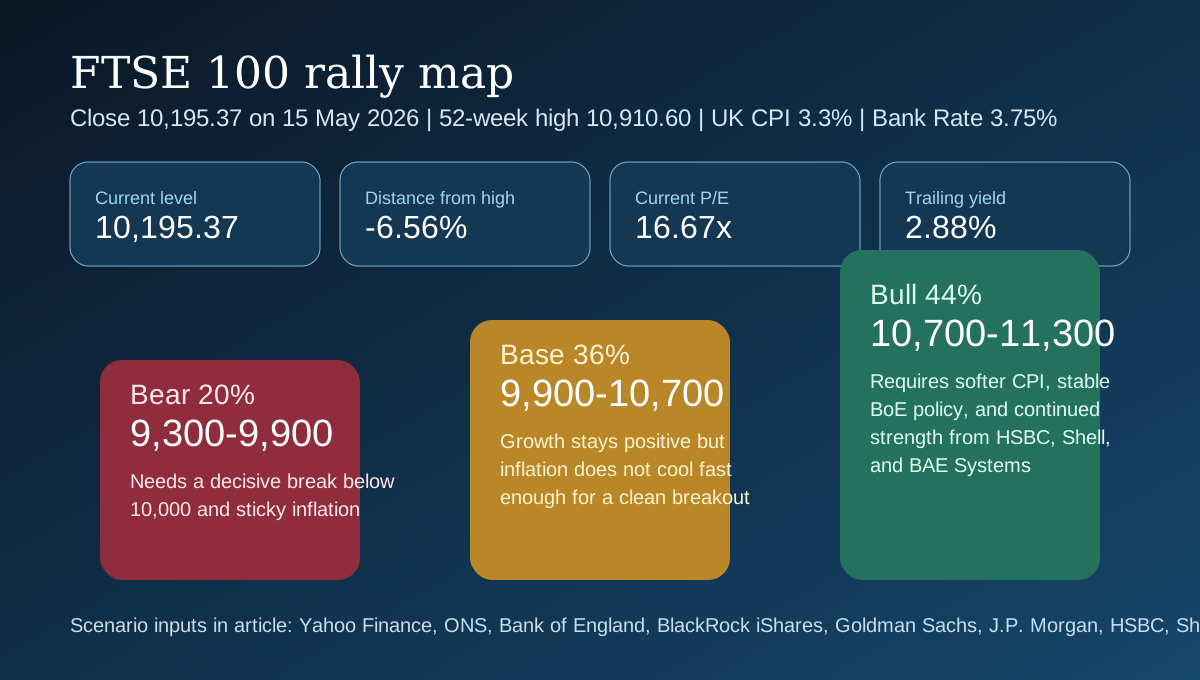
The ranges below are author estimates built from the current FTSE 100 level, the February 2026 high, the 52-week range, the current valuation profile, and the macro and institutional inputs cited above. They are not third-party index targets.
| Scenario | Probability | Range | Trigger conditions | When to review |
|---|---|---|---|---|
| Bull | 44% | 10,700-11,300 | The index reclaims 10,400 and holds above 10,000, UK CPI falls back below 3.0%, services inflation cools from 4.5%, and heavyweight guidance from HSBC, Shell, and BAE remains intact | Review after the 20 May 2026 CPI release, the 18 June 2026 MPC decision, and the late-July half-year reporting window |
| Base | 36% | 9,900-10,700 | Growth stays positive but soft, Bank Rate remains at 3.75% for longer, and the benchmark holds 10,000 without a clean breakout | Review monthly with ONS CPI and GDP releases |
| Bear | 20% | 9,300-9,900 | The index loses 10,000 decisively, CPI stays above 3.0%, the BoE stays hawkish, and at least one of the major earnings pillars weakens | Review immediately on a weekly close below 10,000 or on renewed upside inflation surprise |
The tactical conclusion is simple. Buyers should want confirmation above 10,400 and cleaner inflation before assuming the next leg higher is durable. Existing holders can stay constructive, but the position is stronger if it is defended by earnings and policy relief rather than by hope for a quick rerating.
If the data cooperate, the FTSE 100 can retest and exceed its February high. If they do not, the more likely outcome is a broad range around the 10,000 level rather than an immediate breakout.
References
Sources
- Yahoo Finance chart API for FTSE 100 10-year monthly history
- Yahoo Finance chart API for FTSE 100 latest daily price metadata
- LSEG FTSE Russell insight: FTSE 100 hits five figures, 8 January 2026
- iShares Core FTSE 100 UCITS ETF product page with current portfolio characteristics
- iShares Core FTSE 100 UCITS ETF factsheet, March 2026
- Office for National Statistics: GDP monthly estimate, UK, March 2026
- Office for National Statistics: Consumer price inflation, UK, March 2026
- Office for National Statistics: Employment in the UK, April 2026
- Bank of England: Monetary Policy Summary and Minutes, April 2026
- Goldman Sachs Research: UK GDP is expected to grow 1.4% this year despite weaker employment, 12 January 2026
- Goldman Sachs: 2026 Outlooks hub
- J.P. Morgan Asset Management: global ex-US equities outlook
- J.P. Morgan Asset Management: UK smaller companies commentary noting attractive UK large-cap valuations
- J.P. Morgan Asset Management: review of markets over the first quarter of 2026
- HSBC Holdings: 1Q 2026 earnings release quick read
- Shell plc quarterly results page, including Q1 2026 release
- BAE Systems trading update, 7 May 2026