01. Historical Context
The FTSE 100 is vulnerable to a setback because it is elevated, concentrated, and still dependent on a few macro pillars
The bearish case does not start from collapse; it starts from complacency risk. The FTSE 100 has risen 56.75% over the last ten years in price terms, and LSEG noted that it achieved its first five-figure close at 10,004.57 on 5 January 2026. That means the benchmark is not entering this phase from washed-out sentiment. It is entering it from a level where inflation, rates, and heavyweight earnings matter a great deal.
| Horizon | What matters most | What would strengthen the thesis | What would weaken the thesis |
|---|---|---|---|
| 1-3 months | Inflation, Bank of England tone, and whether 10,000 holds | CPI stays above 3.0%, services inflation stays near 4.5%, and the index closes below 10,000 | Inflation cools quickly and buyers defend the 10,000 area |
| 6-12 months | Earnings resilience from the largest constituents | Guidance weakens in banks, energy, or defence while valuation support proves insufficient | Heavyweights keep buybacks, dividends, and earnings delivery intact |
| To 2027 | Whether UK macro softness and higher-for-longer policy feed into profits | Labour weakness deepens, rates stay restrictive, and the commodity tailwind fades | Inflation normalizes and the benchmark keeps compounding on cash generation rather than on sentiment |
The current valuation backdrop is not cheap enough to ignore those risks. BlackRock's iShares FTSE 100 tracker showed a 16.67x P/E ratio, 2.31x price-to-book, and 2.88% trailing yield as of 14 May 2026. That mix can cushion moderate weakness, but it does not give the market the sort of low-valuation protection that would normally make a bearish case hard to sustain.
Concentration is the other reason to take downside seriously. The March 2026 iShares factsheet put the top ten holdings at 49.84% of the benchmark. In practice that means the FTSE 100 can look healthy while only a few sectors lead, and it can also fall quickly if health care, banks, energy, or mining all wobble together.
02. Key Forces
Five bearish forces that could push the trend lower
First, inflation is still too sticky for a clean easing story. The ONS said UK CPI rose 3.3% in the 12 months to March 2026, up from 3.0% in February, while services CPI was 4.5% and core CPI was 3.1%. That is uncomfortably high for a market that wants lower rates to validate current valuations.
Second, the Bank of England is not yet in obvious cutting mode. In its 30 April 2026 summary, the MPC voted 8-1 to keep Bank Rate at 3.75%, with one member preferring a rise to 4.0%. The statement also said there was a risk of material second-round effects in wage and price setting. That matters because a benchmark trading near highs is much more vulnerable when the policy floor beneath it is uncertain.
Third, the labour backdrop is soft enough to become a real earnings issue if it worsens. ONS employment data released on 21 April 2026 showed unemployment at 4.9%, inactivity at 21.0%, and a claimant count of 1.694 million for March. Those are not disaster numbers, but they imply a domestic economy with little margin for another energy shock or policy mistake.
Fourth, the index's concentration makes a small number of misses more dangerous than they look. The FTSE 100 is still heavily dependent on AstraZeneca, HSBC, Shell, Rolls-Royce, BP, Rio Tinto, and BAE Systems. If even two or three of those pillars weaken at the same time, the headline benchmark can fall more quickly than a simple GDP forecast would suggest.
Fifth, the very sector mix that helped earlier can reverse. J.P. Morgan Asset Management said the FTSE All-Share had benefited from its commodity tilt in the first quarter of 2026. That is useful on the way up, but it also means that any drop in oil, mining margins, or global cyclical confidence can hit the FTSE 100 disproportionately compared with more domestically balanced markets.
| Factor | Why it matters | Current assessment | Bias |
|---|---|---|---|
| Inflation | Sticky prices delay easier policy and keep real rates higher | UK CPI is 3.3% and services CPI 4.5% as of the latest release | Bearish |
| Policy | The BoE sets the discount-rate backdrop | Bank Rate is 3.75%, with an 8-1 split and one vote for a hike to 4.0% | Bearish |
| Growth and labour | Soft activity eventually feeds into earnings | GDP is still growing, but unemployment is 4.9% and claimant count is 1.694m | Neutral to bearish |
| Valuation | Determines how much bad news the market can absorb | P/E 16.67x and P/B 2.31x leave some support, but not a deep-value cushion | Neutral to bearish |
| Concentration | Narrow leadership can turn into narrow failure | Top ten holdings total 49.84% of the benchmark | Bearish |
The bearish path is most credible when these forces arrive together: sticky inflation, no policy relief, and weakness in the sectors that carry so much of the index's weight.
03. Countercase
What could stop the decline from becoming a larger problem
The most important counterargument is that the earnings base is still holding up. HSBC, Shell, and BAE Systems all reported supportive updates in early May 2026, with HSBC still generating double-digit billions of quarterly pre-tax profit excluding notable items, Shell continuing buybacks, and BAE maintaining guidance for strong sales, EBIT, and EPS growth. A bearish view on the FTSE 100 is weaker if those pillars keep delivering.
A second counterpoint is that the economy has not rolled over. ONS GDP data showed real GDP rising 0.3% in March and 0.6% over the latest three months, which means the UK is still growing even under a restrictive policy rate. That does not eliminate downside risk, but it does mean the bear case still needs confirmation.
Third, the benchmark continues to offer some valuation and income support. A 2.88% trailing yield and a market that still screens as relatively attractive versus richer global equity segments can bring buyers back faster than many expect if inflation starts to ease again.
| Offset | Latest data point | Why it matters | Current assessment |
|---|---|---|---|
| Heavyweight earnings | HSBC 1Q26 profit before tax ex notable items USD 10.1bn; Shell adjusted earnings USD 6.915bn; BAE guidance unchanged | Shows the index still has real earnings support | Bullish |
| Growth resilience | UK GDP +0.3% in March and +0.6% over the latest three months | Means the macro backdrop is soft, not yet recessionary | Neutral to bullish |
| Valuation and yield | P/E 16.67x, P/B 2.31x, trailing yield 2.88% | Offers some support if inflation data improve | Neutral |
| Relative value appeal | J.P. Morgan says UK large caps remain attractively valued | Can pull flows back into the market on weakness | Neutral to bullish |
| Price location | Index is still above 10,000 and well above the 52-week low of 8,684.60 | Confirms that the bearish thesis still requires technical and macro follow-through | Neutral |
The practical conclusion is that a bearish call on the FTSE 100 should be conditional rather than theatrical. The ingredients are present, but they still need to align.
04. Institutional Lens
How professional investors usually frame the downside
The Bank of England is the clearest institutional warning light. Its April 2026 statement said the conflict in the Middle East had made energy-price prospects highly uncertain and that policy would need to lean against second-round inflation effects if they become material. That is exactly the kind of backdrop in which equity markets can struggle even without a formal recession.
Goldman Sachs Research's January 2026 UK outlook is useful here because it shows what the optimistic macro script needed to be: 1.4% Q4-over-Q4 growth in 2026, headline inflation down to 2.1% in the second quarter, and three rate cuts to 3%. If the actual data fail to move in that direction, then the downside case becomes less hypothetical and more likely.
J.P. Morgan Asset Management's 2026 outlook makes a similar point from a market angle. It says returns should increasingly be driven by earnings rather than multiple expansion because valuations are elevated. For FTSE 100 bears, that matters because if the earnings pillars crack, there is no obvious valuation safety net large enough to prevent a deeper pullback.
| Source | What it said | Date | Read-through for FTSE 100 |
|---|---|---|---|
| Bank of England | Bank Rate held at 3.75%; energy-price uncertainty is high; policy may need to lean against second-round effects | 30 April 2026 | Sticky inflation is still a live reason for equity downside |
| Goldman Sachs Research | UK inflation was expected to slow to 2.1% in Q2 and the BoE was expected to cut three times to 3% | 12 January 2026 | If that disinflation path does not materialize, the bearish case strengthens |
| Goldman Sachs Research | The UK should have another mixed year with trend-like growth, higher unemployment, lower inflation, and more BoE cuts | January 2026 outlook hub | The risk is not weak growth alone; it is weak growth plus inflation that refuses to cool |
| J.P. Morgan Asset Management | Returns are likely to be increasingly earnings-driven rather than multiple-driven as valuations stay elevated | 2026 outlook page available in May 2026 | Downside gets sharper if profit delivery slips |
| J.P. Morgan Asset Management | The FTSE All-Share benefited from its commodity tilt in Q1 2026 | First-quarter 2026 market review | The same sector mix can become a drag if commodity support fades |
The institutional message is not that a fall is inevitable. It is that the downside case becomes much more credible if inflation and earnings both stop moving in the market's preferred direction.
05. Scenarios
Actionable 3 to 9 month scenarios
The ranges below are author estimates built from the current FTSE 100 level, the 10,000 support zone, the current valuation profile, and the latest macro and institutional inputs cited above. They are not third-party index targets.
| Scenario | Probability | Range | Trigger conditions | When to review |
|---|---|---|---|---|
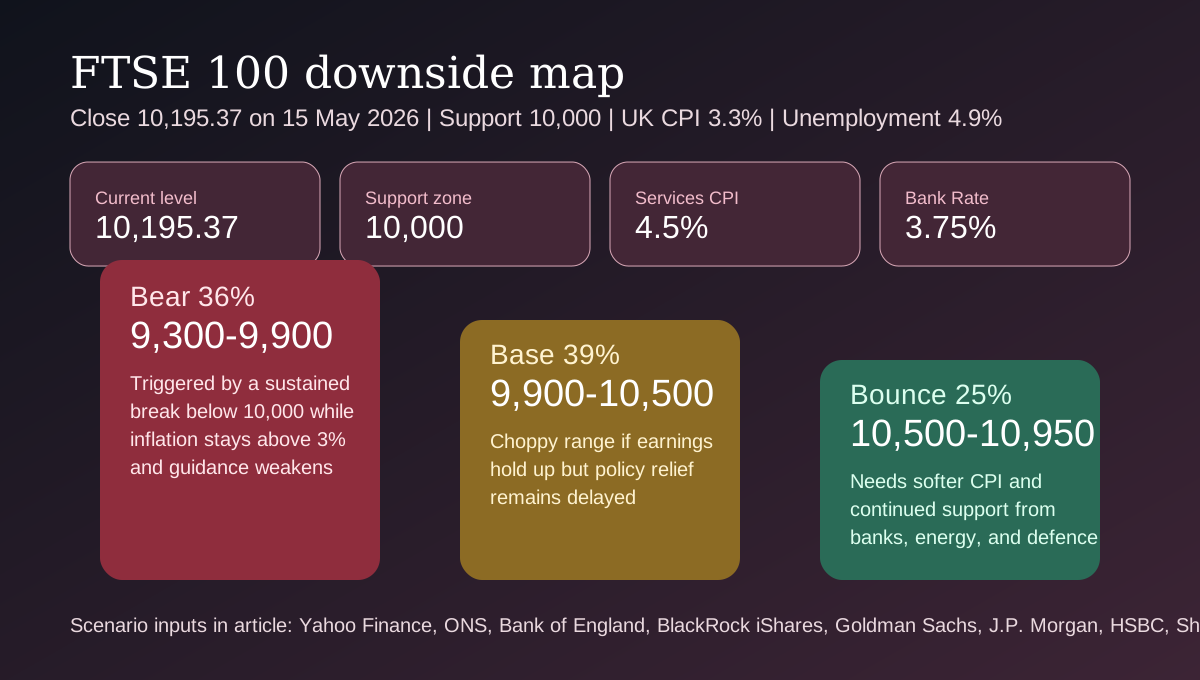
| Bear | 36% | 9,300-9,900 | The FTSE 100 closes below 10,000 on a sustained basis, CPI stays above 3.0%, services inflation stays near or above 4.5%, and heavyweight guidance begins to soften | Review after the 20 May 2026 CPI release, the 18 June 2026 MPC decision, and any weekly close below 10,000 |
| Base | 39% | 9,900-10,500 | Inflation cools only slowly, Bank Rate stays at 3.75% for longer, and earnings remain good enough to stop a deeper slide but not good enough to drive a breakout | Review monthly with ONS CPI, GDP, and labour releases |
| Bull | 25% | 10,500-10,950 | CPI drops back below 3.0%, the BoE turns less defensive, and HSBC, Shell, and BAE continue to underpin the index | Review immediately if inflation surprises lower and the benchmark retakes 10,400 |
The tactical message is straightforward. Bears need confirmation through both the data and the price. A decisive break of 10,000 with sticky inflation would justify a more defensive stance. Without that break, the more likely outcome remains a choppy range rather than a one-way decline.
For current holders, the key is not to assume that every dip is a buying opportunity when policy and inflation are still this uncertain. For new money, patience is cheaper than forcing a view before the market confirms it.
References
Sources
- Yahoo Finance chart API for FTSE 100 52-week history
- Yahoo Finance chart API for FTSE 100 latest daily price metadata
- LSEG FTSE Russell insight: FTSE 100 hits five figures, 8 January 2026
- iShares Core FTSE 100 UCITS ETF product page with current portfolio characteristics
- iShares Core FTSE 100 UCITS ETF factsheet, March 2026
- Office for National Statistics: Consumer price inflation, UK, March 2026
- Office for National Statistics: GDP monthly estimate, UK, March 2026
- Office for National Statistics: Employment in the UK, April 2026
- Bank of England: Monetary Policy Summary and Minutes, April 2026
- Goldman Sachs Research: UK GDP is expected to grow 1.4% this year despite weaker employment, 12 January 2026
- Goldman Sachs: 2026 Outlooks hub
- J.P. Morgan Asset Management: global ex-US equities outlook
- J.P. Morgan Asset Management: review of markets over the first quarter of 2026
- J.P. Morgan Asset Management: UK smaller companies commentary noting attractive UK large-cap valuations
- HSBC Holdings: 1Q 2026 earnings release quick read
- Shell plc quarterly results page, including Q1 2026 release
- BAE Systems trading update, 7 May 2026