01. Historical Context
The FTSE MIB can still move higher, but it is starting from a strong level rather than from deep value
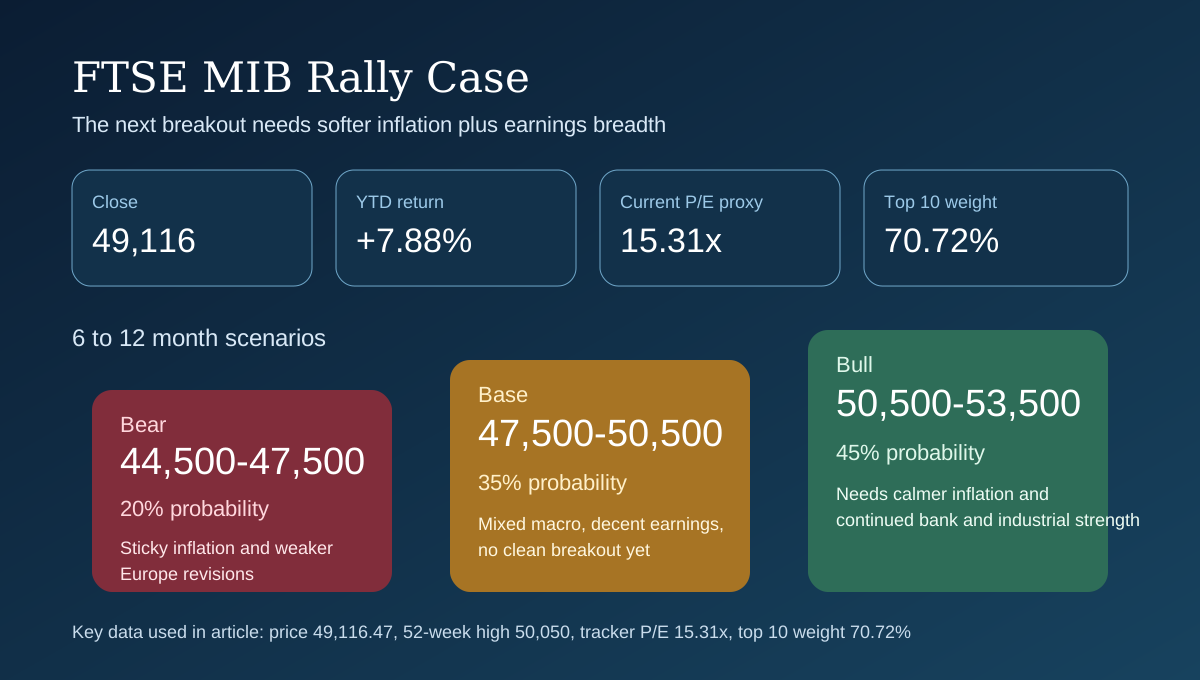
Yahoo Finance data show the FTSE MIB rising from 16,198.00 on 31 May 2016 to 49,116.47 on 15 May 2026, a 203.23% price gain, or roughly 11.73% annualized over ten years. The benchmark is also up 7.88% from its 31 December 2025 close of 45,527.00. That trend strength matters because the next rally is not a rescue trade. It is a continuation trade that needs more evidence than a deeply oversold market would.
| Horizon | What matters most | What would strengthen the thesis | What would weaken the thesis |
|---|---|---|---|
| 1-3 months | Inflation, ECB tone, and the 50,000 level | The index holds above 49,000 and reclaims 50,000 while headline inflation cools from April's spike | Inflation stays sticky and the market fails again near the high |
| 6-12 months | Earnings breadth across banks, utilities, and industrials | UniCredit, Intesa, Enel, Leonardo, Prysmian, and other heavyweights keep guidance intact | The rally depends mostly on multiple expansion while revisions stop improving |
| To 2027 | Whether modest Italian growth still converts into cash-flow resilience | Italy avoids a domestic demand setback and Europe keeps delivering positive earnings revisions | Bank concentration becomes a liability as macro data cool and rates stay restrictive |
Valuation is supportive, but not so cheap that it erases execution risk. BlackRock's iShares FTSE MIB UCITS ETF showed a holdings P/E ratio of 15.31, price-to-book of 2.05, and a 12-month trailing dividend distribution yield of 3.44 as of 14 May 2026. Public tracker data do not provide a benchmark forward P/E for the FTSE MIB, so the cleanest public valuation reference is the trailing holdings multiple. It is workable, but not distressed.
Concentration is the other defining feature. The same tracker had 40 holdings, with UniCredit at 14.97%, Intesa Sanpaolo at 12.43%, and Enel at 10.47%. The top ten holdings made up 70.72% of the benchmark, and financials alone were 46.97%. That means the bullish case should be judged mainly through banks, utilities, and a handful of industrial names, not through a vague idea of broad market strength.
02. Key Forces
Five bullish forces that could extend the move
First, the banks that dominate the benchmark are still producing hard numbers. UniCredit's 1Q26 press release said net profit was a record EUR 3.2 billion, up 16% year over year. Intesa Sanpaolo said on 8 May 2026 that first-quarter net income was EUR 2.8 billion, up 5.6% from Q1 2025. With UniCredit and Intesa together accounting for 27.40% of the FTSE MIB tracker, continued delivery from those two names alone materially strengthens the rally case.
Second, industrial breadth is improving. Leonardo said on 6 May 2026 that first-quarter new orders were EUR 9 billion, up 31% year over year, revenues were EUR 4.4 billion, up 7%, and EBITA was EUR 281 million, up 33%. Prysmian said on 8 May 2026 that Digital Solutions adjusted EBITDA rose to EUR 88 million from EUR 42 million a year earlier. STMicroelectronics said its datacenter revenue should be nicely above USD 500 million in 2026 and well above USD 1 billion in 2027. Those figures matter because they broaden the bull case beyond financials.
Third, Italy's macro backdrop is still positive even if it is not booming. Istat's preliminary estimate for Q1 2026 showed GDP up 0.2% quarter on quarter and 0.7% year on year, with carry-over annual growth for 2026 estimated at 0.5%. Istat's March 2026 labor release showed the unemployment rate at 5.2% and the employment rate at 62.4%. That is enough to support the idea of resilience, even if it is not strong enough to justify complacency.
Fourth, the relative valuation case versus other developed equity markets remains reasonable. J.P. Morgan Asset Management wrote in its 2026 global ex-US outlook that Europe ex-UK trades on around 16x forward earnings versus 23x in the US, while European bank price-to-book is around 1.1x with an 8% shareholder yield. The FTSE MIB tracker at 15.31x trailing earnings and a 3.44 yield still looks compatible with further upside if revisions keep improving.
Fifth, a better inflation path would make the rally easier to own. Italy's April 2026 CPI spike was energy-driven rather than a broad-based core surge: Istat said core inflation slowed to 1.6% from 1.9% even as headline CPI rose to 2.7%. If subsequent releases show the energy shock stabilizing rather than spreading, the FTSE MIB gets room for a cleaner bull case without needing heroic macro assumptions.
| Factor | Why it matters | Current assessment | Bias |
|---|---|---|---|
| Bank earnings | Financials are 46.97% of the benchmark | UniCredit net profit EUR 3.2 billion and Intesa net income EUR 2.8 billion both support the thesis | Bullish |
| Industrial breadth | A rally is healthier if it extends beyond banks | Leonardo, Prysmian, and ST all reported supportive first-quarter signals | Bullish |
| Growth and labour | Determines whether domestic conditions can absorb shocks | Italy GDP grew 0.2% qoq in Q1 and unemployment is 5.2% | Neutral to bullish |
| Inflation and rates | Controls how much further multiples can expand | Headline CPI rose to 2.7% and euro area HICP to 3.0%, but Italy core inflation eased to 1.6% | Neutral |
| Valuation and concentration | Near-high markets are less forgiving of disappointment | P/E is 15.31x and the top ten holdings are 70.72% of the benchmark | Neutral to bearish |
The best version of the bull case is therefore a combined one: banks keep compounding, industrial breadth improves, and inflation cools just enough to stop policy from becoming a new headwind.
03. Countercase
What could interrupt the rally
The biggest near-term threat is that the inflation spike proves less temporary than the market wants. Istat said on 15 May 2026 that Italian CPI accelerated to 2.7% in April from 1.7% in March, while HICP rose to 2.8% from 1.6%. The main drivers were non-regulated energy at 9.6%, regulated energy at 5.3%, and unprocessed food at 5.9%. If the next releases show that pressure spilling into broader pricing, the bullish case loses macro support quickly.
The second risk is that the euro area backdrop keeps the ECB cautious. Eurostat's 30 April 2026 flash estimate put euro area inflation at 3.0%, up from 2.6% in March, with energy inflation at 10.9%. The ECB kept its three key rates unchanged on 30 April 2026. A benchmark like the FTSE MIB can still rally in that environment, but it becomes more dependent on earnings and less able to count on multiple expansion.
The third risk is valuation discipline. Goldman Sachs Research said on 15 January 2026 that Europe traded at 15x its 2026 P/E and in the 70th percentile of the last 25 years, even while it expected an 8% total return for the STOXX 600 in 2026. That combination means upside is still possible, but only if earnings keep doing the work. The FTSE MIB's current trailing P/E proxy of 15.31x is consistent with that same message.
The fourth risk is simple concentration. UniCredit, Intesa, and Enel alone account for 37.87% of the tracker. A rally led by a few giants can continue, but it also becomes fragile if one of those leaders misses on margins, capital return, or guidance.
| Risk | Latest data point | Why it matters | Current assessment |
|---|---|---|---|
| Italian inflation | CPI 2.7%, HICP 2.8%, core inflation 1.6% in April 2026 | Headline re-acceleration can delay a more supportive rates narrative | Bearish |
| Euro area inflation | Euro area HICP 3.0% in April 2026; energy 10.9% | Supports ECB caution and limits clean multiple expansion | Bearish |
| Valuation | Goldman says Europe is at 15x 2026 P/E; FTSE MIB tracker is 15.31x trailing P/E | Leaves less room for disappointment than a cheap market would | Neutral |
| Concentration | Top ten holdings 70.72%; UniCredit, Intesa, and Enel alone 37.87% | Single-stock misses become index events very quickly | Bearish |
| Domestic demand | Istat said Q1 GDP growth came from net exports while the domestic component was negative | Shows the rally still needs external and corporate support | Neutral to bearish |
The bullish setup remains live, but it is not unconditional. The rally becomes much harder to extend if hotter inflation and narrow leadership start reinforcing one another.
04. Institutional Lens
What professional research implies for further upside
Goldman Sachs Research is constructive on Europe, but its stance is conditional rather than euphoric. In its 15 January 2026 outlook, Goldman said it expected the STOXX 600 to produce an 8% total return in 2026, supported by euro area growth of 1.3% and corporate earnings growth of 5% in 2026 and 7% in 2027. The same note also said Europe was trading at 15x 2026 earnings and was already in the 71st percentile of its own 25-year history. That is a workable bull case, but not one that justifies ignoring valuation risk.
J.P. Morgan Asset Management's 2026 global ex-US equity outlook sends a similar message. The firm wrote that after seven months of negative revisions, Europe's 2026 EPS estimate was now being revised up, but that mid-single-digit growth looked more realistic than the 12% implied by bottom-up forecasts. It also noted that Europe ex-UK trades on around 16x forward earnings and that European banks trade at about 1.1x book with an 8% shareholder yield. That is especially relevant to the FTSE MIB because of the benchmark's near-47% financials weight.
The live macro check on those institutional views is still Italy's inflation path. Istat's latest GDP and labor releases are good enough to keep the rally credible. The next step now is whether inflation stops forcing investors to demand a higher risk premium for the same earnings stream.
| Source | What it said | Date | Read-through for FTSE MIB |
|---|---|---|---|
| Goldman Sachs Research | STOXX 600 total return forecast of 8% in 2026, euro area GDP growth of 1.3%, and EPS growth of 5% in 2026 and 7% in 2027 | 15 January 2026 | Constructive backdrop, but one that still requires earnings delivery |
| Goldman Sachs Research | Europe trades at 15x 2026 P/E and is in the 71st percentile of the last 25 years | 15 January 2026 | Explains why the FTSE MIB needs real confirmation rather than blind rerating hope |
| J.P. Morgan Asset Management | Europe's 2026 EPS revisions turned positive after seven negative months, but mid-single-digit growth is more realistic than 12% | 2026 outlook page available in May 2026 | Supports the rally if revisions stay firm, but warns against over-optimistic profit assumptions |
| J.P. Morgan Asset Management | Europe ex-UK is around 16x forward earnings; European banks trade around 1.1x book with 8% shareholder yield | 2026 outlook page available in May 2026 | Favors a bank-led index like the FTSE MIB if profitability holds up |
| Istat and Eurostat | Italy GDP rose 0.2% qoq in Q1 2026, unemployment is 5.2%, but Italy CPI is 2.7% and euro area HICP is 3.0% | 30 April to 15 May 2026 | The macro base case is positive, but the inflation hurdle is still real |
The institutional conclusion is straightforward. The FTSE MIB can push higher, but the next rally should be thought of as an earnings-confirmation trade, not as a free multiple-expansion trade.
05. Scenarios
Actionable 6 to 12 month scenarios
The ranges below are author estimates built from the current FTSE MIB level, the 52-week range, current valuation, Italy and euro area inflation data, recent heavyweight results, and the institutional research cited above. They are not third-party index targets.
| Scenario | Probability | Range | Trigger conditions | When to review |
|---|---|---|---|---|
| Bull | 45% | 50,500-53,500 | The index holds above 49,000 and reclaims 50,000 on a weekly closing basis, Italy CPI drops back below 2.5%, euro area HICP stops rising from 3.0%, and heavyweight guidance from UniCredit, Intesa, Leonardo, Enel, and Prysmian remains intact | Review after the 29 May 2026 Istat inflation and labor releases, the 11 June 2026 ECB decision, and the late-July reporting window |
| Base | 35% | 47,500-50,500 | Growth stays positive but soft, inflation cools only gradually, and the index keeps oscillating around the 49,000-50,000 area without a decisive breakout | Review monthly with Istat CPI, GDP, and labor releases and after each major heavyweight earnings update |
| Bear | 20% | 44,500-47,500 | The index loses 47,500 on a sustained basis, Italy inflation remains above 2.5%, euro area HICP stays near or above 3.0%, and Europe-wide EPS revisions roll over again | Review immediately on a weekly close below 47,500 or on another upside surprise in inflation data |
The tactical conclusion is that buyers should want confirmation, not just proximity to the high. The FTSE MIB can break higher, but the move is stronger if it arrives with calmer inflation and broader earnings support.
If those conditions fail to appear, the more likely outcome is a grind around the current level rather than a clean breakout. That is still constructive, but it is a lower-quality rally path than the headline chart alone suggests.
References
Sources
- Yahoo Finance chart API for FTSE MIB 10-year monthly history
- Yahoo Finance chart API for FTSE MIB latest daily price metadata
- iShares FTSE MIB UCITS ETF product page
- iShares FTSE MIB detailed holdings and analytics export
- Istat: preliminary estimate of GDP - Q1 2026
- Istat: employment and unemployment - March 2026
- Istat: consumer prices - April 2026
- Eurostat: euro area annual inflation up to 3.0% in April 2026
- Eurostat: euro area GDP and employment flash estimate for Q1 2026
- ECB monetary policy decision, 30 April 2026
- ECB Governing Council meeting calendar
- Goldman Sachs Research: European stocks outlook, 15 January 2026
- J.P. Morgan Asset Management: global ex-US equities outlook
- UniCredit 1Q26 group results
- Intesa Sanpaolo consolidated results as at 31 March 2026
- Leonardo 1Q2026 results
- Prysmian Q1 2026 results
- STMicroelectronics Q1 2026 financial results