01. Historical Context
Gold is already expensive, but the demand regime is still supportive
Gold is not valued through earnings, so trailing P/E, forward P/E, EPS estimates, and EPS growth do not apply to the metal itself. The cleaner starting point is price, macro sensitivity, and physical demand. Yahoo Finance monthly data show gold near $1,318.40 ten years ago and about $4,561.90 on the latest monthly close, which implies roughly 13.2% annualized growth over that period. The same 10-year monthly-close range runs from about $1,150 to $4,713.90, while the two-year daily range spans roughly $2,299.20 to $5,318.40.
| Horizon | What matters most | Current assessment | What would strengthen the thesis | What would weaken the thesis |
|---|---|---|---|---|
| 1-3 months | Inflation trend and price support | Constructive but volatile | Gold holds above $4,500 and macro data cool | Gold breaks $4,500 and real-rate pressure rises |
| 6-12 months | ETF and bar-and-coin demand | Bullish | ETF inflows resume and retail demand stays firm | Investment demand fades while yields stay elevated |
| To 2027 | Central-bank buying and macro stress | Bullish with valuation risk | Official-sector demand stays near current range | Policy normalization reduces safe-haven urgency |
The main reason gold still deserves respect after a massive move is that the demand structure changed before price fully changed. The World Gold Council said full-year 2025 total gold demand, including OTC, exceeded 5,000 tonnes for the first time, while central banks still bought 863.3t and ETF holdings rose 801.2t. That is not a normal late-cycle gold tape.
The market therefore looks stretched, but not obviously broken. The right question is whether the next buyers still have a reason to step in, not whether gold is already far above its old range.
02. Key Forces
Five bullish forces that could extend the move
The first bullish force is official demand. The World Gold Council reported central-bank purchases of 863.3t in 2025, and its Q1 2026 Gold Demand Trends release said central banks added another 244t in the first quarter, above both the previous quarter and the five-year average. As long as reserve diversification stays active, gold keeps a structural buyer base that does not depend on Western retail sentiment.
Second, investment demand remains strong even at elevated prices. WGC said 2025 global investment demand reached 2,175.3t, up 84% year over year, driven by 801.2t of ETF inflows and 1,374.1t of bar-and-coin demand. In Q1 2026 alone, bar-and-coin demand rose 42% year over year to 474t, while physically backed ETFs added 62t. That matters because rallies with both official and private demand are usually more durable than rallies driven by only one group.
Third, the macro backdrop still favors hedges. IMF's April 14, 2026 World Economic Outlook projects global growth of 3.1% in 2026 and 3.2% in 2027, but says downside risks dominate. The World Bank then added on April 28, 2026 that precious-metals prices are forecast to rise 42% on average in 2026 as geopolitical uncertainty fuels safe-haven demand. Gold tends to perform best when growth is still positive but confidence in policy and geopolitics is deteriorating.
Fourth, the market has already proved it can absorb higher yields better than in prior cycles. That said, inflation still matters. April 2026 CPI rose 3.8% year over year, and the March 2026 PCE price index rose 3.5%. Those are not perfect gold inputs, but they are high enough to preserve hedging demand and low enough that investors can still imagine policy easing later.
Fifth, institutional outlooks remain supportive. Goldman Sachs Research said on September 30, 2025 that gold could rise to $4,000 by mid-2026; the fact that spot gold has already traded well above that level shows that demand ran stronger than that forecast. J.P. Morgan Private Bank, in a note published February 9, 2026, said it remained firmly bullish and raised its outlook to $6,000-$6,300 per ounce. Those calls should not be treated as targets to trust blindly, but they confirm that major institutions still see the regime as structurally bullish rather than exhausted.
| Factor | Why it matters | Current assessment | Bias | Bullish read | Bearish read |
|---|---|---|---|---|---|
| Central-bank demand | Creates a durable structural bid | Still strong after 244t in Q1 2026 | Bullish | Buying stays near the 700-900t WGC 2026 range | Official demand falls sharply below recent norms |
| Private investment demand | Extends momentum when safe-haven demand rises | Strong after 474t bar-and-coin demand in Q1 2026 | Bullish | ETF inflows and physical demand remain positive | Retail and ETF demand fade together |
| Macro inflation | Shapes real-rate pressure and hedging demand | Mixed with CPI at 3.8% and PCE at 3.5% | Neutral | Inflation cools without killing geopolitical hedging demand | Real yields rise faster than safe-haven demand |
| Supply response | Determines whether high prices trigger enough new metal | Still restrained | Neutral to bullish | Supply growth remains modest | Recycling and mine output respond much faster |
| Price action | Confirms whether buyers still defend the trend | Volatile but constructive above $4,500 | Neutral to bullish | Gold retakes $4,700 and stabilizes | Gold loses $4,500 and fails to recover it |
The bull case does not require fresh euphoria. It only requires the market to keep seeing gold as one of the few assets that still hedges policy error, reserve diversification, and geopolitical stress at the same time.
03. Countercase
What could interrupt the rally
The first risk is real-rate pressure. Gold can withstand high nominal yields better than it used to, but it is still a non-yielding asset. If inflation does not cool meaningfully from April CPI at 3.8% and March PCE at 3.5%, policy could stay tight enough to reduce the urgency of chasing gold at already elevated prices.
The second risk is that price has outrun immediate demand elasticity. WGC said jewellery demand fell 23% year over year to 300t in Q1 2026 and fell 19% in full-year 2025. That does not break the gold story, but it does show that some demand segments are already rationing at current prices.
Third, positioning risk remains real. J.P. Morgan Private Bank noted that gold dropped 9.8% on January 30, 2026, the biggest one-day loss since 2013. A market that can do that after a record run can still suffer violent tactical pullbacks even if the larger thesis survives.
| Investor type | Main risk | Suggested posture | What to monitor next |
|---|---|---|---|
| Already profitable | Giving back gains in a sharp de-risking | Trim if gold loses $4,500 and fails to reclaim it | Inflation releases, ETF flows, and central-bank demand updates |
| Currently losing | Averaging into a real-rate-driven correction | Add only after macro and price both improve | Whether support holds and yields stop tightening |
| No position | Buying into late-stage momentum | Wait for confirmation or a deeper reset | Price behavior around $4,500 and the next WGC demand data |
The practical point is that gold can remain structurally bullish while still being tactically overextended. Those are not contradictory statements.
04. Institutional Lens
What professional research would need to see for the rally to stay credible
The World Gold Council remains the most important primary source because it measures the actual demand mix. Its January 29, 2026 full-year report said total 2025 demand reached 5,002.3t, ETF flows added 801.2t, and central banks bought 863.3t. Its April 29, 2026 Q1 update then showed total Q1 demand of 1,231t, bar-and-coin demand of 474t, ETF holdings up 62t, and central-bank buying of 244t. That is the real backbone of the current bull case.
Goldman Sachs Research's September 30, 2025 note forecast $4,000 gold by mid-2026, based on strong central-bank demand and Fed easing. J.P. Morgan Private Bank's February 9, 2026 note went further, raising its outlook to $6,000-$6,300 per ounce while also warning that volatility is intrinsic to the asset. Those calls matter less as precise targets than as proof that institutional desks are still treating gold as a structurally supported market rather than a spent rally.
Macro agencies reinforce that setup. IMF still sees positive global growth but heavy downside risk, while the World Bank said on April 28, 2026 that precious-metals prices are expected to rise 42% on average this year because geopolitical uncertainty remains intense.
| Source | Latest update | What it says | Why it matters here |
|---|---|---|---|
| World Gold Council | April 29, 2026 | Q1 2026 demand 1,231t, bar and coin 474t, ETFs +62t, central banks +244t | Confirms the bull case still has broad demand support |
| Goldman Sachs Research | September 30, 2025 | Forecast gold at $4,000 by mid-2026 | Shows how quickly actual demand outpaced prior institutional expectations |
| J.P. Morgan Private Bank | February 9, 2026 | Raised 2026 gold outlook to $6,000-$6,300/oz | Shows institutional upside conviction remains unusually high |
| World Bank | April 28, 2026 | Precious-metals prices forecast to rise 42% on average in 2026 | Supports the safe-haven macro backdrop |
The institutional message is still constructive, but it is not a license to ignore entry quality or macro risk.
05. Scenarios
How to think about buying, holding, or trimming from here
| Scenario | Probability | Trigger conditions | Target range | Review point |
|---|---|---|---|---|
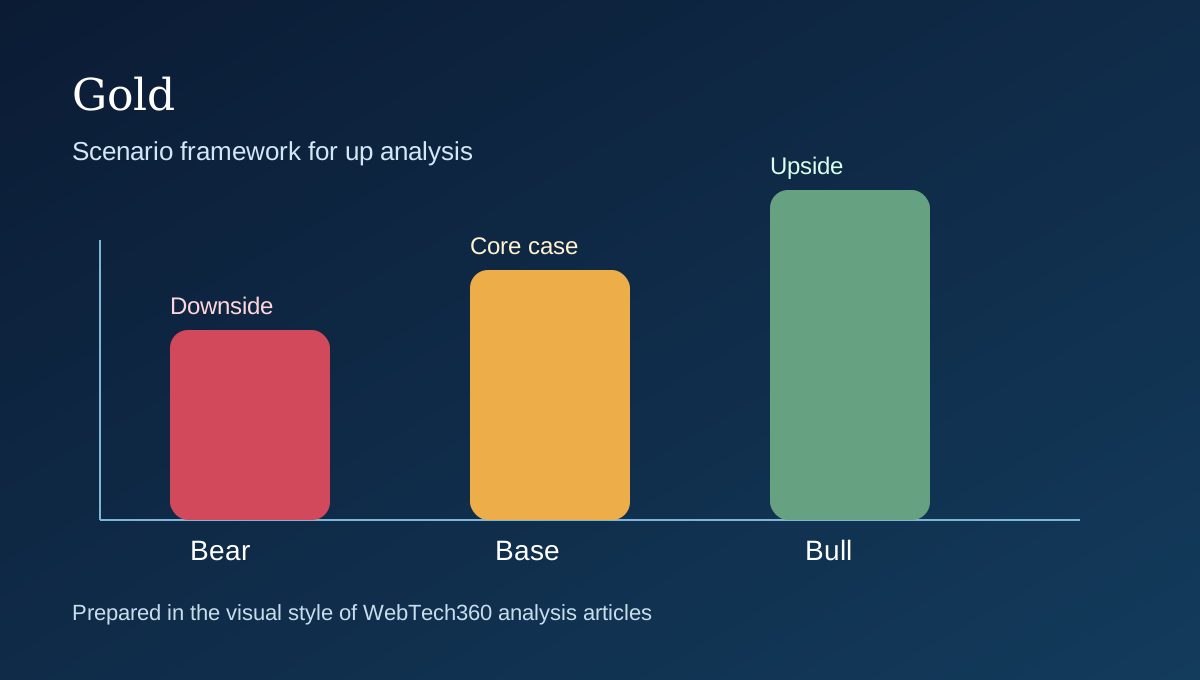
| Rally extends | 45% | Gold holds above $4,500, ETF demand stays positive, central-bank buying remains firm, and CPI/PCE stop re-accelerating | $4,700-$5,100 | Review after each monthly CPI and PCE release and the next WGC demand update |
| Sideways digestion | 35% | Demand stays solid, but higher-for-longer rates cap upside momentum | $4,200-$4,700 | Review monthly and on any sustained break above or below the range |
| Deeper pullback | 20% | Gold breaks $4,500, inflation stays sticky, and investment flows weaken | $3,800-$4,200 | Review immediately if support breaks on follow-through selling |
If you already have gains, the best bullish response is to let the trend justify size rather than assuming every record high makes the position safer. If you do not own gold yet, the cleaner entry is confirmation above support or a sharper reset, not forced buying into unresolved volatility.
References
Sources
- Yahoo Finance quote page for Gold futures (GC=F)
- Yahoo Finance 10-year chart data endpoint for Gold futures
- World Gold Council, Gold Demand Trends: Q4 and Full Year 2025
- World Gold Council, Gold Demand Trends: Q1 2026 Outlook
- World Gold Council Q1 2026 Gold Demand Trends press release, April 29, 2026
- IMF World Economic Outlook, April 2026
- U.S. Bureau of Labor Statistics CPI release for April 2026, published May 12, 2026
- U.S. BEA Personal Consumption Expenditures Price Index
- World Bank Commodity Markets Outlook press release, April 28, 2026
- Goldman Sachs Research, gold forecast article, September 30, 2025
- J.P. Morgan Private Bank, Is it a golden era for gold?, published February 9, 2026