01. Historical Context
The downside case starts with a market that is strong, concentrated, and no longer cheap enough to ignore misses
The IBEX 35 is not rolling over from a depressed level. Yahoo Finance chart data show the index at 17,622.7 on 15 May 2026, up 115.88% from 8,163.3 ten years earlier and still 28.28% above its 52-week low of 13,737.2. That matters because the next downside move, if it happens, is more likely to come from de-rating and earnings disappointment than from an already broken market simply getting cheaper.
| Horizon | What matters most | What would strengthen the bearish thesis | What would weaken the bearish thesis |
|---|---|---|---|
| 1-3 months | Inflation, ECB tone, and the 17,000 level | Spain CPI and HICP stay above 3%, and the index loses 17,000 on weak breadth | Inflation cools and the benchmark reclaims 18,000 quickly |
| 6-12 months | Bank earnings and domestic demand durability | Santander, BBVA, and CaixaBank guidance softens while real rates stay restrictive | Heavyweight earnings remain solid and dividends or buybacks cushion sentiment |
| To 2027 | Whether slower growth and sticky inflation overlap | Banco de España growth downgrades deepen and energy-led inflation stays elevated | Spain keeps outgrowing the euro area and inflation resumes easing |
The sector structure amplifies that risk. BME's latest public factsheet shows financial services at 36.34% of the index, oil and energy at 20.04%, consumer goods at 14.02%, and technology and telecommunications at 12.56%. The top four constituents, Santander, Iberdrola, BBVA, and Inditex, account for 55.88% of the benchmark. That concentration is helpful in rallies when the leaders execute. It becomes a problem when the same leaders face a simultaneous macro or valuation headwind.
Valuation is not stretched by U.S. standards, but it is no longer a full cushion either. BME said on 16 January 2026 that Spanish equities were trading on 13 times earnings, 2.3 points below their 37-year average, with an average dividend yield of 4.1%. That still looks attractive on a relative basis. It does not mean the index is immune to a correction when inflation re-accelerates and the market is already trading close to cycle highs.
02. Key Forces
Five bearish forces that could push the trend lower
First, the inflation pulse has moved the wrong way again. INE said Spain's annual CPI rate was 3.2% in April 2026, while HICP rose to 3.5%. Eurostat's flash estimate put euro area inflation at 3.0%, up from 2.6% in March, with energy inflation surging to 10.9%. For a bank- and utility-heavy benchmark, that matters because stickier inflation can hold real rates higher for longer and cap the multiple investors are willing to pay.
Second, policy is not truly loose. The ECB's main page still showed the deposit facility at 2.00%, the main refinancing rate at 2.15%, and the marginal lending facility at 2.40% in mid-May 2026. That is easier than the peak, but it is not a backdrop in which equity investors can assume a straight-line rerating. If inflation remains firm, the market has to do more work through earnings rather than monetary relief.
Third, Spain's own central bank is still projecting a slowdown. Banco de España's March 2026 exercise expected Spanish GDP growth to slow from 2.8% in 2025 to 2.3% in 2026 and 1.7% in 2027, while projecting HICP at 3.0% in 2026. That combination is awkward for equities because it implies slower nominal growth support at the same time that inflation may not cool quickly enough to deliver a valuation tailwind.
Fourth, the benchmark is concentrated in the exact sectors that are most exposed to this macro mix. Financial services make up 36.34% of the index and the two largest banks alone, Santander and BBVA, account for 30.04%. If higher-for-longer rates stop helping net interest income and start hurting credit quality or loan demand instead, the index-level effect can be swift.
Fifth, upside expectations already require ongoing execution. The index is only 5.12% below its 52-week high. After a 115.88% ten-year price gain, IBEX 35 no longer has the luxury of mediocre evidence. A market this close to its highs can fall simply because earnings stop improving fast enough to validate the existing narrative.
| Factor | Why it matters | Current assessment | Bias |
|---|---|---|---|
| Inflation | Determines whether rates can ease further | Spain CPI is 3.2%, Spain HICP 3.5%, and euro area inflation 3.0% | Bearish |
| ECB stance | Policy sets the ceiling for multiple expansion | Deposit facility is still 2.00%, not an emergency-support setting | Neutral to bearish |
| Growth backdrop | Slower growth makes earnings misses more damaging | Banco de España sees GDP growth slowing to 2.3% in 2026 and 1.7% in 2027 | Bearish |
| Index concentration | A few sectors can move the whole benchmark | Financials are 36.34% of the index and the top four names total 55.88% | Bearish |
| Valuation starting point | Cheap markets absorb shocks better than near-high markets | BME's 13x earnings and 4.1% yield are supportive, but the index is still close to its highs | Neutral |
The bearish path therefore does not require a crisis. It only requires sticky inflation, a slower growth impulse, and weaker evidence from a handful of large constituents at the same time.
03. Countercase
What could stop the decline from becoming a larger problem
The bear case is still conditional because recent heavyweight earnings remain strong. Santander reported underlying first-quarter profit of EUR 3.6 billion on 29 April 2026, with revenue up 4%, costs down 3%, and underlying EPS up 17%. BBVA reported attributable profit of EUR 2.989 billion, up 10.8% in current euros, while its non-performing loan ratio improved to 2.6%. Those are not numbers that normally precede an immediate collapse in a bank-heavy index.
There is also support outside the banks. Iberdrola's adjusted net profit rose 11% to EUR 1.865 billion in the first quarter and management upgraded full-year adjusted net profit growth guidance to more than 8%. Inditex said its 2025 revenue reached EUR 39.9 billion and net profit EUR 6.2 billion. Those updates matter because the index is not a pure macro trade; it still has large companies generating real cash flow and maintaining capital discipline.
Spain's macro data are not recessionary either. INE's first-quarter flash estimate showed GDP growth of 0.6% quarter on quarter and 2.7% year on year. That does not erase the inflation risk, but it does mean any decline still needs confirmation from earnings and positioning rather than a simple assumption that the economy is rolling over.
| Offset | Latest data point | Why it matters | Current assessment |
|---|---|---|---|
| Santander execution | Q1 underlying profit EUR 3.6bn, revenue +4%, costs -3%, EPS +17% | Shows the largest index weight is still delivering strong operating leverage | Bullish |
| BBVA resilience | Q1 attributable profit EUR 2.989bn, up 10.8%; NPL ratio 2.6% | Credit quality and profitability still look healthy | Bullish |
| Iberdrola guidance | Q1 adjusted net profit EUR 1.865bn, up 11%; 2026 guidance raised to more than 8% growth | Utilities and networks still provide a defensive earnings anchor | Bullish |
| Spain GDP | Q1 2026 GDP +0.6% qoq and +2.7% yoy | The domestic economy is slowing, but not yet contracting | Neutral to bullish |
| Valuation support | BME market reference of 13x earnings and 4.1% dividend yield | Relative valuation is not demanding enough to assume automatic deep downside | Neutral |
The practical takeaway is that a bearish call on IBEX 35 needs both price confirmation and a deterioration in the current earnings cushion. Without those two pieces together, the more likely outcome is a range-bound reset rather than a sustained downtrend.
04. Institutional Lens
How professional investors would frame the downside risk
The institutional lens is not screaming crisis, but it is clearly more conditional than the price chart alone suggests. Banco de España is projecting slower growth and above-target inflation. The ECB is not back in a clearly easy policy regime. J.P. Morgan Asset Management still likes European banks on valuation and shareholder yield, which is important for IBEX 35, but that also means the downside case depends on a change in earnings expectations rather than on a market that is already universally hated.
BME's valuation reference is another reason to avoid exaggeration. A 13x earnings multiple is not expensive for a developed-market equity benchmark. It simply becomes vulnerable when inflation rises and the index is near highs. The downside thesis is therefore best framed as a quality downgrade in the setup, not as a call that Spanish equities have suddenly become structurally overpriced.
| Source | What it said | Date | Read-through for IBEX 35 |
|---|---|---|---|
| Banco de España | Projects Spain GDP growth of 2.3% in 2026, 1.7% in 2027, and HICP of 3.0% in 2026 | 27 March 2026 | A slower but still positive economy makes de-rating risk more likely than outright collapse risk |
| ECB | Deposit facility at 2.00%, main refinancing operations at 2.15%, marginal lending facility at 2.40% | ECB rates page viewed in May 2026 | Policy is easier than peak, but not loose enough to neutralize sticky inflation automatically |
| Eurostat | Euro area inflation rose to 3.0% in April 2026, with energy at 10.9% | 30 April 2026 | Energy-led inflation can delay the policy relief equity bulls want |
| BME / Spain Investors Day | Spanish equities were trading on 13x earnings with a 4.1% average dividend yield | 16 January 2026 | Valuation is supportive enough to cushion dips, but not enough to prevent them |
| J.P. Morgan Asset Management | Europe's 2026 EPS estimate is now being revised up; European banks trade at 1.1x book and offer 8% shareholder yield | 2026 outlook page available in May 2026 | The bear case strengthens only if that positive European bank earnings narrative starts to reverse |
The institutional message is disciplined rather than dramatic. For IBEX 35 to fall materially from here, inflation persistence and weaker bank-heavy earnings probably need to appear together.
05. Scenarios
Actionable 3 to 12 month downside scenarios
The ranges below are author estimates built from the current IBEX 35 level, the 52-week high and low, BME's January 2026 valuation reference, the latest Spain and euro area inflation prints, Banco de España's macro projections, and the recent results of the index's largest constituents. They are not third-party index targets.
| Scenario | Probability | Range | Trigger conditions | When to review |
|---|---|---|---|---|
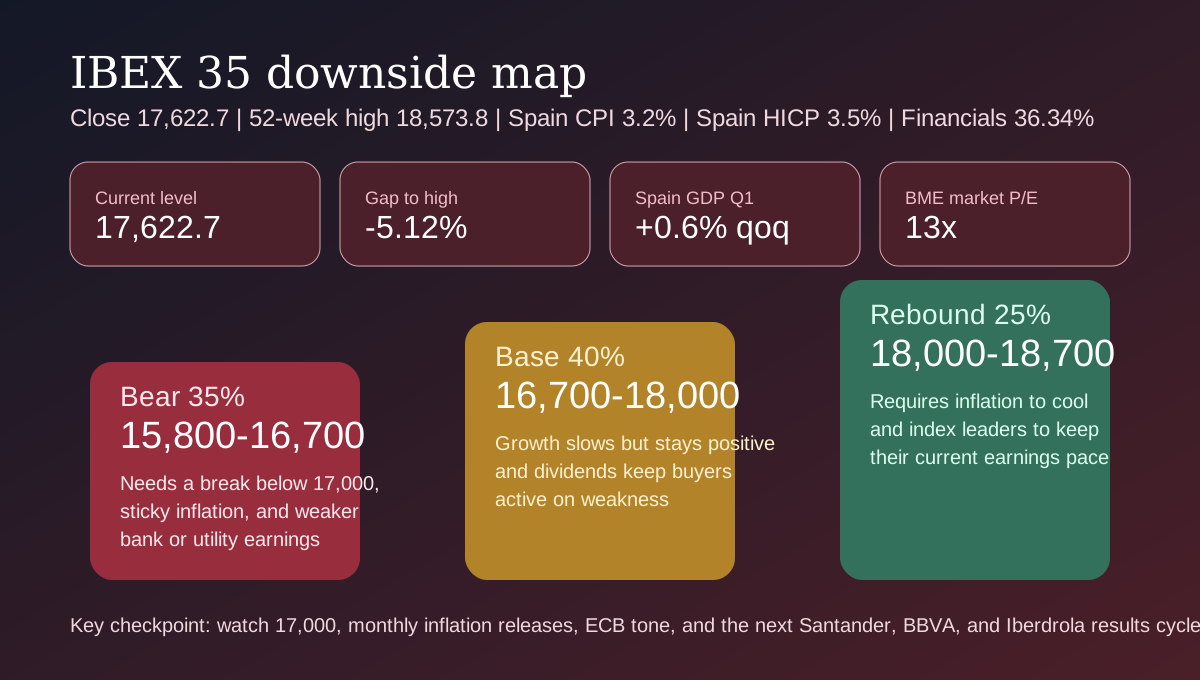
| Bear | 35% | 15,800-16,700 | The index breaks 17,000 decisively, Spain CPI stays around or above 3%, euro area inflation remains elevated, and at least one of the major bank or utility anchors weakens in the July-August 2026 reporting window | Review after each INE inflation release, Eurostat flash print, and the next bank-heavy results season |
| Base | 40% | 16,700-18,000 | Growth slows but stays positive, inflation cools only gradually, and strong dividends and buybacks keep buyers active on dips | Review monthly and again after each ECB policy update |
| Rebound | 25% | 18,000-18,700 | Spain inflation drops back below 3%, heavyweights maintain guidance, and the benchmark retakes 18,000 with broader participation | Review quickly if price regains 18,000 and holds there through the next earnings cycle |
The tactical conclusion is straightforward. A deeper selloff is possible, but it is not the default outcome unless inflation and earnings deteriorate together. Without that combination, the more probable path is a broad trading range rather than a clean breakdown.
That is why the 17,000 level, the next two inflation releases, and the next bank and utility results matter so much. They are the measurable checkpoints that distinguish an ordinary reset from a lower-quality regime change.
References
Sources
- Yahoo Finance chart API for IBEX 35 10-year monthly history
- Yahoo Finance chart API for IBEX 35 latest daily price metadata
- BME IBEX 35 factsheet, data updated as of 19 December 2025
- BME Spain Investors Day market valuation note, 16 January 2026
- INE national accounts release for the first quarter of 2026
- INE CPI and HICP release for April 2026
- Eurostat flash estimate: euro area inflation in April 2026
- European Central Bank key interest rates page
- Banco de España macroeconomic projections, March 2026
- J.P. Morgan Asset Management: global ex-US equities outlook
- Santander Q1 2026 results
- BBVA Q1 2026 earnings release
- Iberdrola Q1 2026 results update
- Inditex Annual Report 2025 CEO statement