01. Historical Context
The recent softness can still become a broader de-rating
LVMH's Q1 2026 result was not disastrous, but it was weak enough to matter. Organic growth was only 1%, Fashion & Leather Goods declined 2%, and Reuters-syndicated coverage noted that sales missed expectations for roughly 1.95% growth.
| Horizon | What matters most | What would strengthen the bearish view | What would weaken the bearish view |
|---|---|---|---|
| 1-3 months | Whether H1 still looks soft | Organic growth remains around Q1 levels | Fashion & Leather Goods returns to growth |
| 6-12 months | Estimate direction | 2027 EPS expectations are revised down | Consensus stays near EUR25.55 |
| To 2027 | Sector sentiment | Luxury demand remains merely stable | Asia and travel demand broaden visibly |
The stock is therefore vulnerable not because the business is fragile, but because the recovery still has to prove itself.
02. Key Forces
Five bearish forces that could push the stock lower
First, the largest division is still under pressure. Fashion & Leather Goods remains the group's most important earnings engine, and its 2% organic decline in Q1 2026 is still the clearest bearish fact in the story.
Second, the industry backdrop is no longer strong enough to hide softness. Bain's 2025 luxury market estimate of EUR358 billion, flat in constant currency and down 2% reported, supports the idea of stabilization, not easy growth.
Third, valuation still matters. MarketScreener shows LVMH at about 20.5x 2026 earnings. That is not bubble territory, but it still leaves room for compression if the rebound gets pushed further out.
Fourth, macro and geopolitical risks remain live. Management itself said the conflict in the Middle East cost the group about 1 point of Q1 growth.
Fifth, the recovery narrative is consensus enough to be vulnerable. If investors stop believing in the 2027 EPS rebound, the stock can derate even while cash flow stays strong.
| Factor | Current Assessment | Bias | Why it matters now |
|---|---|---|---|
| Core division | Fashion & Leather Goods at -2% organic growth | Bearish | This is the main signal the market still cares about |
| Sector backdrop | Luxury market stabilized rather than re-accelerated | Bearish | Reduces the sector tailwind for a fast recovery |
| Valuation | About 20.5x 2026 PE | Neutral to Bearish | Leaves room for derating if the recovery takes longer |
| Geopolitical risk | Middle East tension already hit Q1 growth | Neutral | Shows how exposed the demand backdrop still is |
| Estimate sensitivity | 2027 EPS rebound is still priced into consensus | Bearish if cut | Downward revisions would likely hit the stock quickly |
The bearish case becomes much stronger if these factors reinforce one another rather than appearing one at a time.
03. Countercase
What could stop the decline from extending
The strongest counterargument is cash generation. LVMH produced EUR11.3 billion of operating free cash flow in 2025 and ended the year with manageable net financial debt. That gives the group resilience while it works through a softer cycle.
The second counterargument is regional breadth. Asia ex-Japan still grew 7% in Q1 2026 and the United States grew 3%, which means the weakness is not universal.
The third counterargument is that the industry may already be close to its cyclical floor. A stabilized sector is not enough for a strong rally, but it can be enough to prevent a larger breakdown.
| Signal | Latest data point | Current Assessment | Bias |
|---|---|---|---|
| Cash generation | Operating free cash flow at EUR11.3 billion in 2025 | Still a powerful stabilizer | Bullish counterpoint |
| Regional support | Asia ex-Japan +7%, U.S. +3% in Q1 2026 | Recovery pockets remain | Bullish counterpoint |
| Sector base | Bain sees stabilization in 2025 | Suggests the floor may be forming | Neutral to Bullish counterpoint |
The bearish view works best as a warning against overpaying for a delayed recovery, not as a call that LVMH's franchise is deteriorating structurally.
04. Institutional Lens
What outside research says about the downside
Reuters-syndicated reporting after Q1 2026 is useful because it showed some analysts turning cautious even while keeping the long-term quality case intact. That is the right bearish framework: institutions are not calling the business broken, but they are less willing to pay up without cleaner numbers.
Bain's sector view and the IMF's more moderate macro forecasts reinforce that stance. A stabilized but slower luxury market is enough to keep LVMH fundamentally strong while still making the stock vulnerable to a lower multiple.
| Source | Updated | What it says | Why it matters here |
|---|---|---|---|
| Reuters-syndicated coverage | April 2026 | Q1 sales missed expectations and some brokers stayed cautious | Confirms the market is demanding evidence |
| Bain luxury study | November 2025 | Sector stabilized in 2025 | A stable market can still produce underwhelming equity returns |
| IMF WEO | April 14, 2026 | Growth remains positive, but not exceptionally strong | Supports a slower recovery base case |
| MarketScreener | May 2026 | 2027 EPS rebound is still embedded in consensus | Bearish conviction rises if that estimate path is cut |
The institutional lens therefore argues for caution on timing rather than for a structurally negative view of the company.
05. Scenarios
Who should wait, who should reduce, and who can stay constructive
| Scenario | Probability | Trigger | Target range | Review point |
|---|---|---|---|---|
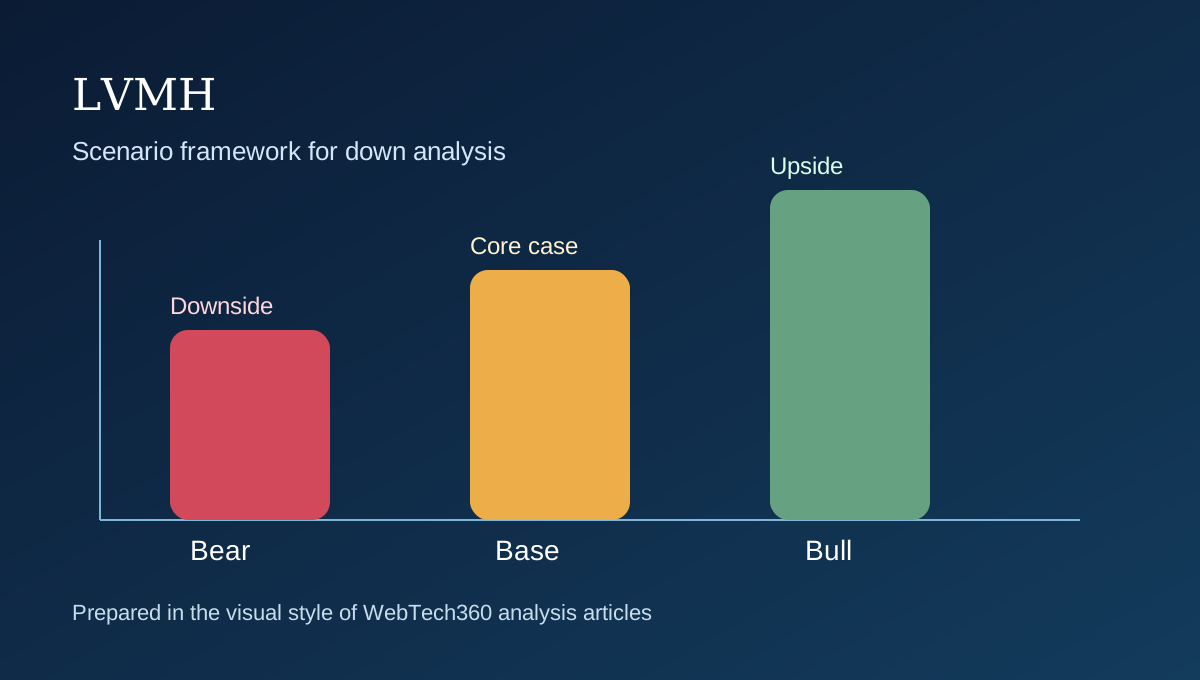
| Bear | 35% | Fashion & Leather Goods stays negative, estimate cuts begin, and valuation compresses | EUR380 to EUR455 | Review after H1 2026 and FY2026 results |
| Base | 35% | The business remains stable but the recovery stays slow | EUR455 to EUR500 | Reassess if organic growth improves only marginally |
| Bullish reversal | 30% | The key division turns positive and investor confidence rebuilds | EUR500 to EUR575 | Review if the next two reports clearly improve on Q1 |
The highest-risk bearish setup is one where softer division growth and lower valuation expectations start feeding each other. That is the combination worth watching.
References
Sources
- Yahoo Finance 10-year chart data for MC.PA
- LVMH Q1 2026 revenue update
- LVMH 2025 full-year results
- MarketScreener quote page for LVMH
- MarketScreener earnings estimates for LVMH
- Bain luxury market outlook after 2025 stabilization
- Reuters-syndicated report on LVMH's sales miss and broker reactions
- IMF World Economic Outlook, April 2026