01. Current Data
What the latest data says about upside potential
The Nasdaq Composite still has the strongest structural growth story of the three major U.S. indexes, but it also carries the highest valuation and duration risk. My base case is bullish, yet much more conditional than the price chart suggests: the index needs disinflation, continued AI monetization, and broader earnings participation to justify another multi-year rerating.
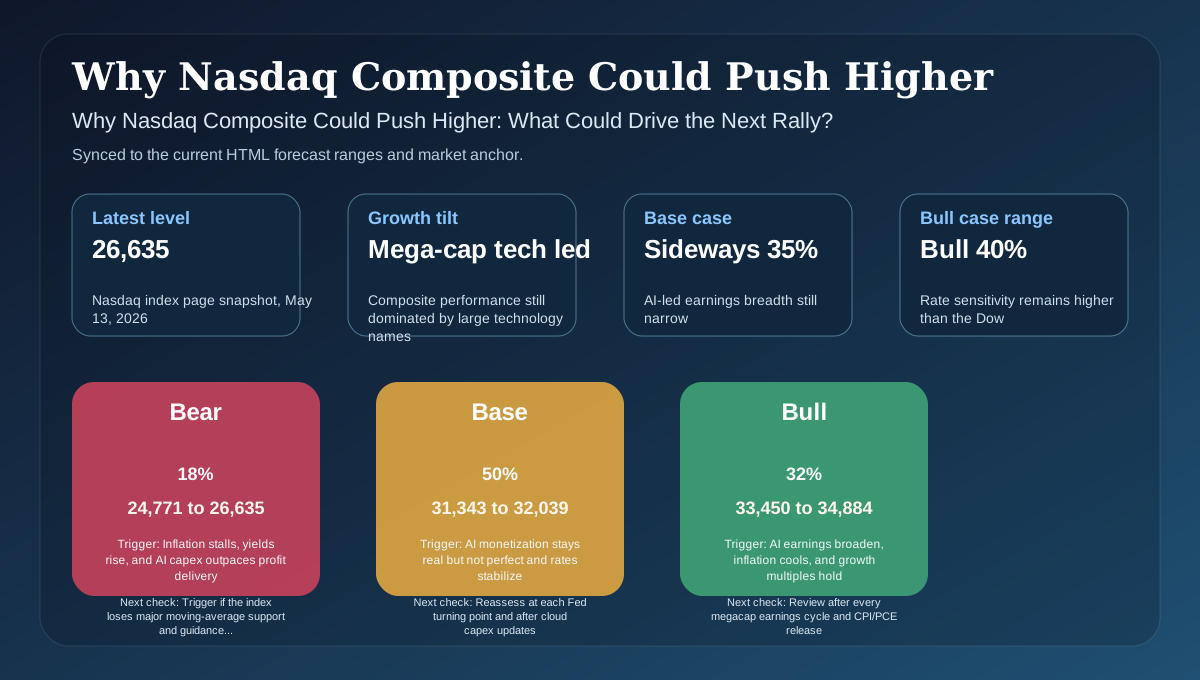
| Metric | Latest reading | Why it matters |
|---|---|---|
| Index level | 26,635 | Nasdaq index page snapshot, May 13, 2026 |
| Growth tilt | Mega-cap tech led | Composite performance still dominated by large technology names |
| Growth / macro | Goldman 2026 GDP ~2.5%; IMF 2026 GDP 2.4% | Still expansionary, but not low-inflation perfection |
| Inflation | CPI 3.8%, core CPI 2.8%, core PCE 3.2% | Rate-cut hopes are possible, but not automatic |
The Nasdaq story is still about concentration and duration. Official Nasdaq material has repeatedly emphasized the index's heavy technology and innovation tilt, and that remains the defining fact for any forecast. When long-duration growth is being repriced upward, the Nasdaq can outperform dramatically. When rates move the wrong way or AI optimism narrows to a few names, the drawdowns can also be faster than in the Dow or S&P 500.
That is why the latest inflation numbers matter so much here. April 2026 CPI at 3.8%, core CPI at 2.8%, and March 2026 core PCE at 3.2% are not recessionary readings, but they are also not low enough to remove discount-rate risk for tech-heavy indexes. Goldman Sachs' 2.5% 2026 GDP view is broadly constructive because the Nasdaq still needs growth. But the same macro setup that helps revenue can hurt valuation if the bond market decides policy easing should be delayed.
The question investors keep avoiding is whether AI breadth is truly broadening. Nasdaq's own research on the Nasdaq-100 has highlighted how a small set of companies still drives a large share of index behavior. For the Composite, that means the bull case is strongest when software, semis, internet platforms, and second-tier growth names all participate. If the rally is again carried mainly by the top handful of AI beneficiaries, the upside can continue, but the setup becomes more brittle.
02. Five Factors
Five forces that could still drive the next rally
The Nasdaq story is still about concentration and duration. Official Nasdaq material has repeatedly emphasized the index's heavy technology and innovation tilt, and that remains the defining fact for any forecast. When long-duration growth is being repriced upward, the Nasdaq can outperform dramatically. When rates move the wrong way or AI optimism narrows to a few names, the drawdowns can also be faster than in the Dow or S&P 500.
That is why the latest inflation numbers matter so much here. April 2026 CPI at 3.8%, core CPI at 2.8%, and March 2026 core PCE at 3.2% are not recessionary readings, but they are also not low enough to remove discount-rate risk for tech-heavy indexes. Goldman Sachs' 2.5% 2026 GDP view is broadly constructive because the Nasdaq still needs growth. But the same macro setup that helps revenue can hurt valuation if the bond market decides policy easing should be delayed.
The question investors keep avoiding is whether AI breadth is truly broadening. Nasdaq's own research on the Nasdaq-100 has highlighted how a small set of companies still drives a large share of index behavior. For the Composite, that means the bull case is strongest when software, semis, internet platforms, and second-tier growth names all participate. If the rally is again carried mainly by the top handful of AI beneficiaries, the upside can continue, but the setup becomes more brittle.
| Factor | Why it matters | Current assessment | Bias | What the data says now |
|---|---|---|---|---|
| Macro | Growth helps, but inflation and yields still drive multiples | Constructive with rate risk | 0 | The macro mix is good for revenues, less ideal for premium valuations |
| Valuation | High growth indexes need a friendlier discount rate | Rich | - | The index remains the most sensitive to bond-market repricing |
| Earnings | AI leaders are delivering, but breadth is still uneven | Good | + | Top-tier platforms continue to support earnings expectations |
| Breadth | A rally led by only a few giants is brittle | Below ideal | - | Broader participation is still the missing piece |
| AI monetization | This is the key bull-case engine | Strong but unproven at the margin | + | The spending wave is real; the question is how wide the payoff becomes |
The valuation question is now measurable. On the S&P 500, FactSet's 21.0x forward multiple is already above normal. For the Dow and Nasdaq, the correct conclusion is not that valuation does not matter, but that index composition changes how you should interpret it. The Dow's quality cyclicals can tolerate a less friendly rate backdrop than the Nasdaq. The Nasdaq, in turn, can tolerate richer levels only if AI earnings breadth genuinely spreads.
The second force is earnings quality. Markets can absorb rich pricing if earnings keep surprising on the upside, but that support weakens fast when revisions stop improving. That is why the earnings season cadence matters more than broad philosophy here. If the next two quarters still show positive revisions and margin resilience, the base case remains constructive. If revisions flatten while inflation stops improving, the market will likely reprice before the economic data turns decisively weaker.
The third force is breadth. A healthier bull market is one where more stocks, sectors, and styles participate. A weaker one is a market in which index-level gains are doing most of the talking. For the S&P 500 and Nasdaq, that means watching whether the rally widens beyond mega-cap AI names. For the Dow, it means asking whether industrials, banks, healthcare, and staples are all contributing or whether the index is being flattered by a small cluster of winners.
The fourth force is policy sensitivity. April 2026 CPI and March 2026 PCE data do not justify panic, but they do justify discipline. If inflation keeps easing, the ceiling on valuation stress comes down. If inflation stalls near current levels, the market can still rise, but it probably needs more earnings support and less narrative excess. The fifth force is AI itself: real productivity and monetization are bullish; narrow capex optimism without broader payoff is not.
03. Countercase
What could weaken the outlook from here
The bear case should be tied to current data, not textbook language. Inflation is not just a vague risk; April 2026 CPI was 3.8% year over year, with core CPI at 2.8%, and March 2026 core PCE was still 3.2%. That matters because these numbers are low enough to keep hopes of easier policy alive, but high enough to keep the Fed from sounding complacent. If those readings stop moving lower, the market's valuation cushion becomes thinner.
The second live risk is concentration. S&P DJI's own breadth data shows the average stock has not kept up with the headline index. In the Nasdaq, that concentration is even more obvious because AI-linked megacaps still dominate narrative and performance. If AI capex remains huge but the monetization evidence broadens slowly, the market can keep working for a while, but the downside becomes sharper if one or two key leaders disappoint.
The third risk is that institutional optimism may already be fully known. Goldman Sachs, LPL, and other large houses are not hiding the fact that they still see room for gains. That helps the bull case, but it also means the market may need fresh upside evidence rather than just confirmation of what investors already believe. The fourth risk is simple: expensive indexes do not need recession to correct. They only need inflation, yields, or guidance to land a little worse than expected.
| Risk | Latest data point | Why it matters now | What would confirm it |
|---|---|---|---|
| Sticky inflation | CPI 3.8%, core CPI 2.8%, core PCE 3.2% | Keeps rate sensitivity alive | Two more hot inflation prints or hawkish Fed repricing |
| Narrow leadership | Breadth still mixed, especially in growth | Makes the market more fragile | More index gains with fewer stocks participating |
| Valuation compression | Mega-cap tech led | Premium assets need strong execution | Weaker guidance or higher real yields |
| AI over-ownership | Capex enthusiasm remains intense | Could unwind if monetization disappoints | Large leaders miss or cautious commentary spreads |
04. Institutional Lens
How current institutional research changes the outlook
Institutional insight is more useful when translated into practical terms. The good version of the Nasdaq bull case is not 'AI is big.' It is that AI capex stays high, monetization improves, and investors become comfortable that earnings growth is diffusing beyond a few hyperscalers. The bad version is that the market keeps paying peak multiples for uncertain future cash flows while inflation and real rates stop cooperating.
That is why I am keeping the institutional section concrete. The S&P 500 article now uses FactSet's published 21.0x forward P/E and Q1 2026 surprise data, Goldman Sachs' latest U.S. growth read, IMF's 2026 U.S. growth baseline, and the latest BLS and BEA inflation releases. For the Dow and Nasdaq, I am using the same macro inputs but translating them through index composition rather than pretending there is one universal multiple that explains everything.
The practical insight is this: the medium-term bull case still exists, but the market is no longer priced for sloppiness. Strong earnings and cooling inflation can keep the trend alive. Flat earnings and sticky inflation would make current levels much harder to defend. That conclusion is more useful than repeating that institutions like earnings growth or worry about policy uncertainty.
Of the three major indexes, the Nasdaq is where AI matters most directly. Goldman Sachs' estimate that AI investment could rise toward $527 billion by 2030 is a real positive because the Composite holds many of the beneficiaries. But that also means this index is the most exposed if AI economics disappoint, if cloud spending normalizes, or if regulators begin pushing back harder on data, power, or competition.
| Source | Concrete datapoint | What it changes in the thesis |
|---|---|---|
| FactSet | S&P 500 forward P/E 21.0x and strong Q1 2026 surprise rate | Tells you valuation is rich enough that execution still matters |
| Goldman Sachs | 2026 U.S. GDP around 2.5% and only 20% recession risk | Supports risk assets, but not indiscriminate multiple expansion |
| IMF | U.S. growth still positive in 2025 and 2026 | Keeps the medium-term expansion intact |
| BLS / BEA | Inflation is easing, but not low enough to forget rates | This is the main constraint on the bull case |
05. Scenarios
Scenario analysis with probabilities, triggers, and review dates
The bullish near-term setup is actionable only if the trigger is measurable. For the S&P 500, that means holding above the recent breakout zone and seeing breadth improve instead of weaken. For the Dow, it means stable credit quality, resilient industrial commentary, and no ugly deterioration in nominal growth indicators such as ISM or payrolls. For the Nasdaq, it means AI capex and monetization data continuing to surprise positively without a renewed inflation scare.
If you are already profitable, the better tactic is not blind conviction but position management. If you are losing, the right move is not averaging because a story sounds good; it is waiting for evidence that the market is rewarding the right things again. If you have no position, these scenario ranges tell you when patience is discipline rather than hesitation.
| Scenario | Probability | Range / implication | Trigger | When to review |
|---|---|---|---|---|
| Bull | 32% | 33,450 to 34,884 | AI earnings broaden, inflation cools, and growth multiples hold | Review after every megacap earnings cycle and CPI/PCE release |
| Base | 50% | 31,343 to 32,039 | AI monetization stays real but not perfect and rates stabilize | Reassess at each Fed turning point and after cloud capex updates |
| Bear | 18% | 24,771 to 26,635 | Inflation stalls, yields rise, and AI capex outpaces profit delivery | Trigger if the index loses major moving-average support and guidance weakens |
References