01. Historical Context
Why a defensive stock can still disappoint
Nestle is often treated as a safe haven, but safety in consumer staples is rarely absolute. FY2025 sales were CHF 89.49 billion and organic growth was 3.5%, yet gross margin fell 110 basis points, UTOP margin fell 110 basis points to 16.1%, and basic EPS dropped 16.3% to CHF 3.51. That matters because the stock now depends on a recovery narrative rather than on a spotless trailing year.
The share price at CHF 78.07 on May 15, 2026 sits above the 52-week low of CHF 69.90, but not by a huge distance. In other words, the market has not thrown out the recovery story, but it has not fully trusted it either. That leaves the stock exposed to any evidence that 2026 improvement will be slower than management expects.
| Horizon | What matters now | Current assessment | Bias |
|---|---|---|---|
| Next 3 months | Whether Q2 confirms recall normalization | Q1 still carried about -90 bps of recall drag | Neutral to bearish |
| 6-18 months | Whether 2026 margin beats 16.1% | Management says yes, but cost pressure is still visible | Neutral |
| To 2030 | Whether growth reverts to durable 4%+ in a normal environment | That ambition still needs proof after a difficult 2025 | Neutral to bearish |
02. Key Forces
Five bearish forces that could push the stock lower
The first bearish force is that the strongest part of the portfolio may be hiding the weakest. Coffee organic growth of 9.3% in Q1 2026 was strong, but Nutrition was down 3.9%. If a single category is carrying sentiment while a damaged category stays impaired, investors can quickly stop paying a recovery multiple.
Second, Nestle remains highly exposed to input costs and logistics. Management already attributed 2025 margin compression to coffee and cocoa inflation, tariffs, and heavier brand spending, and the April 23, 2026 trading update also flagged higher energy and freight costs alongside geopolitical uncertainty. When a staple loses margin at the same time it is trying to rebuild volume, the stock usually stalls before the income statement fully turns.
| Factor | Current data point | Current assessment | Bias |
|---|---|---|---|
| Category imbalance | Coffee OG 9.3%; Nutrition OG -3.9% in Q1 2026 | The recovery is not broad yet | Bearish |
| Margin reset | FY2025 UTOP margin 16.1%, down 110 bps | Nestle still has to climb out of a weaker profitability base | Bearish |
| Profit quality | Basic EPS fell to CHF 3.51 in FY2025 | The market will demand better reported EPS, not just better underlying language | Bearish |
| Valuation floor | Trailing P/E about 22.2x | That is reasonable, but not low enough to fully insulate the stock from estimate cuts | Neutral |
| Macro costs | Nestle maintained guidance but flagged geopolitical, freight, and energy risk in April 2026 | A real consumer and cost squeeze would hit staples later, not never | Neutral to bearish |
03. Countercase
What could stop the decline
The bearish case breaks down quickly if Q2 or H1 shows that Nutrition is recovering faster than investors feared. Management said product availability is back to normal and expects to recover the recall effect by year-end. If that is visible by July, the market can forgive a soft first half.
The second counterargument is cash flow. Nestle still produced CHF 9.154 billion of free cash flow in 2025 and guides to more than CHF 9 billion again in 2026. A company with that level of cash generation and a long dividend record is less likely to enter a true downside spiral unless category damage becomes structural.
| Potential offset | Latest data point | Why it matters | Bias |
|---|---|---|---|
| Recall recovery | Management expects full recovery by year-end 2026 | If shelves normalize and consumer demand comes back, the earnings bridge improves fast | Bullish |
| Guidance stability | 2026 OG still guided at 3% to 4% | A stable guide lowers the chance of immediate estimate cuts | Bullish |
| Free cash flow | 2026 FCF guided above CHF 9 billion | Cash flow reduces balance-sheet stress risk | Bullish |
| Strategic savings | CHF 3 billion savings target by end-2027 | Cost savings can offset some commodity and freight pressure | Neutral to bullish |
04. Institutional Lens
How the published institutional frame currently looks
The institutional warning sign is simple: the January 2026 company-compiled consensus expected basic EPS of CHF 3.91 for FY2025, but the actual figure was CHF 3.51. That miss matters because it shows how quickly below-the-line headwinds can overwhelm a seemingly steady top line.
The more balanced read is that underlying EPS of CHF 4.42 actually beat the CHF 4.33 consensus median. That is why Nestle is a de-rating risk rather than a broken company. The bearish case needs reported EPS disappointment and a weaker 2026 margin bridge, not just a bad memory of 2025.
| Source and date | What it showed | Specific number | Why it matters |
|---|---|---|---|
| Nestle pre-FY2025 consensus, January 2026 | Street expected a cleaner reported year | Median basic EPS CHF 3.91 | Sets the benchmark that the actual FY2025 result missed |
| Nestle FY2025 results, February 19, 2026 | Reported result missed that basic EPS bar | Actual basic EPS CHF 3.51 | Explains why the market still wants proof |
| Nestle FY2025 results, February 19, 2026 | Underlying line was better than feared | Underlying EPS CHF 4.42 vs CHF 4.33 median | Shows the bear case is about reported damage and recovery timing |
| Nestle Q1 2026 release, April 23, 2026 | The recall was still a live earnings issue | About -90 bps impact on OG in Q1 | Keeps the debate open into H1 2026 |
05. Scenarios
Actionable downside scenarios
Investors leaning bearish should avoid treating Nestle like a momentum short. The better process is to wait for evidence that the recovery is narrowing, not broadening. The July 23, 2026 and October 22, 2026 updates are the key checkpoints.
A bear position only earns conviction if Nutrition stays weak, the margin line does not improve, or guidance is softened. Without at least one of those triggers, the more likely outcome is dead money rather than a full downside break.
| Scenario | Probability | Trigger | Review date | Target range |
|---|---|---|---|---|
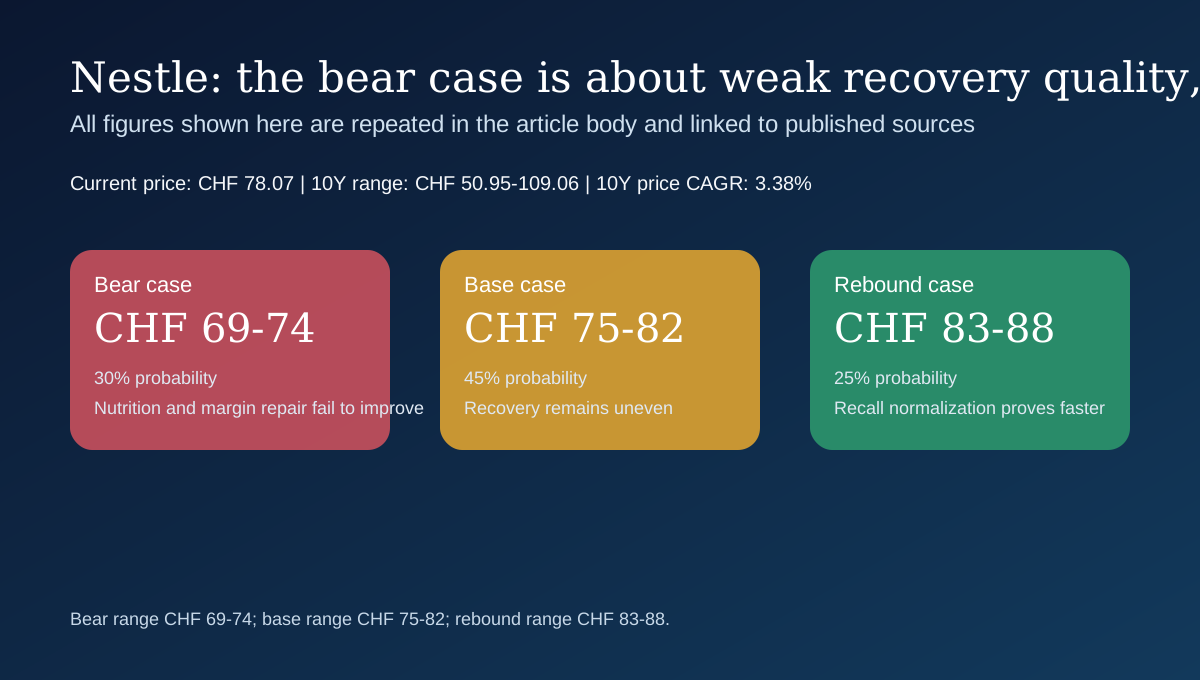
| Bear case | 30% | H1 shows no clear Nutrition recovery or a weaker margin bridge than management implied | July 23, 2026 | CHF 69-74 |
| Base case | 45% | Guidance holds, but category recovery stays uneven and investors refuse to rerate the multiple | October 22, 2026 | CHF 75-82 |
| Rebound case | 25% | Management proves recall effects are temporary and H2 margin progression is visible | February 18, 2027 | CHF 83-88 |
References
Sources
- Yahoo Finance chart API for Nestle (NESN.SW) 10-year price history and latest market data
- Nestle three-month sales 2026 press release, published April 23, 2026
- Nestle full-year 2025 results and 2026 guidance, published February 19, 2026
- Nestle analysts and consensus page, including the latest company-compiled consensus references
- Nestle pre-full year 2025 company-compiled consensus PDF, published January 2026
- Nestle strategy page with 4%+ organic growth, 17%+ margin, and CHF 3 billion savings ambition
- StockAnalysis valuation page for Nestle ADR (NSRGY), used for forward P/E reference